01
What health tests does a Beagle need before breeding?
The National Beagle Club CHIC list has five required tests on both parents: a hip x-ray scored by the OFA, an eye exam by a specialist, a heart (cardiac) exam, a thyroid blood test, and the Musladin-Lueke Syndrome (MLS) DNA test. A wider DNA panel (Factor VII, IGS, NCCD, and Lafora epilepsy) is strongly recommended on top of these.
02
What is Musladin-Lueke Syndrome (MLS)?
MLS is a Beagle-specific disease that affects connective tissue, the material that holds the body together. Affected dogs have tight, thick skin, stiff joints, and a distinctive face, and many walk up on their toes. It is recessive, so a simple DNA test tells you a dog’s status. Its DNA test is the one gene test required for a Beagle CHIC number.
03
Can you breed a Beagle that carries a genetic disease?
Yes, as long as you breed it to a clear mate. A carrier is a healthy dog with one copy of a recessive gene. Carrier bred to clear produces no affected puppies. The only pairing to avoid is carrier to carrier for the same disease, which risks 25 percent affected puppies. Removing every carrier would needlessly shrink the gene pool.
04
What DNA tests should Beagle breeders run?
The MLS DNA test is required for CHIC. The National Beagle Club also recommends testing for Factor VII deficiency (a mild bleeding disorder), Imerslund-Grasbeck Syndrome (IGS, a vitamin B12 absorption problem), neonatal cerebellar cortical degeneration (NCCD), and Lafora epilepsy. All are recessive cheek-swab tests, so you only need to avoid pairing two carriers of the same one.
05
At what age can I breed my Beagle?
Wait until at least 2 years old, on the second or third heat. A female Beagle’s first heat can come as early as 6 months, but that is far too young. The AKC advises breeding females only after age 2, when health screening is complete and the dam is fully grown. Most breeders retire a female by about 6 to 7 years.
06
Can you breed a 13-inch Beagle to a 15-inch Beagle?
Yes. The 13-inch and 15-inch Beagles are two size varieties of one breed, not two breeds, so they can be bred together and a single litter can contain both. The variety is decided by the dog’s height at maturity. Breed to the standard and avoid extremes; "pocket Beagles" under 13 inches are not a recognized AKC variety.
07
What colors do Beagles come in?
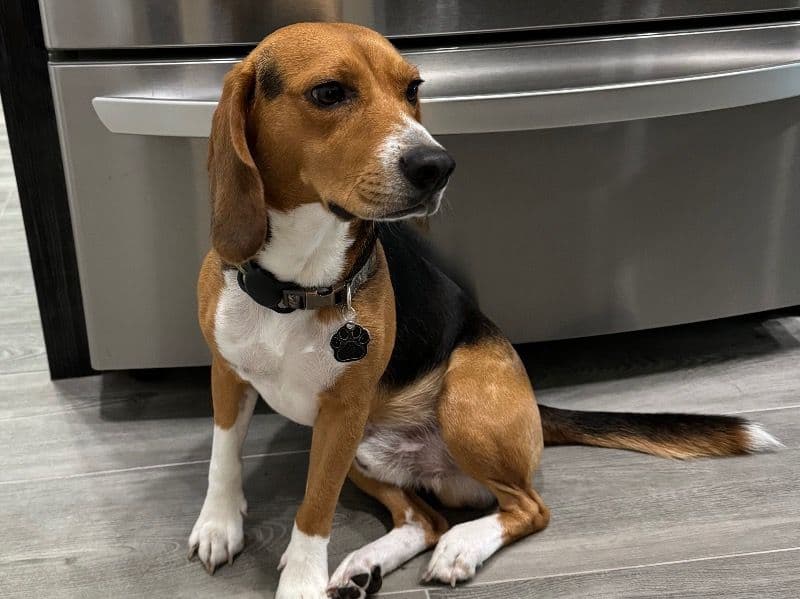
The classic and most common color is tricolor (black, white, and tan). Beagles also come in lemon and white, red and white, and chocolate tricolor, among others. The AKC standard allows any true hound color. Merle and brindle patterns are disqualified, and a merle Beagle is a warning sign of an outcross or a health risk.
08
How many puppies do Beagles have?
A Beagle litter averages about 6 to 7 puppies, with a range of roughly 1 to 10. First litters are often smaller. An x-ray around day 55 of pregnancy gives an accurate puppy count before whelping (the birth), which matters more in a breed that can have large litters.
09
Are pocket Beagles a real breed?
No. "Pocket Beagle" is a marketing label for an undersized Beagle, not a separate breed or AKC variety. Dogs bred deliberately tiny often come from runts or unhealthy lines and can carry extra health problems. Be cautious of any seller charging a premium for a "pocket" or "teacup" Beagle.
10
How much does it cost to breed a Beagle litter?
Budget roughly $2,500 to $6,000. Health testing is moderate (hips, eyes, cardiac, thyroid, and the DNA panel, with no MRI needed). Add a stud fee, prenatal scans, and a cushion for an emergency C-section. Beagles often have larger litters, which spreads the cost, but a first litter still rarely turns a real profit.
11
Can a Beagle give birth naturally?
Most Beagles whelp naturally without help. They are a sturdy medium breed with normal head and hip proportions, so C-sections are less common than in flat-faced or toy breeds. Still keep a vet on call, and call right away for hard straining with no puppy or long gaps between puppies.
12
Where can I find a Beagle breeding partner?
You can search for Beagle breeding partners on Petmeetly and message the owners directly. Listings are free, and you can filter for breeding dogs. Ask each owner for the CHIC clearances and the full DNA panel results, including MLS status, and verify them independently before you commit to a mating.