01
What health tests does a Cane Corso need before breeding?
The Cane Corso Association of America CHIC list is six tests on both parents: a hip x-ray (OFA or PennHIP), an elbow x-ray (OFA), a heart exam (OFA), a kneecap (patella) check (OFA), and DNA tests for two inherited diseases, NCL and DSRA. Many breeders also add an eye exam, since the breed is prone to eyelid problems.
02
What are NCL and DSRA in the Cane Corso?
They are the two DNA-testable diseases the breed club requires. NCL (neuronal ceroid lipofuscinosis) is a fatal nerve disease that strikes young dogs. DSRA (dental skeletal retinal anomaly) is a Cane Corso-specific disorder of the teeth, bones, and eyes. Both are recessive, so a simple cheek-swab test lets you avoid pairing two carriers.
03
Why is heart screening so important in the Cane Corso?
Dilated cardiomyopathy (DCM) is the breed’s most common heart disease, and it can cause sudden death even in a young dog. The heart muscle stretches and weakens, so it pumps poorly. A yearly heart exam, ideally an echocardiogram (an ultrasound of the heart) by a cardiologist, is the way to catch it before breeding.
04
How serious is bloat (GDV) in the Cane Corso?
Very serious. Bloat, or gastric dilatation-volvulus (GDV), is when the stomach fills with gas and twists. It is a deep-chested large-breed emergency that can kill within hours, with death rates of 10 to 33 percent even with surgery. A gastropexy, a surgery that tacks the stomach to the body wall, cuts the risk of a deadly twist by over 90 percent and is often done during spay or neuter.
05
What eye problems affect the Cane Corso?
The breed is prone to two eyelid faults: entropion, where the eyelid rolls inward and the lashes scratch the eye, and ectropion, where the lid sags outward and exposes the inner eye. Both can need surgery. Breed away from them, and have an eye specialist check breeding dogs even though it is not a required CHIC test.
06
At what age can you breed a Cane Corso?
Wait until at least 2 years old. The OFA does not finalize hip and elbow scores before 24 months, so you cannot complete the health tests any earlier. A female should be on her second or third heat and fully grown. Most breeders retire a female by about 6 to 7 years or after 4 to 5 litters.
07
Should you crop a Cane Corso’s ears or dock its tail?
It is your choice, and natural ears and tails are increasingly common. Cropping and docking are cosmetic, not health procedures. They are legal in the United States but banned in the United Kingdom and much of Europe. The AKC standard accepts both cropped and natural. If you crop or dock, only a veterinarian should do it.
08
What colors do Cane Corsos come in?
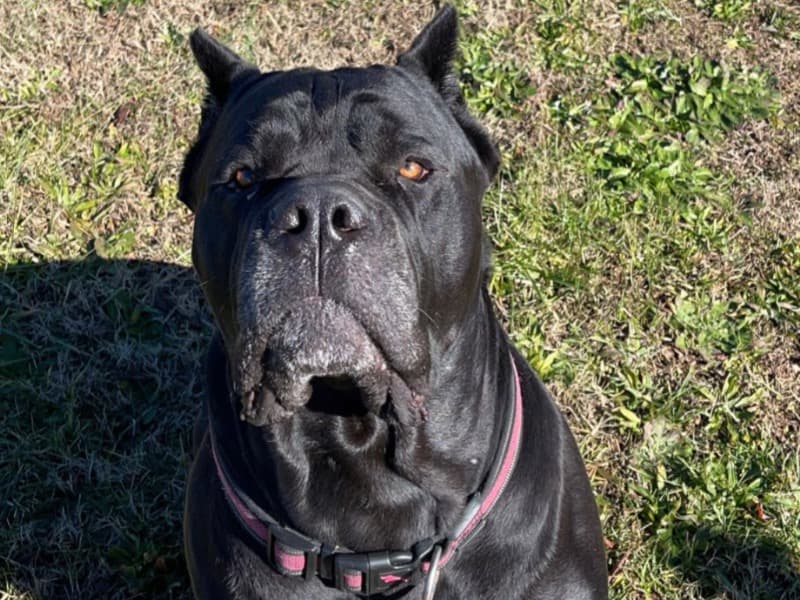
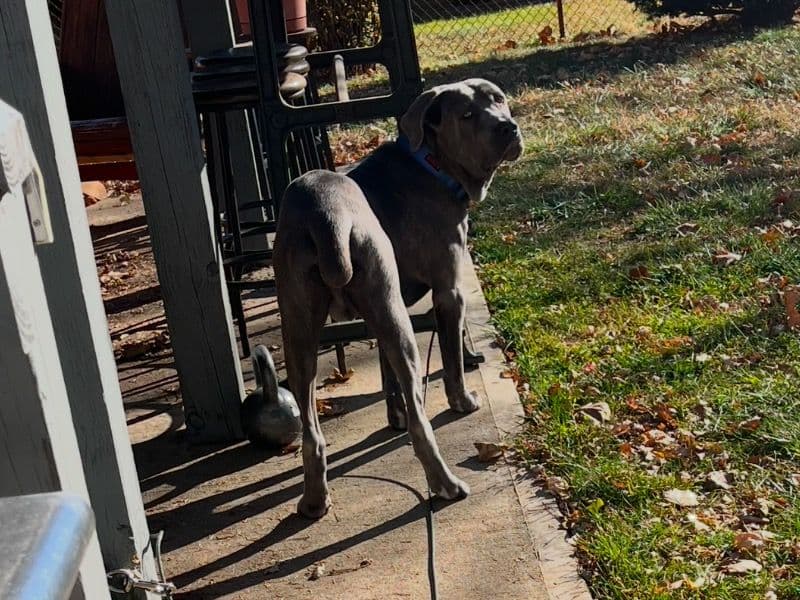
The AKC recognizes black, gray (also called blue), fawn, and red, each of which can also appear as brindle (a tiger-stripe pattern). Fawn and red dogs usually wear a black or gray face mask. Color does not affect health, so let the health tests, not the coat, decide a pairing.
09
How many puppies do Cane Corsos have?
A Cane Corso litter is large, usually 6 to 8 puppies, and can reach 10 or more. First litters are often smaller. An x-ray around day 55 of pregnancy counts the puppies so you know when whelping is done and whether the litter is unusually large.
10
How much does it cost to breed a Cane Corso litter?
Budget roughly $4,000 to $9,000. Health testing runs high because of the hip, elbow, heart, patella, and two DNA tests on each dog. Add a stud fee, prenatal care, a cushion for an emergency C-section, and the cost of raising a large litter. A first litter rarely turns a real profit.
11
Is the Cane Corso a good breed for a first-time breeder?
Only with a mentor and a real plan. The Cane Corso is a powerful guardian dog, so temperament and careful placement matter as much as health. You must screen buyers hard, because a poorly placed guardian dog can be dangerous and often ends up surrendered. Every puppy should leave on a contract with a return clause.
12
How long do Cane Corsos live?
About 9 to 12 years, which is typical for a large breed. Breeding from older dogs that have stayed sound and heart-clear helps, since it shows the line ages well. Good hips, a clear heart, and a healthy weight do the most to give a Cane Corso a long, comfortable life.
13
Where can I find a Cane Corso breeding partner?
You can search for Cane Corso breeding partners on Petmeetly and message the owners directly. Listings are free, and you can filter for breeding dogs. Ask each owner for the hip, elbow, heart, and patella clearances and the NCL and DSRA DNA results, and verify them independently before you commit to a mating.