

Can you breed a French Bulldog at six months old?
No. Wait for the female's second heat, around 14 to 15 months. Males need OFA hips, patellae, and an RFG grade on file before any planned mating.

Everything you need before breeding a French Bulldog: the airway test, the spine test, AI timing, and the scheduled C-section.
French Bulldog
French Bulldog
French Bulldog

French Bulldog
French Bulldog

French Bulldog

French Bulldog mix
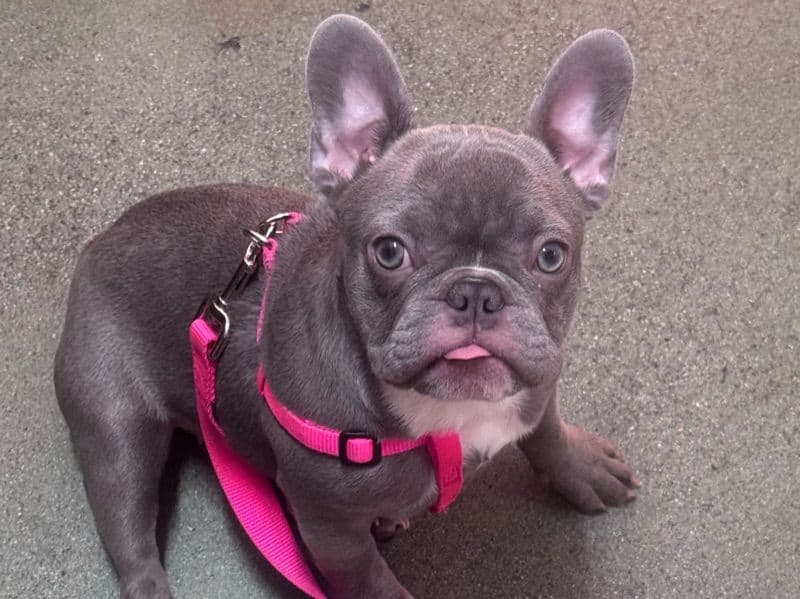
French Bulldog
Cambridge BOAS (brachycephalic airway disease) RFG grade 0 or 1, OFA hips, OFA patellae, a spine X-ray for hemivertebrae, eye CERF, and a broad DNA panel on both dogs.
Match COI (inbreeding coefficient) under 6.25 percent. Never pair two RFG grade-2 dogs. Pair complementary tail and spine conformation away from screw tails.
Natural mating is rarely possible. Time vaginal, TCI (transcervical AI), or surgical AI by progesterone testing during the female's fertile window.
About 80 percent of Frenchie births require a C-section. Book the date with your reproductive vet ahead of time, not when she goes into labor.
Short answer
Both parents need six results on file: a Cambridge BOAS RFG grade, an OFA hip and patella evaluation, a spine X-ray, an annual eye CERF, a broad DNA panel, and a cardiac exam by a board-certified cardiologist. That is the French Bulldog Club of America baseline.
The breathing test comes first. The Cambridge BOAS Respiratory Function Grading scheme grades dogs from 0 (clinically unaffected) to 3 (severe). It runs about six minutes and includes nostril inspection, auscultation, a 3-minute exercise test, and post-exercise auscultation[4]. The AVMA endorses RFG as the working clinical standard for brachycephalic breeds[6].
How to read a Cambridge BOAS RFG grade
Retest every 2 years for any dog in a breeding program[5].
Hips and patellae come next. OFA records show about 29.8% of Frenchies with some hip dysplasia on X-ray[14], and a UK primary-care study ranks the breed #11 by patellar luxation surgery volume[10]. Most Frenchies live with subclinical hip changes, but the X-ray is still a breeding decision input.
How to read an OFA hip score
OFA only finalizes hip scores at 24 months or older[14].
The spine X-ray catches severe hemivertebrae and screw-tail abnormalities linked to IVDD risk[8]. See the BOAS and IVDD section below for the full spinal-disease picture.
A broad Embark DNA panel layers on top of the four imaging tests: degenerative myelopathy, hyperuricosuria, juvenile cataracts, 200+ markers, plus the color loci useful for pairing planning[18].
An annual eye CERF (entropion, cherry eye) and cardiac auscultation, listening for pulmonic stenosis (a narrowed heart valve), close the workup; the FCA lists both on its basic pre-breeding checklist[3].
Short answer
Breed the female on her second heat, around 14 to 15 months. Hold the male until his RFG, OFA hip, and OFA patella results are finalized (12 months minimum, often 24). Retire females after 3 to 4 lifetime litters or by age 5 to 6.
Wait for the second heat. Earlier breeding raises C-section risk and skips OFA finalization.
Fertile from 12 months. Hold him back until RFG, OFA hip, and OFA patella results are in writing.
First heat usually arrives between 6 and 12 months. Skip it; the cycle is unpredictable and the skeleton is still maturing. Most Frenchies cycle about twice a year, so the second heat lands cleanly in the 14 to 15 month window[15].
The lifetime cap is 3 to 4 litters because every Frenchie pregnancy carries AI, a planned C-section, and a brachycephalic recovery load. Repeat C-sections add scar tissue, so retire after the 4th surgery or by age 5 to 6.
What if my Frenchie's heat is quiet?
Frenchie heats can be quiet: light bleeding, small vulvar changes, subtle behavior cues. Calendar timing misses the fertile window. Progesterone bloodwork fixes it.
Start draws around day 6 and repeat every 2 to 3 days. Each draw runs $50 to $150; most cycles need 2 or 3.
Both dogs need a brucellosis test within 30 days of mating; one missed test can seed a whole kennel. For cross-breed cycle timing, see the dog breeding hub.
Short answer
Pick a partner with a BOAS RFG grade of 0 or 1, a 5-generation COI under 6.25%, and complementary OFA hip and patella scores. The Kennel Club specifically rules out pairing two grade-2 dogs[5]. Avoid pairing two severely deformed (screw) tails; tail shape tracks with hemivertebrae risk.
BOAS RFG pairing matrix
| Dam × Sire | Sire RFG 0 | Sire RFG 1 | Sire RFG 2 | Sire RFG 3 |
|---|---|---|---|---|
| Dam RFG 0 | OK | OK | Caution | No |
| Dam RFG 1 | OK | OK | No | No |
| Dam RFG 2 | Caution | No | No | No |
| Dam RFG 3 | No | No | No | No |
Green = breeding-acceptable. Amber = caution, pair with a stronger partner. Red = do not breed.
The BOAS RFG grade is the single biggest mate-selection number[4]. Two grade-0 dogs is ideal; grade 0 with grade 1 is fine; grade 1 with grade 1 is acceptable; grade 2 pairs only with grade 0; grade 3 does not breed. A 2025 Frontiers study on Danish Frenchie owners found awareness of this matrix is still low in the breeder community, which is why it has to go on every contract[13].
Coefficient of inbreeding thresholds
Target zone. Common great-grandparent ceiling.
Caution. Recessive disease risk climbs. Common in show lines.
Disqualifier in most parent-club guidance.
OFA hip and patella numbers come next. Match a Fair-hipped female to a Good or Excellent male; patella grades I to IV use the same match-better rule. Frenchie hip dysplasia is often subclinical, so a Fair pass is not a working-breed-style disqualifier.
Coefficient of inbreeding (COI) is the third number. Run a 5-generation pedigree or pull the relatedness score from an Embark report[18]. 6.25% is the practical ceiling; the Frenchie gene pool makes that harder to hold than in Labs or GSDs because of popular-sire effects.
Selecting against severely deformed (screw) tails is one of the few easy levers to reduce hemivertebrae in offspring[8]. The spine section below has the full picture.
5 questions to ask the other owner
A brucellosis test on both dogs within 30 days of mating closes the checklist. Both owners sign the breeding contract before the first AI.
Short answer
Natural mating is rarely possible because the male’s short legs and the female’s narrow hips make it physically hard. Frenchie programs use vaginal, transcervical (TCI), or surgical AI timed by progesterone testing. AI costs $300 to $1,500 per attempt depending on method.
The 3 AI methods for French Bulldogs
Fresh or chilled semen placed in the vagina with a pipette.
Endoscopic catheter through the cervix; semen placed directly in the uterus.
Minor laparotomy under general anesthesia; semen placed in the uterine horns.
The breed’s conformation (barrel chest, short legs, narrow hips) makes natural mating mechanically hard, so AI is the standard, not the exception[8]. Trying naturally first is a welfare problem because of the strain it puts on the male and the dam’s joints.
Vaginal AI is the simplest method ($200 to $400), with 60 to 70% pregnancy rates on a well-timed cycle. It is the usual starting point for first-time Frenchie breeders working with a local stud.
TCI places semen through the cervix directly into the uterus with an endoscope ($400 to $600, 70 to 85% pregnancy). Most US reproductive vets now prefer TCI for Frenchies because it uses less semen, which matters when shipping chilled or frozen.
Surgical AI ($600 to $1,500) is used for frozen semen or when TCI is contraindicated; general anaesthesia is required. AKC accepts AI-bred litters with the appropriate paperwork[1].
Progesterone timing is the universal lever
Draw progesterone from day 6 of estrus (the heat cycle), every 2 to 3 days. Watch for the LH surge (2 to 3 ng/mL) and ovulation (5 to 8 ng/mL). AI is optimal around 10 ng/mL. Skipping progesterone is the single biggest cause of AI failure.
Proestrus. Light bleeding. No AI yet.
Start progesterone draws every 2 to 3 days. Watch for the LH surge.
AI window opens 48 to 72 hours after the LH surge. TCI or surgical AI scheduled here.
Each progesterone draw runs $50 to $150; most cycles need 2 to 3. For the same workflow in a closely related brachycephalic breed, see the English Bulldog breeding guide.
Short answer
About 80% of Frenchie births require a C-section; the puppy head is too wide for the dam’s narrow pelvis. Set the date with your reproductive vet, usually around day 63, after a day-28 ultrasound, a day-55 X-ray, and a daily progesterone drop watch. Never let the dam labor.
Roughly 80 percent of French Bulldog whelpings end in a C-section. Planned daytime surgery costs $1,000 to $3,000. Emergency overnight surgery costs $3,000 to $5,000 and carries higher complication rates.
Scheduled C-section: a day-by-day timeline
Reproductive vet confirms pregnancy. Heart-rates and embryo count visible. Resorption ruled out.
Skeletons are now calcified. Puppy count confirmed. Anatomical mismatch flagged early.
Daily progesterone draws. Drop from 4 to 8 ng/mL to under 2 ng/mL signals labor is 24 hours away.
Planned daytime surgery at the reproductive vet hospital. Typical surgery time 30 to 45 minutes.
Frenchie dystocia (trouble giving birth) is the rule, not the exception. The puppy skull is large relative to the dam’s pelvis, and the dam’s brachycephalic airway makes the strain of natural labor unsafe. Plan the C-section by default[16].
The protocol is well established. Day 28 ultrasound confirms pregnancy. Day 55 X-ray counts puppies. From day 60 onward, daily progesterone draws watch for the drop from 4 to 8 ng/mL to under 2 ng/mL, which means labor is 24 hours away and the scheduled surgery is performed[16].
Planned and emergency costs are not close. A scheduled daytime C-section runs $1,000 to $3,000. An emergency overnight C-section, which is usually the only option once a Frenchie is allowed to labor, runs $3,000 to $5,000 and carries higher complication rates.
Call the vet immediately if any of these happen during the day-60 watch
Labor in 12 to 24 hours. Move the surgery up.
Placental separation. Puppy in distress. Emergency surgery.
Do not let her labor. Go straight to surgery.
Shock, eclampsia, or respiratory distress. Vet emergency.
Each C-section adds scar tissue, which is why responsible Frenchie programs cap dams at 3 to 4 lifetime surgeries and retire earlier than Lab or GSD programs do.
Short answer
Frenchie color is governed by several loci including B (brown), D (dilution), HPS3 (cocoa), KIT (merle), and L (long coat). The AKC standard recognizes brindle, fawn, cream, white, and pied. The FCA does not recognize blue, chocolate, lilac, or merle as standard colors[3].
The 4 genetic loci that drive Frenchie color
Ay (sable) dominates over fawn over brindle pattern modifiers in interaction with E and K loci.
B/B and B/b dogs are black-pigmented. b/b dogs are chocolate. A separate HPS3 "cocoa" variant exists in Frenchies.
D/D and D/d are full saturation. d/d dilutes black to blue and chocolate to lilac. Not in the AKC standard.
Single-copy merle (M/m) is a visible pattern. Double merle (M/M) causes deafness and blindness. FCA disqualifying fault.
Standard FCA / AKC-recognized colors
Non-standard “rare” colors (registrable but not standard)
Merle to merle: a hard rule, not a guideline
Merle is a single dominant mutation. Two copies (double merle, M/M) cause deafness, blindness, and microphthalmia. The FCA treats merle as a disqualifying fault[3].
A merle Frenchie should only ever be bred to a non-merle (m/m) partner. The 25% double-merle outcome from a merle-to-merle pairing is the single most well-known genetic harm in the breed.
Frenchie color sits on several interacting loci including B (black vs chocolate), D (dilution to blue or lilac), HPS3 (the “cocoa” variant), KIT (merle), and L (the recessive long coat that produces “fluffy” Frenchies). An Embark color report will read each locus and explain carrier vs affected status; that is the right place to learn the genetics in detail, not this page.
The market reality matters. Non-standard colors sell for 2 to 5 times the standard price: blue or lilac puppies often $5,000 to $20,000 against $2,000 to $6,500 for brindle or fawn[12]. The colors themselves are not unhealthy (merle is the documented exception), but the price ceiling pulls many programs away from BOAS, OFA, and spine testing. Run the full panel regardless of color and pair against the AKC + FCA standard, not the market.
Color is what most owners look at first. It matters the least. Pick a healthy, RFG-low pair first; think about color after.
Short answer
Frenchie litters average 3 to 4 puppies[17]. Whelping is almost always a scheduled C-section around day 63. Watch for fading puppy syndrome through the first two weeks; brachycephalic puppies are more prone to it.
The three stages of a French Bulldog whelping
Daily progesterone draws. Temperature drops below 99°F 12 to 24 hours before labor. Move the surgery up.
Planned daytime surgery. Puppies out within 20 minutes of the incision. Dam recovers under monitoring[16].
Brooder at 85 to 90°F. Weigh every 12 hours. Supplemental feeding for any pup not gaining.
A typical Frenchie litter is 3 to 4 puppies (range 1 to 7). First litters from a 14 to 18-month-old dam often run smaller, 2 to 3. Litter size also depends on AI method and timing[17].
The first 72 hours after the C-section are the highest-risk window. Keep puppies in a brooder at 85 to 90°F and weigh every 12 hours. Healthy puppies gain 5 to 10g per day; any pup not gaining for 12 hours needs supplemental tube or bottle feeding with a commercial puppy milk replacer. Cow milk is not a substitute.
Fading puppy syndrome: brachycephalic-specific risk
Brachycephalic puppies have smaller airways that are more prone to fluid accumulation. Watch for any puppy that goes quiet, refuses the teat, or falls behind siblings on the warming pad. That puppy needs vet attention within hours, not the next day.
Puppy goes quiet, latches weakly, falls off the teat, fails to gain in 12 hours, cold to the touch.
Warm slowly to 85°F, supplemental tube or bottle feed, call the reproductive vet on the same day.
By week 2 the eyes open and the risk window narrows. Eight-week-old standard-color puppies place at $2,000 to $6,500 from health-tested AKC breeders; serious buyers value the OFA, RFG, and DNA paperwork over color.
For a contrast, see the Labrador breeding guide: natural whelping, 6 to 10 puppy litters, no scheduled surgery.
Short answer
BOAS (the brachycephalic airway disease) and IVDD (the disc disease) are the two breed-defining Frenchie health risks. Pair against the Cambridge RFG matrix, breed away from screw tails, and disclose family histories of disc episodes in writing.
Median age of first IVDD event in Frenchies is 4 years (two years younger than dachshunds). About 50 percent of Frenchies that have one IVDD episode will have another, versus 25% in dachshunds[8].
The 4-grade Cambridge BOAS RFG scheme visualized
No stridor. Full exercise tolerance. Ideal for breeding.
Audible noise, no exercise impact. Breeding-acceptable.
Affects exercise tolerance. Pair only with grade 0.
Surgical referral. Do not breed.
BOAS is the single most-discussed Frenchie health issue. The Cambridge RFG protocol is the working standard[4]. Dogs are graded after a 3-minute exercise test on stridor severity and recovery time. Retest every 2 years for any dog in a breeding program[5].
IVDD is the spinal half of the story. Most Frenchies are chondrodystrophic (short-legged, dwarf-type cartilage) and many carry the FGF4 retrogene mutation that predisposes to disc disease[8]. Median age of the first episode is 4 years (two younger than Dachshunds), about 50% of affected Frenchies have a second episode (versus 25% in Dachshunds), and the disc extrusions tend to be larger.
Hemivertebrae and the screw-tail correlation
The Frenchie body shape is partly the result of vertebral malformations (hemivertebrae, block vertebrae). Selecting against severely deformed tails is one of the few easy levers to reduce hemivertebrae in offspring[8]. The pre-breeding spine X-ray catches the most severe cases.
The Royal Veterinary College, Tufts Cummings School, and the ASPCA have all flagged Frenchie welfare in the context of rapid popularity growth[7][11][12][2].
Four things responsible breeders do in response
A Frenchie breeding program is also a disclosure program. Buyers paying $4,000 to $10,000 for an AKC-affiliated puppy expect RFG, OFA, and spine clearances on both parents, plus a written family history of BOAS surgeries, IVDD episodes, and C-section difficulty in the line.
Short answer
Budget $2,500 to $5,000 per Frenchie in pre-breeding tests, $1,500 to $3,000 for a standard stud (more for titled or imported), $300 to $1,500 for AI, and $1,000 to $3,000 for a scheduled C-section. Total per-litter cost: $5,000 to $15,000.
Estimated cost of a first French Bulldog litter
Typical US pricing. Budget against the litter, not the puppy. Average Frenchie litter is 3 to 4.
What can the puppies sell for?
Market range only, not a Petmeetly endorsement. The FCA does not recognize blue, lilac, chocolate, or merle. If the parents do not have OFA, RFG, and spine clearances, say so plainly in the listing. Buyers should ask to see the test results at any price.
The pre-breeding workup is the biggest non-obvious cost. RFG runs $100 to $250[4], OFA hips and patellae under sedation $400 to $700 combined[14], spine X-ray $150 to $300, Embark $159[18], eye CERF $50 to $100, cardiac auscultation $150 to $300, brucellosis $40 to $80 per mating. All of this is per parent, so a serious program spends $2,500 to $5,000 per dog before any breeding.
Stud fees are the second line item. The standard US Frenchie stud fee is $1,500 to $3,000. Titled studs (AKC champions, imported European pedigrees, RFG grade 0) charge $5,000 to $10,000 or more. Some take a "puppy back" arrangement instead of cash. A color premium does not change the dog's health status.
AI plus C-section costs are predictable: vaginal AI $200 to $400, TCI $400 to $600, surgical AI $600 to $1,500, progesterone draws $150 to $450 total, scheduled C-section $1,000 to $3,000, emergency $3,000 to $5,000. For a non-brachycephalic comparison, the Labrador breeding guide shows total costs of $3,000 to $7,000 thanks to natural mating and whelping.
Revenue math is real but harder than it looks. Standard-color puppies sell for $2,000 to $6,500 from AKC-affiliated breeders. With a 3 to 4 puppy average, gross revenue is $6,000 to $26,000 per litter against $5,000 to $15,000 in costs. Non-standard colors fetch $5,000 to $20,000 each but the FCA actively warns against them[3]. Many first-time Frenchie breeders underestimate C-section, fading puppy, and emergency vet costs and finish the first litter at a loss. See German Shepherd breeding for a working-breed pricing comparison, or live Frenchie puppy listings.
No. Wait for the female's second heat, around 14 to 15 months. Males need OFA hips, patellae, and an RFG grade on file before any planned mating.
Most reproductive vets cap Frenchie dams at 3 to 4 lifetime litters, with a full heat cycle of rest between, and retire by age 5 to 6 or after the 4th C-section.
About 80% need one because the puppy head is too wide for the dam's pelvis. Set the date with your reproductive vet, because scheduled daytime surgery is far safer and cheaper than an overnight emergency.
About 63 days from ovulation (range 58 to 68). Confirm pregnancy by ultrasound on day 28; count puppies by X-ray on day 55.
No. Roughly 25% of the litter will be double merle, with deafness, blindness, and eye defects. The FCA disqualifies merle. Pair a merle only to a non-merle.
About 3 to 4 puppies (range 1 to 7). First litters often run 2 to 3. Confirm the count by day-55 X-ray.
Mood and appetite shift around week 3, but ultrasound on day 28 is the reliable confirmation. Day-55 X-ray then counts puppies. Home tests are not reliable.
There is no single US age law. Many states set 8 weeks as the minimum for selling or giving away a puppy, and some set none, so check your state’s rules. Responsible Frenchie breeders never place before 8 weeks, and many wait until 10 weeks for stronger handling and bite inhibition.
AKC registers them for record-keeping but they are not in the breed standard. The FCA does not recognize blue, chocolate, lilac, or merle; conformation typically disqualifies them.
US pet-quality standard colors run $2,000 to $6,500, championship lines $6,500 to $10,000. Non-standard "rare colors" are marketed at $5,000 to $20,000+. Price says nothing about health, so ask to see test results for both parents.
BOAS is a brachycephalic airway disease. Cambridge RFG grades it 0 to 3. Grades 0 and 1 breed. Grade 2 pairs only with grade 0. Grade 3 does not breed.
Frenchie heats can be quiet. Progesterone testing from day 6, every 2 to 3 days, is the universal fix. Time AI to progesterone around 10 ng/mL.
A small number can, but most cannot. The male's short legs and the female's narrow hips make AI the safer default in serious programs.
Sources
Real stories from dog owners who found perfect breeding matches on Petmeetly
We had a wonderful interaction with Sarah Holt and are planning to breed during the next heat cycle. To make the site even better, it would be great to have a search feature to find previous conversations with interested parties.
Sara
Washington, US
We’ve had great success with Moose and his Petmeetly mate, Lola. They are now the proud parents of seven healthy pups!
Steve
England, GB
Love Petmeetly! It’s so easy to access and find suitable mates.
Crystal Bonus
Indiana, US
More vetted material for owners planning a French Bulldog litter

More than half of all pre-weaning puppy deaths happen in the first week, and a dying puppy usually looks fine until it does not. This guide covers the three things that kill newborn puppies (cold, low blood sugar, and missed colostrum), the numbers that flag trouble a day early, and when to call the vet.

When can you breed your dog? A vet-informed timing guide covering male and female age windows, 50-breed reference table, OFA CHIC health tests, and heat-cycle protocols.

Behavior kills more US dogs under 3 than disease does. The 8 to 16 week socialization window, the AVSAB-approved checklist, and how to handle an adopted dog.
Discover breeding guides for different dog breeds and find the perfect match for your breeding program
7,519+ French Bulldogs on Petmeetly. Sign up to browse and message owners directly.
No card required to sign up.