
Can you breed a Poodle at six months old?
No. Wait for the second heat cycle: 18-24 months for Standards, 12-18 months for Minis and Toys. Males are fertile at 6-12 months but OFA hip scores aren't final until 24 months.
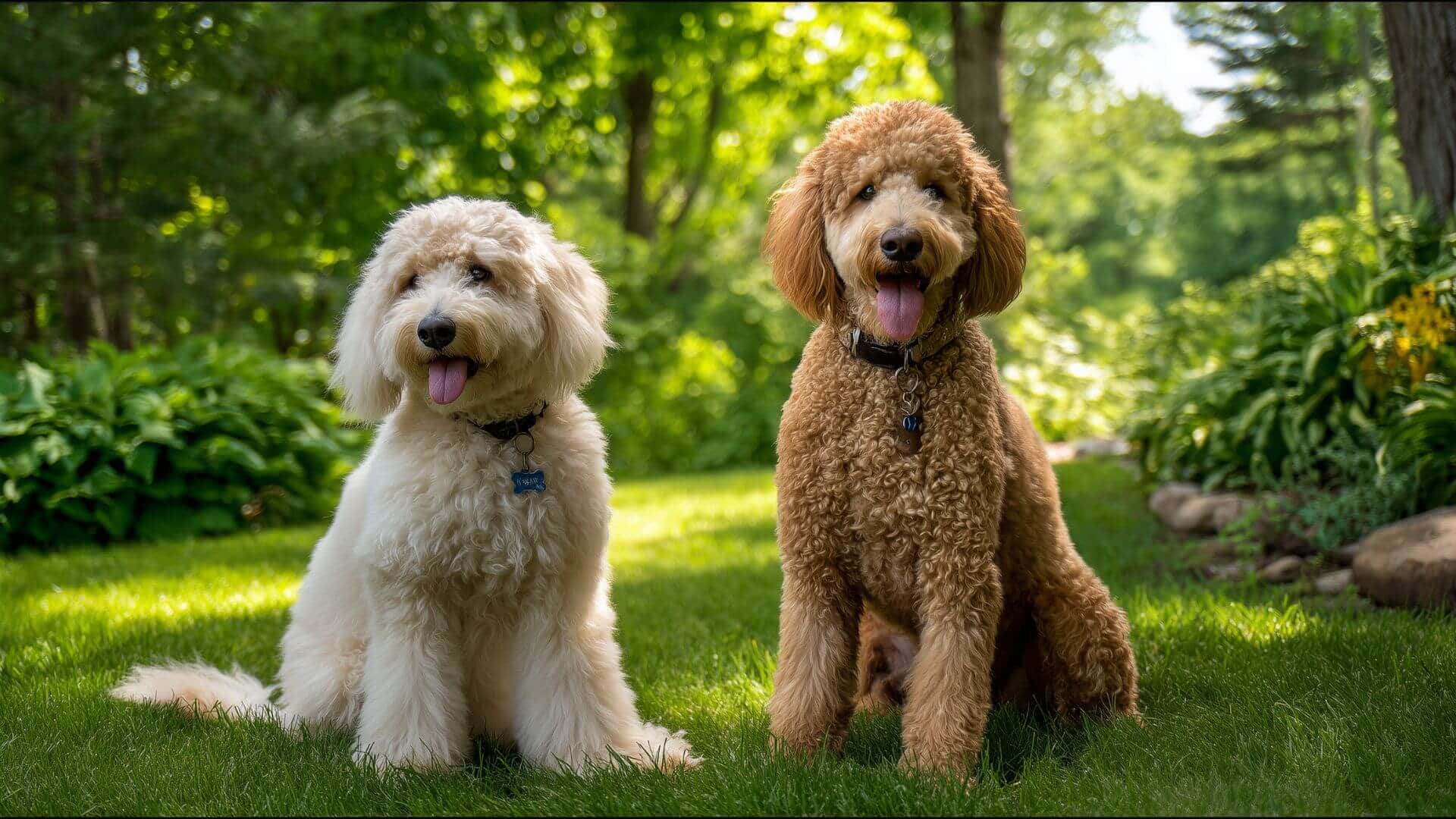
Poodle breeding is really three programs in one coat, with size-specific health tests across Standards, Miniatures, and Toys.
Poodle
Poodle
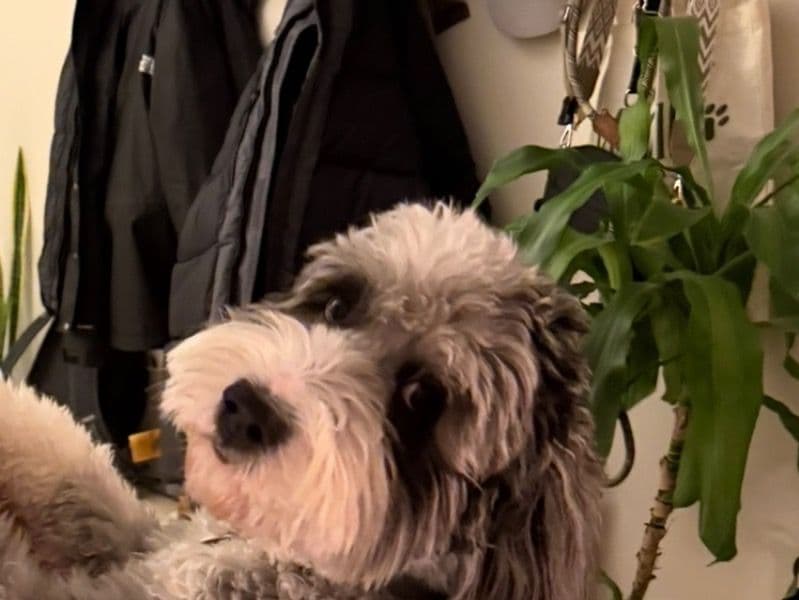
Poodle mix
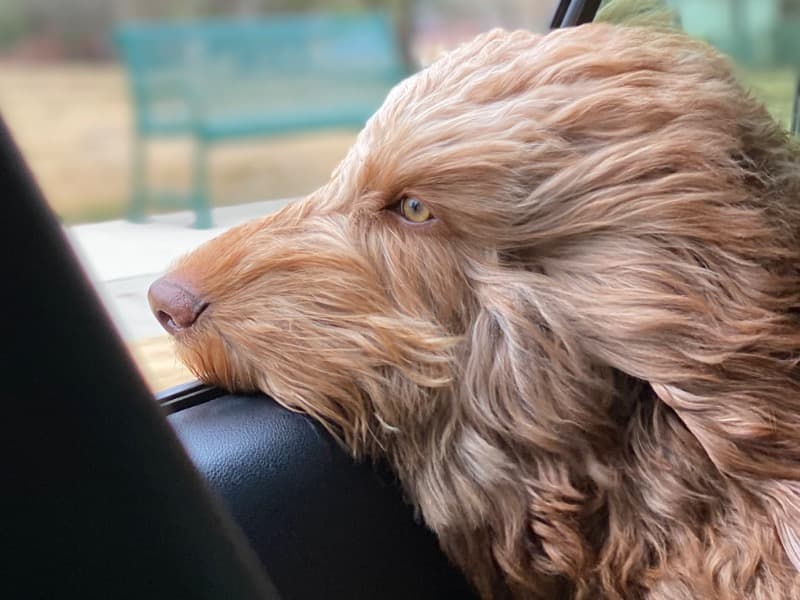
Poodle mix
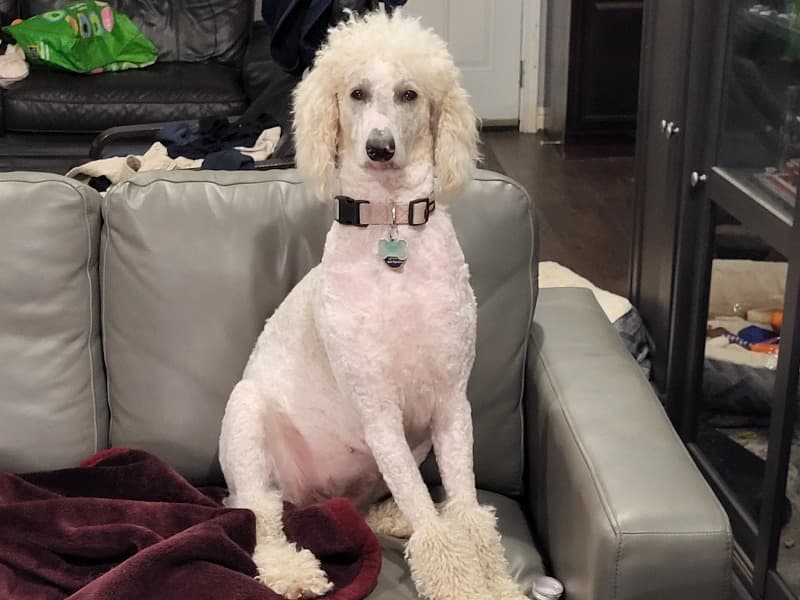
Poodle
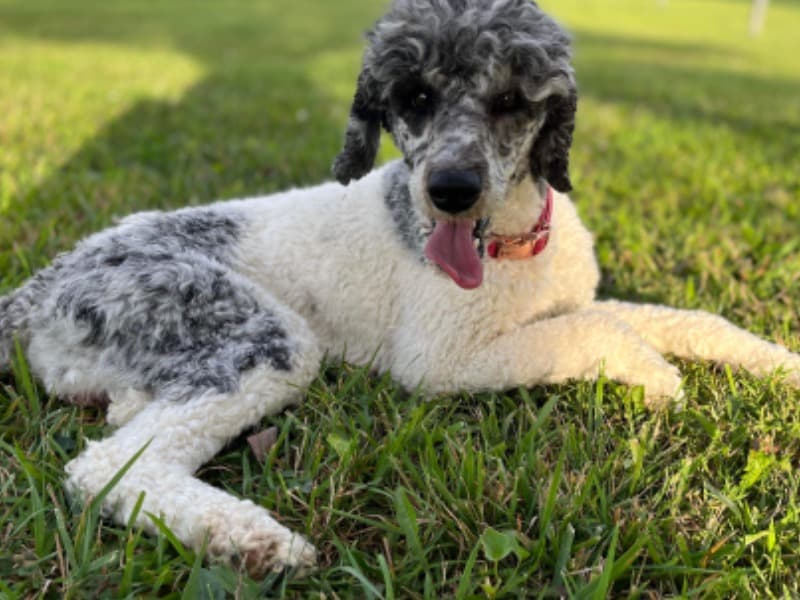
Poodle
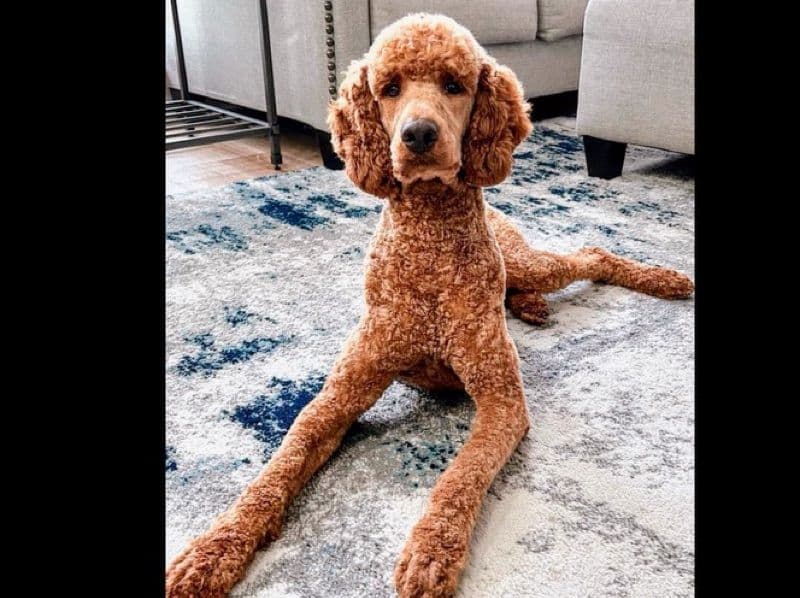
Poodle
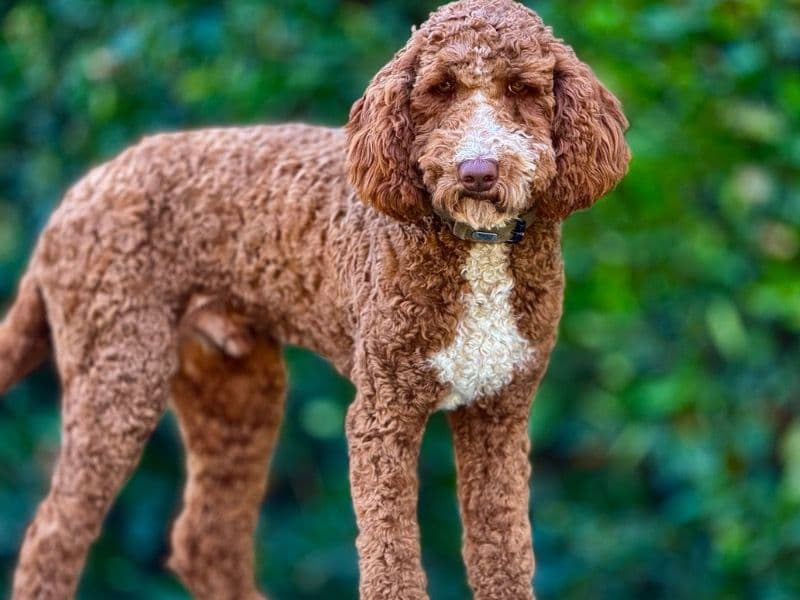
Poodle
Hips for Standards and Minis. Knees for Toys and Minis. A yearly eye exam by an animal eye doctor. prcd-PRA (an inherited eye disease) DNA on both dogs. Plus one extra test you pick: thyroid, skin biopsy, or heart check.
At least one parent must be prcd-PRA clear. Inbreeding coefficient under 6.25 percent over 5 generations. Match Poodles of the same size. Don't breed Standards with a parent or sibling who had Addison's (a hormonal disease affecting adrenal glands).
Start blood tests on day 6 of heat. Natural mating works for all three sizes. AI is used only when timing or distance makes it hard.
Ultrasound on day 28. X-ray on day 55. Toys often need a planned C-section. Standards and Miniatures usually give birth on their own. Keep a reproductive vet on call.
Short answer
Before breeding, both Poodle parents need a yearly ACVO (American College of Veterinary Ophthalmologists) eye exam. They also need prcd-PRA DNA testing through an OFA (Orthopedic Foundation for Animals) approved lab. Plus, they need a bone test based on their size. Standards add an OFA hip check. They also pick one extra test. The choices are thyroid, sebaceous adenitis biopsy (a skin disease where oil glands stop working), or heart check. Miniatures add hips and knees. Toys add knees. The Poodle Club of America (PCA) publishes these CHIC (Canine Health Information Center) rules by size.
The PCA breeding rule is simple: at least one parent in every mating must be prcd-PRA clear. The breed helped scientists first identify this disease. The rule keeps the gene pool healthy while making sure no puppies are born affected.
Poodle health testing changes by size in a way most breeds don’t. The Poodle Club of America publishes a separate test list for each size. Standard Poodles need a hip check (OFA or PennHIP method), a yearly eye exam, prcd-PRA DNA, and one extra test. The extra test is your pick: thyroid, sebaceous adenitis biopsy, or cardiac auscultation (a vet listening to the heart with a stethoscope)[2]. Miniatures need the same eye and prcd-PRA tests, plus hips and patellar luxation (kneecap that slips out of place)[5]. Toys skip the hip test (small dogs rarely get hip dysplasia). They keep knees, eyes, and prcd-PRA[6].
Run prcd-PRA through any OFA-approved lab[12] (Paw Print Genetics[13], UC Davis VGL[14]). Submit results to OFA so they appear in the public CHIC database.
Yearly eye certificates expire after 12 months and must be on file at every breeding. The exam catches cataracts, glaucoma, and entropion (eyelids rolling inward), which Poodles see often enough to require ongoing screening[9].
Hip dysplasia in Standards is moderate-risk; OFA breed statistics put them well below high-risk giant breeds[8]. The harder Standard concerns (skin disease, Addison’s) appear in the risk section below.
Broad DNA panels from Embark[26] cover prcd-PRA plus NEwS (a fatal puppy brain disease), von Willebrand’s, and 200+ other markers in one swab. Cheaper than running each test alone.
Short answer
Female Poodles should wait until their second heat cycle. That’s usually 18 to 24 months for Standards and 12 to 18 months for Miniatures and Toys. Males can father puppies at 6 to 12 months. But don’t use them for planned breeding until hip or knee clearances are done. They also need prcd-PRA results in hand. Retire females by age 7 to 8.
Standards wait 18 to 24 months. Miniatures and Toys wait 12 to 18 months. Breeding too early raises the risk of trouble during labor and permanent hip injury.
Males can father puppies at 6 to 12 months. But hip or knee clearance and a documented prcd-PRA result come first.
First heat arrives between 6 and 12 months, but reproductive vets say to skip it. The bones (especially in Standards) are still growing, and the cycle itself is unpredictable[20]. The Cornell guide is the canonical reference.
Retirement: no more than 4 to 5 litters in her life, one full cycle of rest between litters, retire by age 7 to 8 or after any hard birth. Toys retire earlier because their small pelvises raise dystocia (difficult birth) risk.
Progesterone targets (for quiet heats)
Your vet draws blood from day 6, then every 2 to 3 days. $50 to $150 per draw, 2 to 3 draws per cycle.
Males are fertile from 6 months, but OFA won’t finalize hip scores under 24 months. Plus, prcd-PRA status (clear or carrier) must be documented, and every mating needs at least one clear parent. Add brucellosis (a bacterial infection that causes infertility) testing within 30 days of mating and a current 12-month eye exam[10].
Short answer
Pick a partner of the same size. At least one parent must be prcd-PRA clear. The hip or knee clearance must match the size. Look for a 5-generation COI (Coefficient of Inbreeding) under 6.25 percent, plus matching health tests. Standards should also skip dogs with a parent or sibling who had Addison’s. They should complete a skin biopsy. The PCA’s breeding guide sets these rules.
COI (Coefficient of Inbreeding) thresholds
Target zone. The common ceiling for Poodle programs.
Caution. Recessive disease risk climbs fast. Matters most in Standards.
Most parent clubs say no to this range.
Match the size. Standard to Standard, Mini to Mini, Toy to Toy. The AKC (American Kennel Club) won’t register cross-size litters, and the PCA accepts only the three sizes[3]. The unofficial “Klein”/“Moyen” cross is outside mainstream Poodle ethics.
How prcd-PRA passes from parents to puppies (recessive)
The PCA rule (at least one prcd-PRA clear parent per mating) balances disease control with gene-pool size[2]. Removing every carrier would shrink the gene pool too much.
COI ceiling: 5-generation under 6.25% across all sizes. The mid-twentieth-century Standard Poodle bottleneck links directly to the rise of sebaceous adenitis and Addison’s in modern Standards[17], so this matters most in Standards. Pull COI from the AKC pedigree or an Embark panel[26].
Family history (Standards only). Addison’s shows up in about 8% of Standard Poodles versus <0.5% in dogs overall, with heritability (how strongly genes drive it) of 0.75[15]. No DNA test exists. Skip any dog with a parent, sibling, or child diagnosed. The same family-history bar applies to sebaceous adenitis, plus a clean skin biopsy on both parents. Brucellosis testing within 30 days closes the workup.
5 questions to ask the other owner
Short answer
Poodle color and pattern come from the usual dog genes. The A locus sets the agouti (banded-hair) pattern. The B locus is black or brown. The E locus is red or apricot. The K locus is dominant black, brindle, or agouti pattern. The S locus is solid versus parti (the white-spotted pattern). Phantom is one of the agouti patterns. Parti is recessive at S. Brown and apricot are also recessive. The AKC breed standard accepts only solid colors in the show ring. But breeders work with the full set.
Visible Poodle color spectrum
Solid is dominant at the S locus; parti is recessive, so two solid parents can produce parti puppies if both carry it. The AKC show ring accepts only solid colors, but parti, phantom, abstract, and brindle Poodles sell widely in the pet market[1]. Color doesn’t affect health.
KB (dominant black) blocks the agouti pattern and gives solid color. ky (recessive non-black) lets agouti show through. That’s how phantom patterns appear: tan or red points on a darker base. The VIP color genetics overview is the canonical reference[7].
Brown (B locus) and red/apricot (E locus) are both recessive, so both parents must carry. The apricot “fading” gene (born red, lightening to cream by age two) isn’t fully mapped. A $159 Embark panel reports every major color gene; run it on every parent because the health markers are the real value.
Short answer
Standards (over 15 inches, 50 to 70 pounds) need OFA hip tests. They also screen for Addison’s, skin disease, and bloat. Miniatures (10 to 15 inches, 10 to 15 pounds) need OFA hips and knees, plus prcd-PRA and eye exams. Toys (10 inches and under, 4 to 6 pounds) need knees, eyes, and prcd-PRA, but skip hips. Litter size, birth risk, and price all change by size. The PCA’s size guide defines all three.
The three sizes are one breed on paper and three breeding programs in practice[3]. Standards (50 to 70 lb): hip dysplasia, Addison’s, bloat, sebaceous adenitis; litters of 6 to 8, mostly free-whelp. Miniatures (10 to 15 lb): patellar luxation, Legg-Calvé-Perthes (a hip-joint disease in small breeds), eye disease; litters of 3 to 5, mostly free-whelp. Toys (4 to 6 lb): patellae, tracheal collapse (a windpipe disorder), crowded teeth; litters of 2 to 4, often planned C-section because puppies are large relative to the mother’s pelvis.
For cost contrast, see our Labrador breeding guide (similar free-birth economics) or the French Bulldog breeding guide (C-section based, much higher cost).
Short answer
Standard Poodle litters average 6 to 8 puppies. Most give birth on their own. Miniatures average 3 to 5 puppies. Most also give birth on their own. Toys average 2 to 4 puppies. Many need a planned C-section because the puppies are large compared to the mother. Pregnancy lasts about 63 days from ovulation across all three sizes. The day-55 X-ray confirms the puppy count. Keep an experienced reproductive vet on call for any first litter.
The three stages of a Poodle whelping
Restless, panting, nesting, refusing food. Temperature drops below 100°F (37.8°C) 12 to 24 hours before puppies arrive.
You’ll see her strain and contract. First puppy comes within 4 hours of stage 2. Then 30 to 60 minutes between each one[21].
One placenta comes out after each puppy. Count them. A trapped placenta is a vet emergency.
Pregnancy lasts 63 days from ovulation (58 to 68 normal). Day 28 is ultrasound day, day 55 is X-ray day for the count[22]. Toy programs often schedule a C-section at day 63 rather than risk an emergency: a relatively large puppy can get stuck in a 6-pound mother. For Toys, call your vet at 30 to 60 minutes between puppies (Cornell’s standard breed rule is 2 hours)[21].
Call the vet immediately if any of these happen
A puppy may be stuck in the wrong position.
Labor has stalled, or the uterus has stopped pushing.
Green discharge means the placenta has separated. A puppy is in trouble.
She may be in shock or have low blood calcium (eclampsia, a seizure risk after birth).
Puppies usually go to new homes at 8 to 10 weeks. There is no single US age law, and many states set 8 weeks as the minimum, so check your state’s rules. Many good Poodle breeders wait until 10 to 12 weeks for Toys. The extra time allows more socializing and weight gain. The contract should include a return clause if the buyer can’t keep the dog. The doodle-ethics section below explains why this matters even more in Poodle programs.
Short answer
Poodles have a wider list of breed-specific risks than most breeds. All sizes screen for prcd-PRA, cataracts, and knee problems. Standards add four more. Sebaceous adenitis is a skin disease checked by biopsy. Addison’s disease shows up in 8 percent of Standards (no DNA test, family history only). Bloat or GDV (Gastric Dilatation-Volvulus, a twisted stomach emergency) hits Standards hard (they’re at the top of the risk list). Standards also add hip dysplasia. Miniatures and Toys add Legg-Calve-Perthes. All Standards should think about preventive gastropexy. That’s a surgery that tacks the stomach in place so a twist becomes very unlikely.
Sebaceous adenitis and Addison’s both got more common in Standards after a mid-twentieth-century bottleneck on the public record. UC Davis research links the bottleneck directly to the rise of both diseases. The heritability of Addison’s is 0.75, which is high[16].
GDV is the Standard’s biggest emergency risk; Standards had the most GDV events of any purebred in one multi-breed genetic study[18]. Preventive gastropexy (tacking the stomach so a twist becomes very unlikely) is worth discussing with every Standard buyer, and the Poodle Health Registry tracks Addison’s pedigrees for the family-history decision[19].
The 5 breed-specific risks to disclose
Short answer
Doodles (Goldendoodles, Labradoodles, Bernedoodles) are Poodle crosses bred for low-shedding coats. They aren’t AKC breeds. The PCA discourages doodle programs; outside the PCA, the Goldendoodle Association of North America (GANA) and Australian Labradoodle registries accredit their own. The non-negotiable rule for any doodle litter: full Poodle CHIC tests AND the other breed’s full CHIC tests on each parent.
The PCA tells member breeders not to join doodle programs. The GANA and ALAA have built their own ethical rules. The honest take: doodles aren’t bad dogs, but some doodle breeders are good and some are not. Apply the same testing bar to both sides of the cross.
Generations. F1 is a first-cross (one Poodle, one other breed)[23]. F1B is a backcross to one parent, used to push coat type closer. F2 is two F1 doodles bred together. Multigen is F2 or beyond. Hybrid vigor (fewer recessive diseases when distant breeds cross) is real at F1, but the effect fades with each generation. By multigen, doodle COI can match or pass purebred levels, so health testing matters more, not less.
Health-testing rule. A Standard Poodle stud in a doodle program needs the full Poodle CHIC: OFA hips, ACVO eyes, prcd-PRA, plus one of skin biopsy, thyroid, or heart. The Golden or Labrador dam needs her own breed’s full CHIC. F1B and multigen programs add one more rule: the doodle parent in the cross carries the same testing a purebred would.
The PCA position is on the public record. The PCA Code of Ethics tells member breeders not to take part[4]. Outside the PCA, GANA[24] and the Australian Labradoodle Association run accreditation programs[25]. Judge any doodle program against the same health-testing bar a purebred Poodle program meets. If you’re open to a purebred Poodle, our Poodle adoption page connects to dogs needing a new home.
Short answer
Pre-breeding health testing runs $1,500 to $3,500 per Poodle. The cost depends on size, with Standards on the higher end (skin biopsy, hips, optional heart check). Stud fees range from $800 to $2,500 for health-tested studs. Toys often need a $1,500 to $3,500 planned C-section. Total per-litter cost is $3,500 to $8,000 for Standards and Miniatures (free birth) and $5,000 to $10,000 for Toys (C-section is the norm).
Estimated cost of a first Standard Poodle litter
These are typical US prices. Toys add a planned C-section ($1,500 to $3,500) and skip the hip and skin biopsy work, landing $5,000 to $10,000 per litter.
What can the puppies sell for?
These are market prices only, not a Petmeetly recommendation. If the parents do not have OFA, ACVO, and prcd-PRA clearances, say so plainly in the listing. Buyers should ask to see the test results at any price.
The Mini workup runs $1,200 to $2,500 (drop the skin biopsy, add knee check). The Toy workup runs $800 to $1,500 (drop hips, keep knees + eyes + prcd-PRA) but add a planned $1,500 to $3,500 C-section. Standards earn the most per litter; Toys earn the most per puppy but face the hardest workflow. If you’re thinking of buying instead of breeding, our Poodle puppies for sale page has current listings.
No. Wait for the second heat cycle: 18-24 months for Standards, 12-18 months for Minis and Toys. Males are fertile at 6-12 months but OFA hip scores aren't final until 24 months.
Four to five over her lifetime, with one full cycle of rest between litters. Retire by age 7-8 or after any hard birth. Toys retire earlier because many need a C-section.
prcd-PRA is a slow-progressing eye disease that runs in Poodles. It's recessive, so at least one parent in every mating must be clear. Test through any OFA-approved lab and submit results to OFA for the public CHIC database.
About 63 days from ovulation (58-68 range). Ultrasound confirms pregnancy at day 28; X-ray at day 55 counts the puppies. Timing is the same across all three sizes.
No. Natural mating works for all three sizes. AI is used when timing or distance makes natural mating impossible, or in Toys with a size-mismatched pair.
Standards average 6 to 8 (range 4-12). Miniatures average 3-5. Toys average 2-4. X-ray at day 55 confirms the count.
Early signs (calmer mood, slight nipple swelling, small appetite drop around week 3) aren't reliable. Confirm with day-28 ultrasound. Home dog pregnancy tests don't work.
Never before 8 weeks. There is no single US age law, and many states set 8 weeks as the minimum, so check your state’s rules. Most responsible Poodle breeders wait 8-10 weeks for Standards and Minis, 10-12 weeks for Toys. The extra time builds confidence and bite control.
The PCA tells member breeders not to. Outside the PCA, GANA and ALAA accredit doodle programs that meet a real testing bar. The simple test: does the program require full Poodle CHIC (prcd-PRA, OFA hips or knees, ACVO eyes) AND the other breed's full CHIC? If not, the answer is no.
Pet-quality Standards $1,500-$2,500, show-line Standards $2,500-$4,000, Miniatures $1,500-$2,500, Toys $1,800-$3,500. Price is not evidence of health, so ask to see test results for both parents. Rare colors don't add health value.
A mid-twentieth-century population bottleneck concentrated both diseases in Standards. UC Davis research links the bottleneck directly to the rise of SA and Addison's. No DNA test exists for either; family history (Addison's) and skin biopsy (SA) are the breeding tools.
Quiet heats (light bleeding, little swelling) miss the fertile window with calendar timing. Progesterone testing fixes it: draw blood from day 6, every 2-3 days. Best breeding window: ~10 ng/mL (LH surge at 2-3, ovulation at 5-8).
Yes if you plan to breed later or your dog is a potential stud. PCA requires the ACVO eye exam within 12 months of every breeding, and many Poodle eye diseases appear after 12 months.
Sources
Real stories from dog owners who found perfect breeding matches on Petmeetly
I think I’ve found a suitable mate. I was contacted, but I’d like to stay active for the remaining months I’ve paid for.
Janice
Massachusetts, US
We met up with a wonderful family about 2 months ago. We’re now arranging the next meet-up when she’s ready, and we’re hoping and praying for pups soon! My three girls are absolutely thrilled. Thank you, Petmeetly! xo
Court
Florida, US
Excellent app! Thanks to Petmeetly, Joey found his girlfriend, and I even got one of their daughters—my sweet Holly. 🥰
Michele Silva
Massachusetts, US
More vetted material for owners planning a Poodle litter

More than half of all pre-weaning puppy deaths happen in the first week, and a dying puppy usually looks fine until it does not. This guide covers the three things that kill newborn puppies (cold, low blood sugar, and missed colostrum), the numbers that flag trouble a day early, and when to call the vet.

When can you breed your dog? A vet-informed timing guide covering male and female age windows, 50-breed reference table, OFA CHIC health tests, and heat-cycle protocols.

Behavior kills more US dogs under 3 than disease does. The 8 to 16 week socialization window, the AVSAB-approved checklist, and how to handle an adopted dog.
Discover breeding guides for different dog breeds and find the perfect match for your breeding program
Find a Poodle breeding partner on Petmeetly. Sign up to browse and message owners directly.
No card required to sign up.