01
What health tests does a Yorkie need before breeding?
The Yorkshire Terrier Club of America asks for three tests on both parents: a kneecap (patella) check, an eye exam by a specialist, and a heart exam. Most careful breeders add a bile-acid blood test to screen for liver shunt, the breed’s standout inherited disease. There is no single DNA panel that covers the Yorkie.
02
Why is liver shunt the Yorkie’s biggest breeding concern?
A liver shunt (portosystemic shunt) is a faulty blood vessel that routes blood around the liver instead of through it, so toxins build up. Yorkies have far higher risk than almost any other breed. It is inherited, and there is no DNA test, so a bile-acid blood test on breeding stock is the main screen.
03
What is a bile-acid test, and why does it matter for Yorkies?
A bile-acid test is a simple blood test that checks how well the liver is working. The vet draws blood after fasting, feeds the dog, then draws again two hours later. High levels point to a liver shunt. Because Yorkies carry high shunt risk and there is no DNA test, this is the key liver screen before breeding.
04
Why is whelping a Yorkie so risky?
Yorkies are tiny, often 4 to 7 pounds, so the dam (mother dog) has little room to pass puppies. That means a higher chance of a stuck birth (dystocia) and a C-section. Litters are small, usually 2 to 4 puppies, and the newborns are fragile, so plan for a vet on call for every litter.
05
How do you keep newborn Yorkie puppies alive?
Newborn Yorkies can die of low blood sugar (hypoglycemia) within days because they are too small to store much energy. Keep the whelping box warm, make sure every puppy nurses often, and weigh each one daily. If a puppy is cold, limp, or weak, that is an emergency, so call your vet right away. Warming it and rubbing a little corn syrup on the gums is first aid for the trip, not a treatment.
06
At what age can I breed a Yorkie?
Wait until at least 18 to 24 months, on the second or third heat. A female Yorkie can come into heat as young as 4 months, which is far too early. She should also weigh at least about 4 pounds and be fully grown. Most breeders retire a female by about 5 years, and 7 at the latest.
07
Should you breed a "teacup" Yorkie?
No. "Teacup" is a marketing label, not a real size or breed. The Yorkie standard caps weight at 7 pounds. Dogs bred deliberately tiny are more fragile, harder to whelp, and more prone to low blood sugar. Breeding for extreme smallness puts both the dam and the puppies at serious risk.
08
What colors do Yorkshire Terriers come in?
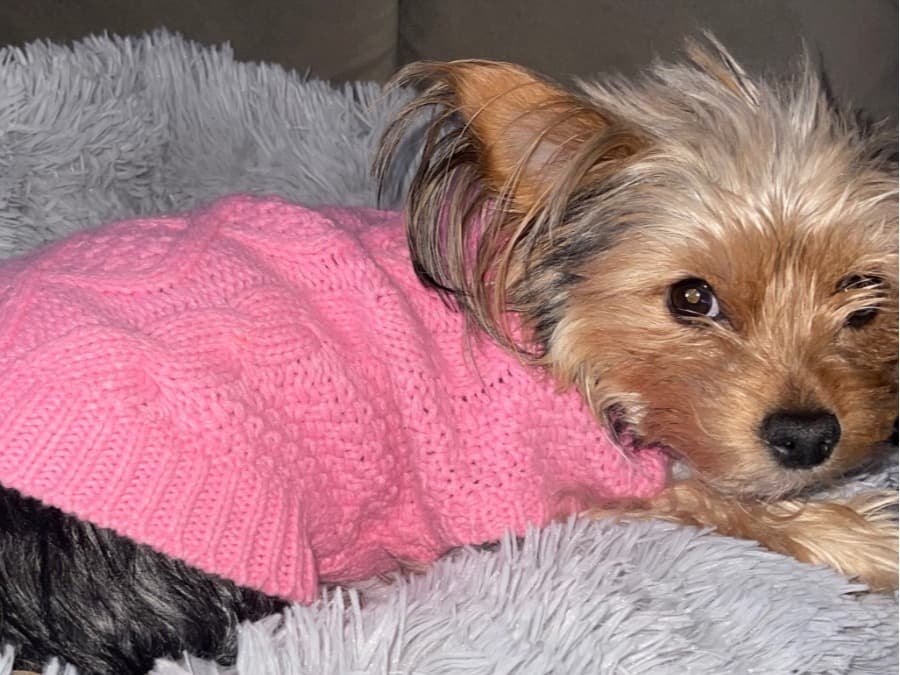
Yorkies are born black and tan and change color as they grow. By about age 1 to 2, the black fades to a dark steel blue over the back, with tan or gold on the head and legs. The breed standard is steel blue and tan. Solid colors, parti-colors, and very pale "golden" coats are outside the standard.
09
How many puppies do Yorkies have?
A Yorkie litter is small, usually 2 to 4 puppies, and first litters are often just 1 or 2. Because the litters are small and the dam is tiny, an x-ray around day 55 of pregnancy is worth doing to count the puppies and plan for a possible C-section.
10
How much does it cost to breed a Yorkie litter?
Budget roughly $3,000 to $7,000. Toy breeds need C-sections far more often than larger dogs, and that single line item can run $1,000 to $3,000. Add health tests, the bile-acid screen, a stud fee, and round-the-clock newborn care. With small litters, a first litter rarely turns a real profit.
11
Can a Yorkie give birth naturally?
Sometimes, but toy breeds need C-sections much more often than larger dogs because the puppies are large relative to the tiny dam. Many Yorkie litters end in a planned or emergency C-section. Keep a vet on call for every litter, and call right away for hard straining with no puppy or long gaps between puppies.
12
Where can I find a Yorkie breeding partner?
You can search for Yorkie breeding partners on Petmeetly and message the owners directly. Listings are free, and you can filter for breeding dogs. Ask each owner for the patella, eye, and heart clearances and the bile-acid (liver) results, and verify them independently before you commit to a mating.