

Choosing the right breeding mate for your small pet
Contents
Jump to a chapter
8 parts
Contents
Jump to a chapter
Should you be breeding your small pet?
For most species on this page, the honest professional answer is no. The American Veterinary Medical Association lists hamsters, gerbils, mice, rats, guinea pigs, and chinchillas as common pet rodents (the biological order that contains most of these animals) and notes their care complexity; nowhere does it encourage casual home breeding. The RSPCA and most exotic vets (veterinarians who treat small mammals, reptiles, and birds; most general-practice vets do not see these species regularly) explicitly recommend against breeding guinea pigs at home because of how often the dam (the mother animal) dies. The California Hamster Association opens its breeding guidance with a page titled “Think Before You Breed.”
If you are not certain you can re-home every animal you produce, do not breed.
Space
Most small-pet litters need at least three separate enclosures within six weeks: a quiet maternity space, a weaned-male group, and a weaned-female group. For solitary species (Syrian hamsters, most dwarf hamsters), the count grows by one cage per kit by weaning. A litter of eight Syrian hamsters means eight separate cages by week eight.
Time
Small mammals breed fast and litters arrive concentrated. A guinea pig can be pregnant again within hours of giving birth, per the RSPCA breeding guidance. A rat doe (the rat term for an adult female) can conceive within 24 hours of delivering. If the sire (the father animal) is still in the cage when she gives birth, you have a back-to-back pregnancy, which is hard on the dam and produces lower-quality kits per breed-club guidance from the American Fancy Rat and Mouse Association (AFRMA).
| Phase | Weekly hours per litter |
|---|---|
| Pre-mating + setup | 2 to 4 |
| Gestation | 2 to 4 |
| Birth through week 4 | 6 to 10 |
| Weaning + placement | 5 to 12 + per-kit work |
Money
Few pet-scale small-pet breeders break even on a first litter. Cages, bedding, food, vet visits, and unexpected emergencies stack quickly. A single dystocia (obstructed labor) in a sow (the guinea pig term for an adult female) can cost more than the cumulative income from her entire breeding career. Chinchillas, per Sunshine Chinchillas' breeding economics page and corroborated by the Exotic Nutrition breeding guide, require a herd of 100+ animals before commercial economics work; below that, the math is a hobby.
Dam risks by species
Each species carries its own headline risk.
- Guinea pigs. The pubic symphysis (the joint at the front of the pelvis) fuses by 6 to 9 months if the sow has never been bred. Per the Merck Veterinary Manual selecting-a-guinea-pig chapter, breeding for the first time after that age makes normal delivery dangerous and often requires an emergency C-section. Pregnancy toxemia (a sudden metabolic crash in late pregnancy) is also common in over-conditioned sows.
- Ferrets. Intact females (jills, the ferret term for an adult female) are induced ovulators (animals that only release eggs after mating) that stay in heat until bred or hormonally treated. Persistent estrus drives high estrogen, suppresses bone marrow, and causes aplastic anemia (bone-marrow failure that stops blood-cell production). Per the Merck Veterinary Manual on ferret reproduction, this can be fatal. An intact jill that is not bred or treated will likely die.
- Hamsters. Mating-induced aggression is a regular cause of injury and death in both partners. Per Wikipedia's Syrian hamster breeding reference summary, supervision is mandatory throughout the brief receptive window.
- Chinchillas. Stuck kits during birth are a chinchilla-specific emergency. Per the Merck chinchilla chapter, dams have two cervices and can carry twin litters simultaneously, complicating birth.
- Rats and mice. The dam can suffer mastitis (infected mammary glands) or be exhausted by back-to-back litters if the sire is not removed before parturition (delivery).
Kit placement
Six to ten weeks post-mating, you will have weaned animals ready to leave. “We will find homes” is not a plan. Small-pet rescues run full year-round; many shelters do not accept hamsters or mice at all. Petmeetly's own small pet adoption listings and small pets for sale carry animals whose first owners did not plan past week six. Before the mating, name three concrete homes who have agreed in writing.
When NOT to breed
- Single-owner households with no exotics-vet relationship.
- Pet-shop animals with no provenance.
- “We just want one litter for the kids.”
- A jill that you cannot afford to spay if pairing falls through.
- A sow already past 8 months that has never been bred.
- A Campbell's-Winter-White dwarf hamster pairing (hybrid kits are widely considered sterile and the practice is widely considered unethical, per Wikipedia's Campbell's dwarf hamster article).
When breeding is reasonable
Both animals are at the recommended age and weight for the species (Chapter 2); both have a clean health history; you have an exotics vet on speed dial; you have written commitments for every kit you are likely to produce; and you understand the species-specific risks above. Most owners who think hard about this list decide to spay or neuter instead. That is also a good outcome.
Species-by-species breeding considerations
This is the chapter no single-species breeding hub can offer. Ten species, ten different biological contracts. Read the row for your species before you read anything else.
The at-a-glance comparison
| Species | Earliest safe breeding age | Gestation | Litter size | Social structure | Headline risk |
|---|---|---|---|---|---|
| Syrian hamster | 10 to 14 weeks (female 4 months recommended) | 15 to 17 days | 6 to 10 (up to 20) | Solitary from week 6 | Mating-window aggression; lethal homozygous dominant-spot and roan pairings |
| Dwarf hamster (Roborovski, Winter White, Campbell's) | 4 to 6 months | 18 to 20 days | 4 to 8 | Variable; pair-toleration but fights common | Hybrid Campbell's x Winter White (sterile, unethical); maternal cannibalism on stress |
| Chinese hamster | 8 to 12 weeks | 18 to 21 days | 4 to 7 | Solitary | Aggressive handling; smaller average litters |
| Guinea pig | 4 to 6 months (HARD CEILING ~7 months) | 59 to 72 days | 2 to 5 | Herd | Pubic-symphysis fusion past ~8 months, leading to dystocia and dam mortality (~20% per RSPCA) |
| Fancy rat | 4 to 6 months (sexually mature at 5 to 8 weeks) | 21 to 23 days | 6 to 12 | Social, pair-housed | Back-to-back pregnancy if sire not removed; respiratory disease |
| Fancy mouse | 12 weeks (sexually mature at 5 to 6 weeks) | 19 to 21 days | 6 to 12 | Social does, solitary bucks | Stress cannibalism; buck odor management |
| Chinchilla | 8 to 12 months | ~111 days | 1 to 2 (rare 4) | Pair / herd | Stuck kits; twin pregnancies via dual cervices; dust-bath sensitivity |
| African dormouse | Specialty (consult exotics vet) | ~24 days | 3 to 4 | Pair (cautious) | Jurisdictional bans; fragility; minimal vet literature |
| Ferret | 4 to 8 months (seasonal) | 41 to 42 days | 6 to 10 (kits) | Pair / colony | Persistent estrus to aplastic anemia if not bred; state bans |
Hamsters in detail
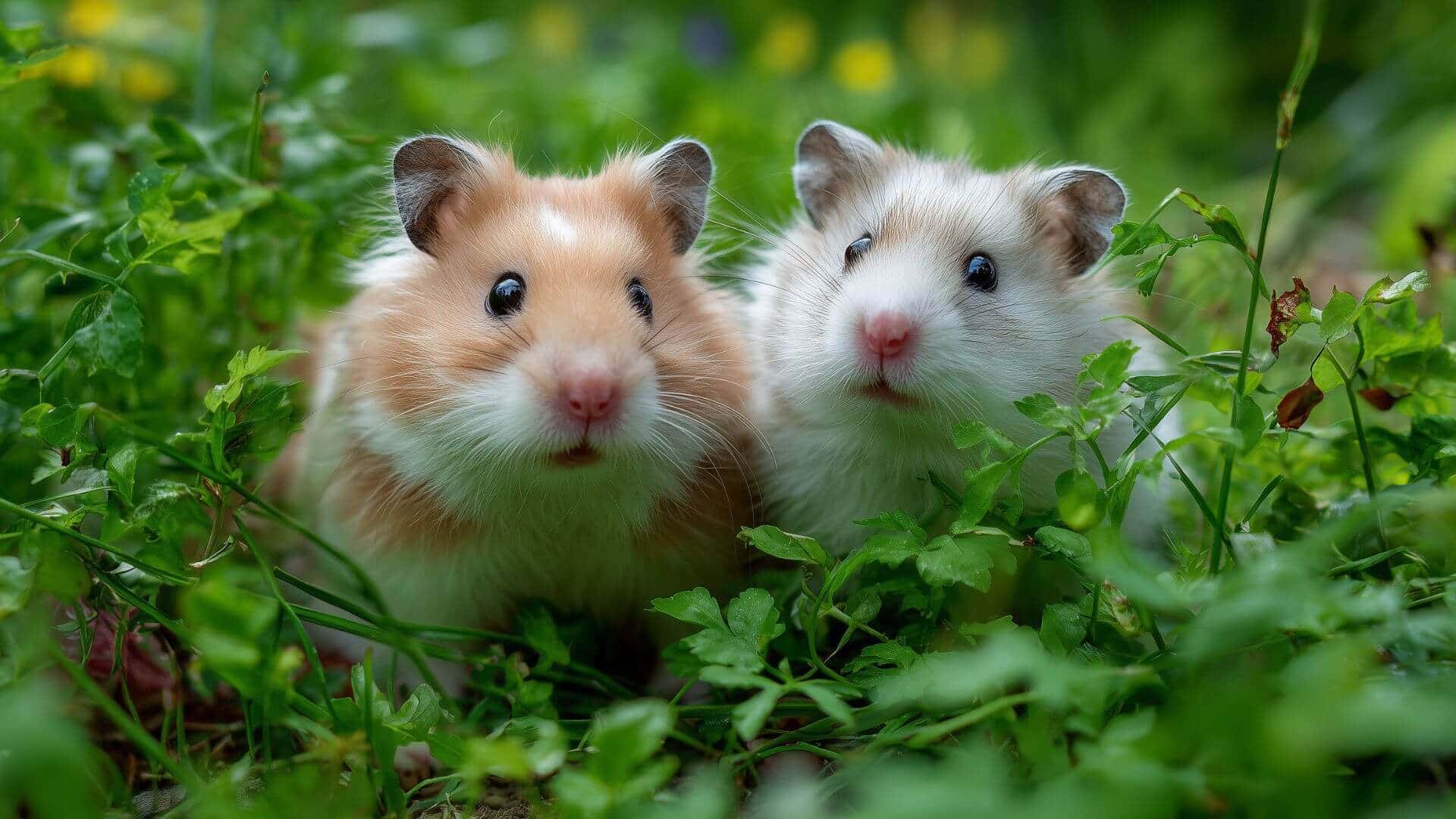
Syrian females cycle into estrus (the receptive phase) every four days; receptivity lasts roughly 6 to 12 hours per cycle, per the Merck hamster reproduction chapter. Always bring the female to the male's enclosure (“introduce female to male”), not the other way round; territorial females routinely attack males in their own cage. Pups must be separated by sex at 4 weeks and singly-housed by 8 weeks for Syrians. The California Hamster Association's pairings-to-avoid guidance lists pairings that produce lethal homozygotes for the dominant-spot and roan colour genes (kits that inherit two copies of these dominant alleles do not survive); pair these patterns only against solid colours.
Dwarf hamsters: the Campbell's x Winter White hybrid problem
Three sub-species are commonly kept (Campbell's, Winter White / Russian, and Roborovski). They cannot interbreed across all three, but Campbell's and Winter White can produce hybrid offspring, per Wikipedia's Campbell's dwarf hamster page. The hybrids are widely sterile and the practice is regarded as unethical by hamster welfare groups. Before any dwarf-hamster pairing, confirm sub-species in writing.
Guinea pigs: the hardest welfare clock among small pets
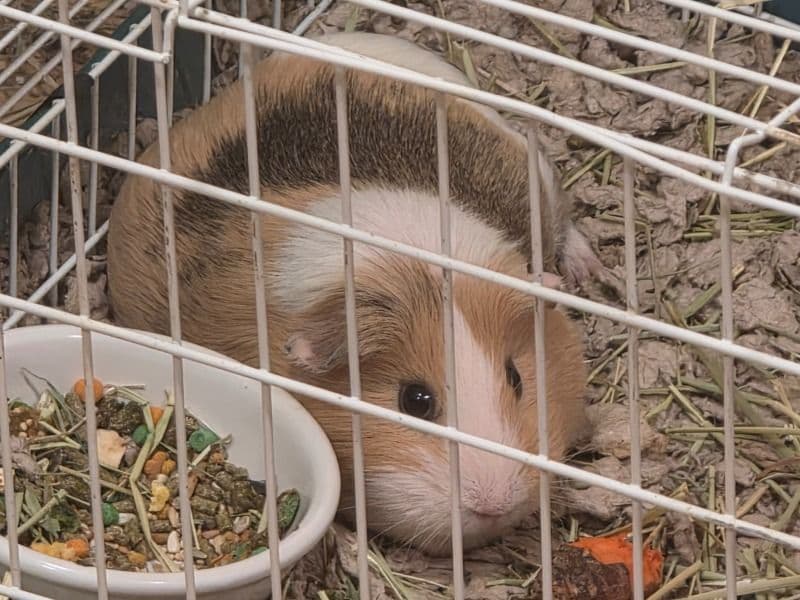
The Merck guinea pig chapter and the Merck selecting-a-guinea-pig chapter describe the pubic-symphysis fusion: in sows that have never been pregnant, the joint at the front of the pelvis ossifies (turns to solid bone) by 6 to 9 months, and a first delivery after that point typically requires a C-section. The RSPCA breeding guidance cites a sow mortality figure of up to 20% in all guinea pig births. The same source notes a sow can become pregnant again within hours of giving birth; separate the boar (the guinea pig term for an adult male) before parturition. The Guinea Lynx breeding guide is a long-running owner-community resource that echoes this.
Fancy rats and mice: the established ethical-breeder culture
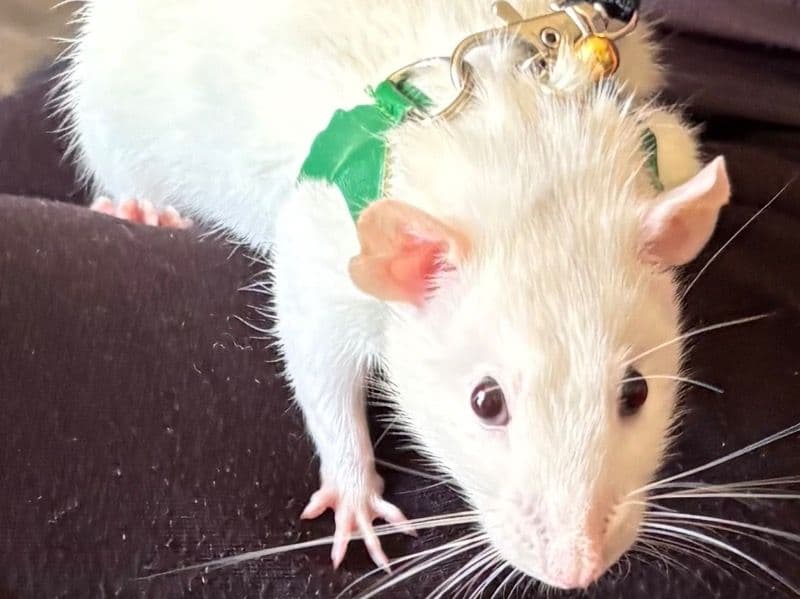
The American Fancy Rat and Mouse Association code of ethics and the AFRMA breeder directory frame the established ethical-rattery (a small-scale ethical rat breeding program) culture in the US. The Merck rat breeding chapter and the Merck mouse breeding chapter cover the biology. The National Mouse Club breeding page is the UK breed-club reference; the Fancy Mouse Breeders' Association is a US equivalent. Rats are sexually mature in 5 to 8 weeks but most ethical ratteries breed does at 4 to 6 months at the earliest; bucks 4 months and up.
Chinchillas: long gestation, twin pregnancies, polygamous colonies
The Merck chinchilla chapter sets the long-gestation context (around 111 days), describes the two-cervix anatomy (dams can carry simultaneous twin pregnancies, “superfetation”), and notes that polygamous breeding colonies use a one-male-to-many-females ratio (one male can serve 12 females). Most kits are born at night; labor takes around 30 minutes per kit. The National Chinchilla Society's breeding guide PDF is the UK breed-club reference.
Ferrets: legal-and-welfare baseline is unusually direct
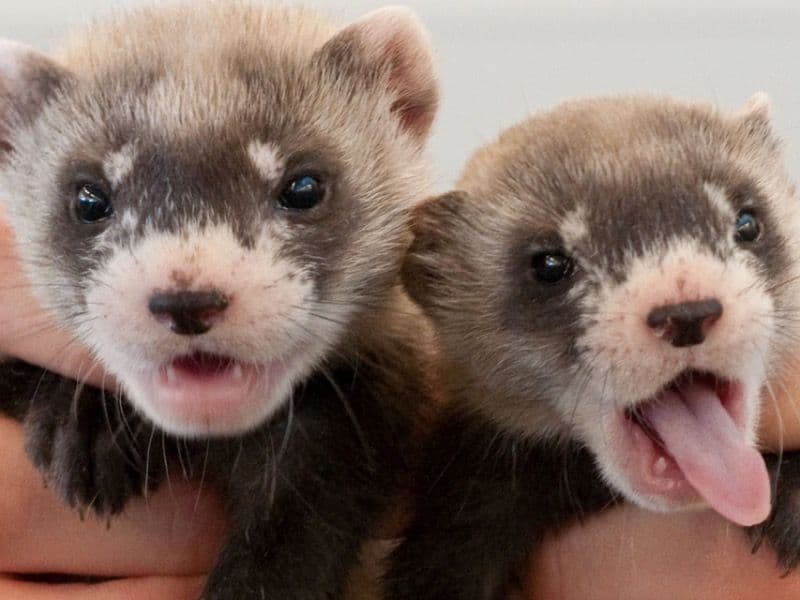
The Merck ferret breeding chapter and the American Ferret Association breeding page frame the legal and welfare baseline. Ferret breeding is regulated state-by-state; ferrets are banned outright as pets in California and Hawaii, and in New York City. Most US states require a breeder permit to keep intact ferrets. The persistent-estrus aplastic-anemia problem means most pet-ferret owners spay before sexual maturity, removing the option to breed casually. If you are not licensed and experienced, do not breed ferrets. The breed-club guidance is unusually direct on this.
African dormice: niche, regulated, sparsely documented
Niche species. Legal status varies by state and country; many US states class them as restricted exotic mammals. Veterinary literature is thin. List for breeding only if you have direct exotics-vet support and are confident about local legality (see Chapter 6).
Choosing a mate
For pet-scale pairings, temperament matters as much as appearance. The “show-quality” framing that drives rabbit and dog breeding mostly does not transfer; hamsters, mice, rats, and chinchillas all have variety standards (the National Mouse Club, AFRMA, and the National Chinchilla Society publish them), but most pet pairings are not headed to the show table.
What to ask the other owner
- How old is the animal, and what age was it when you got it?
- Has it been on any medication in the last six months?
- Any breathing issues, dental wear, or lumps you have noticed?
- For dwarf hamsters: which sub-species? Pure Campbell's, pure Winter White, or hybrid? (Pure-and-pure or no pairing.)
- For guinea pigs: has the sow ever had a litter? If not, what is her age in months? (Hard ceiling at ~7 months for a first pairing.)
- For ferrets: is the jill intact? When was her last estrus or hormonal treatment? Are you licensed for intact breeding in your state?
- For chinchillas: is she part of a polygamous colony, or pair-housed?
- May I see a short video of the animal in its cage?
An owner who answers openly is a candidate. An owner who deflects on a routine question is telling you something else (Chapter 8).
Visiting the seller
For all small pets, smell tells more than photos. Pungent ammonia is dirty bedding (a rat and mouse health concern). Persistent wet-tail discharge (a watery diarrhea around the tail) in a hamster is a serious disease. Sneezing in chinchillas can be respiratory infection. The Merck hamster reproduction chapter, the Merck rat chapter, and the Merck mouse chapter all flag respiratory disease as a leading welfare problem for breeding stock.
| Good signs | Warning signs |
|---|---|
| Clean cages with no ammonia smell | Deep ammonia smell on entry |
| Named individuals; lineage traced | Owner unable to age or trace lineage |
| Consistent species and varieties (a single rattery focused on rats, a single guinea-pig herd, a small hamstery focused on one or two colour lines) | “All small mammals” inventory (hamsters next to rats next to guinea pigs next to ferrets in poorly-isolated rooms) |
| Written care records; quarantine practices | Wet-tail discharge or persistent sneezing on the premises |
| Comfortable letting you observe the animals at rest | Pressure to commit before you see the animal |
Health checks before pairing
Small-pet breeding has nothing like the layered DNA-test culture of pedigree dogs or cats. What it has: hands-on observation, species-aware physical checks, and a small set of red flags that disqualify a pairing.
Universal checks
- Body condition. Animal is alert, well-furred, free of mites or lice (no scratching, no scaly ears in mice or rats), eyes clear, nose dry.
- Respiratory. No persistent sneezing, no rasping breath, no porphyrin (a red-tinged secretion produced under stress or illness) staining around the nose or eyes in rats and mice.
- Dental. Front incisors are even and self-wearing. Asymmetric wear or visible overgrowth is malocclusion (misaligned teeth that grow into each other); in guinea pigs and chinchillas, this is heritable and disqualifying.
- Gait and balance. No head tilt, no circling, no rear-leg weakness.
- Skin and fur. No bald patches, no scabs, no parasites visible at the skin-fur junction.
Species-specific checks
| Species | Specific check | Why |
|---|---|---|
| Syrian / dwarf hamster | Recent wet-tail; cheek-pouch impaction | Wet-tail is bacterial enteritis (intestinal infection), often fatal |
| Chinese hamster | Diabetes risk | The species is a known diabetes model in research |
| Guinea pig | Pubic-symphysis check (palpation, gently feeling the joint by hand); vitamin C status | Pubic fusion timing; guinea pigs cannot synthesize their own vitamin C |
| Fancy rat | Mycoplasma signs (clicking respiration, head tilt); mammary lumps | Mycoplasmosis is endemic; mammary tumors heritable |
| Fancy mouse | Aggression history in line | Maternal cannibalism is partly heritable |
| Chinchilla | Fur-chewing; malocclusion | Fur-chewing is stress and dietary; molars wear with age |
| African dormouse | Recent veterinary handling experience | Few exotics vets see them; baseline depends on owner observation |
| Ferret | Adrenal disease signs; recent estrus or treatment | Adrenal disease is common; intact-jill estrus is the welfare clock |
The Guinea Lynx breeding pages, the California Hamster Association care archive, and the Fancy Mouse Breeders' Association all maintain owner-community resources for species-specific health observations.
Pairing arrangements: fees, trades, and pick-of-litter
Small-pet stud-fee culture is thinner than dogs and rabbits, and almost nonexistent for hamsters, mice, and rats. Most pet pairings involve no cash, a small token fee, or a pick-of-litter (the sire's owner selects one weaned kit instead of cash) clause. Two exceptions: chinchillas (longer-lived, more individual investment per animal) and ferrets (intact-breeder permits are scarce and expensive).
Typical 2026 US ranges
| Species | Typical arrangement | Cash range |
|---|---|---|
| Hamster (any) | No cash; informal pairing between owners | $0 |
| Guinea pig | No cash; sometimes pick-of-litter | $0 to $25 |
| Fancy rat | Pick-of-litter or small token | $0 to $40 |
| Fancy mouse | No cash; informal | $0 |
| Chinchilla (pet-quality) | Small token to cover the dam's care | $50 to $150 |
| Chinchilla (show-line) | Cash stud fee or co-bred kits | $150 to $400 |
| Ferret (where legal) | Stud fee with permit verification | $100 to $500 |
Structures
- No-cash informal pairing. Most hamster, mouse, and casual guinea pig pairings. Risk: hard to enforce a re-service (a second mating if the first does not conceive) if conception fails.
- Pick-of-litter. Sire's owner selects one weaned kit. Common in rat and chinchilla pairings. Write down the timing and the size of the selection window.
- Token fee. Small flat cash to cover the dam's care. Common in chinchilla pet pairings.
- Show-line stud fee. Cash on confirmed pregnancy or live kits. Common only in chinchilla and ferret pairings where the line is documented.
Written invoices
Above $50, a written invoice is the default. Cover six items: breeding date, sire's identification, dam's identification, fee and payment method, re-service clause, contingency on dam mortality.
When NOT to pay
Owner cannot produce the sire on live video; owner will not share health observations; “all species” hobby seller; pressure to commit before meeting; price wildly above local market. Full inventory of behavior signals lives in Chapter 8.
Legal and welfare flags by jurisdiction
This is the chapter most generic small-pet breeding content skips. The legal context varies sharply by species and by US state.
Ferrets: outright bans and breeder permits
Ferrets are banned outright as pets in California, Hawaii, and New York City. Several Florida counties restrict possession; a few states require a breeding permit. The Florida Department of Agriculture and Consumer Services ferret page is one example of state-level reporting requirements. The California Department of Fish and Wildlife restricted species page documents the ferret prohibition. Do not list a ferret for breeding in a banned jurisdiction; the listing itself can attract enforcement action.
Chinchillas and CITES Appendix II
The species is listed on CITES Appendix II (the Convention on International Trade in Endangered Species; Appendix II covers species not currently threatened with extinction but whose international trade is regulated to prevent it from becoming so) in its wild form. Captive-bred pet chinchillas are unaffected by CITES export restrictions in most cases, but international moves require paperwork.
African dormice on restricted-species lists
Restricted exotic mammals in many US states. Check your state's restricted-species list before listing. The California restricted species list is an example; other states maintain their own.
Hamsters in Hawaii
Hawaii bans Syrian hamsters as pets (climate risk if released).
Hobby-business registration and tax
Small-pet breeding above hobby scale can trigger state or local hobby-business registration. Above-$600 stud-fee income in the US may be reportable. None of this is legal or tax advice; consult locally.
Birth, weaning, and placement
The work compresses into a window. Be ready before the dam delivers.
The day-of-birth checklist
- Sire physically removed from the cage (or held in a divided cage where she cannot reach him for re-mating).
- Quiet room temperature; no handling.
- Backup food and water in case the dam is not eating well.
- Phone number of an exotics vet who has confirmed they will see the species in an after-hours emergency.
Hands-off windows by species
| Species | First-touch window after birth |
|---|---|
| Syrian hamster | Day 14 minimum |
| Dwarf hamster | Day 14 minimum |
| Guinea pig | Pups are precocial (born furred and active); gentle hand-checks from day 1 if dam is calm |
| Fancy rat | Day 3 to 5 brief checks |
| Fancy mouse | Day 5 to 7 brief checks |
| Chinchilla | Day 3 to 5 brief checks |
| Ferret | Day 7 to 10 brief checks |
Maternal cannibalism
Stress-driven in all small species. Hamsters and mice are the highest-risk. Reduce by minimizing handling, keeping room temperature stable, removing the sire, and not changing food brands during the first week.
Weaning timeline by species
| Species | Wean | Sex-separate |
|---|---|---|
| Syrian hamster | Week 3 to 4 | Week 4 mandatory; single-house by week 8 |
| Dwarf hamster | Week 4 | Week 5 to 6 |
| Guinea pig | Week 3 | Week 3 (males can sire at 3 weeks) |
| Fancy rat | Week 4 to 5 | Week 5 |
| Fancy mouse | Week 4 | Week 4 |
| Chinchilla | Week 8 | Week 8 to 10 |
| Ferret | Week 6 to 8 | After spay / neuter |
Placement
Lifetime return-to-breeder clauses are the gold standard. A breeder who is not prepared to take a kit back at month 18 or year 3 is not running a responsible program. For ferrets, kits should leave fully spayed or neutered (or with a written commitment from the new home).
Red flags in a small-pet breeding listing
One pattern below in isolation is sometimes innocent. Two or more is almost always a reason to walk.
Red flag 01
“All small mammals” inventory
A single owner listing hamsters and rats and guinea pigs and ferrets together is almost always a mill or backyard production seller. Responsible owners specialize.
Red flag 02
Sub-species ambiguity in dwarf hamsters
“Russian dwarf” without specifying Campbell's vs Winter White is the most common dishonest listing pattern. Walk if you cannot get a clear answer.
Red flag 03
Guinea pig sow past 8 months on her first pairing
Pubic-symphysis fusion makes this genuinely dangerous. The seller either does not know, or does not care.
Red flag 04
Ferret listed in a banned jurisdiction
A listing in California, Hawaii, or NYC for an intact breeding ferret is either an unregistered breeder operating illegally, or a scam.
Red flag 05
Refusal to share parent information
Defensiveness on a routine question is the signal; you do not need to identify what is being hidden before walking.
Red flag 06
No video of the animal in its cage
Photos can be staged or scraped from other listings. Live video confirms the animal exists, in this owner's setup, today.
Red flag 07
Pricing red flags
Hamsters at $100+ (“rare colour”), pet-quality chinchillas at $500+ without paperwork, ferrets at any price in a banned state.
Red flag 08
Pressure to commit same-day
A reasonable owner accepts that you want to think about it overnight.
Red flag 09
Feeder-rodent framing
Anyone explicitly marketing feeders is on the wrong platform. The honest path is a reptile-community feeder supplier.
Red flag 10
Refused exotics-vet check
A reasonable seller lets the buyer arrange an exotics-vet check at the buyer's expense before final payment. Refusing is refusing the only outside verification available.
What to do if you spot a red flag
- Walk away. No money committed, no loss.
- Report welfare concerns to local Animal Control or the state agriculture department; small mammals are covered under most state animal-welfare statutes.
- Share a factual warning locally in your regional small-pet Facebook group, breed club, or rattery forum.
- Do not “rescue” the animal by buying it. The compassionate-sounding purchase funds the seller's next litter.

