01
What health tests does a Doberman need before breeding?
The OFA CHIC program requires six for the breed: an advanced cardiac exam (listening, an echocardiogram, and a 24-hour Holter), a hip evaluation, an ACVO eye exam, an autoimmune thyroid panel, the von Willebrand DNA test, and the Doberman club’s temperament test. The cardiac screen is the most important one and must repeat every year.
02
At what age can you breed a Doberman?
Wait until all health clearances are complete, which for Dobermans means at least the first clear cardiac screen at age 3. Most careful breeders do not breed a female before about 2 years and retire her by mid-life, because dilated cardiomyopathy often appears after age 4.
03
Why do Dobermans get dilated cardiomyopathy so often?
Dilated cardiomyopathy is inherited in the breed, and one large screening study found a cumulative lifetime rate near 58 percent. It is the most common cause of death in Dobermans and often shows no symptoms until the dog collapses, which is why yearly heart screening is essential before breeding.
04
Should I use the DCM gene test (DCM1 or DCM2) to pick breeding dogs?
Use it as extra information, not as a pass-or-fail gate. The AKC and a 2025 peer-reviewed study both found these variants miss many affected dogs and appear in healthy ones. So the yearly echocardiogram and Holter monitor still decide who breeds.
05
What is a white (Z-factor) Doberman, and can you breed one?
A white or Z-factor Doberman has a mutation in the SLC45A2 gene that causes albinism, with light sensitivity and a much higher risk of skin tumors. The breed club opposes breeding them, and a DNA test lets responsible breeders identify and breed away from carriers.
06
What colors can a purebred Doberman be?
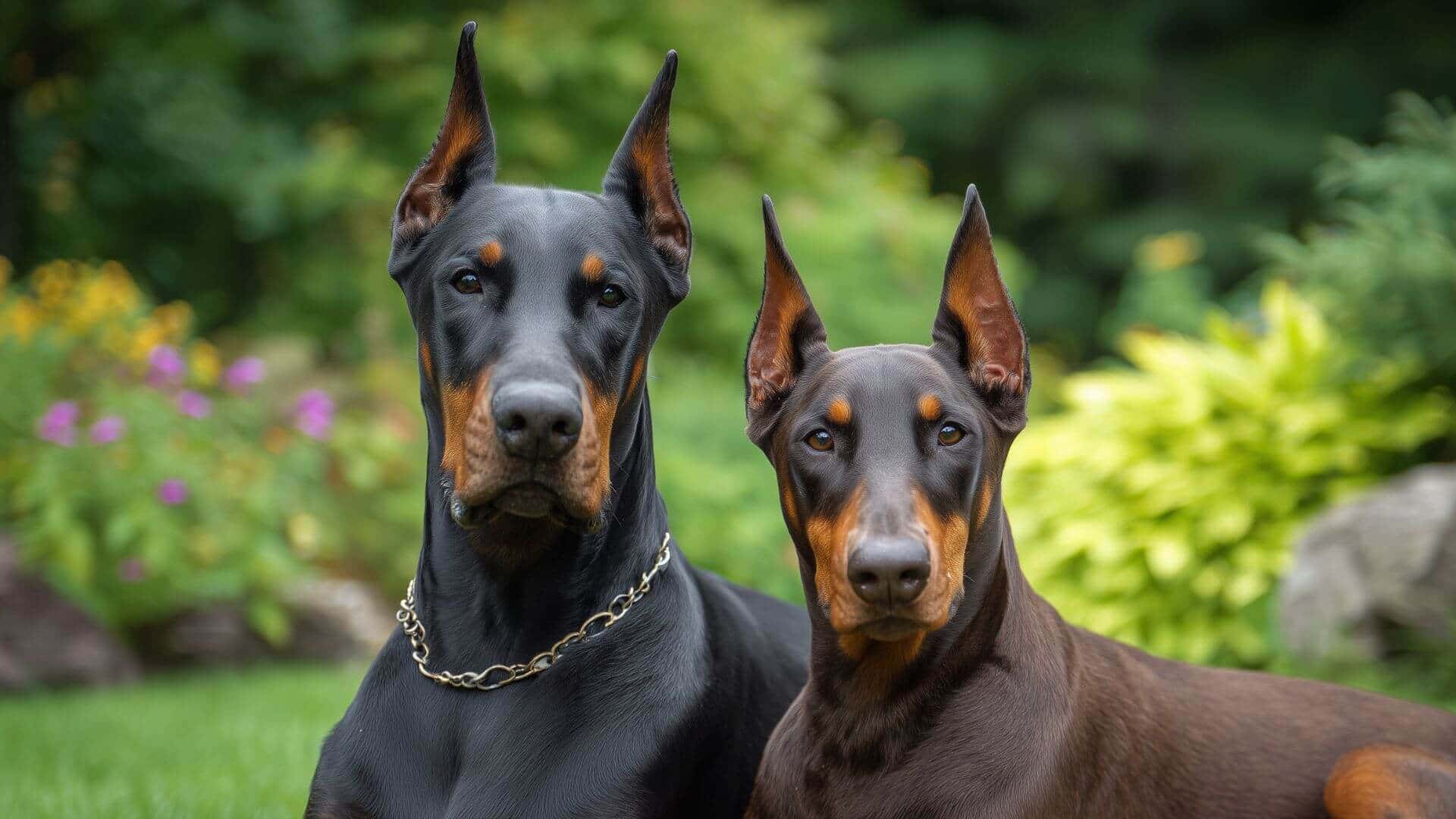
The AKC recognizes four colors, each with rust markings: black, red, blue, and fawn (Isabella). Blue and fawn are dilute colors and carry a high risk of color dilution alopecia, a coat-thinning skin condition. White is not a recognized color.
07
Is it safe to breed blue or fawn Dobermans?
It is legal in the show ring but comes with a welfare cost. Blue and fawn are dilute colors, and dilute Dobermans have high rates of color dilution alopecia, which causes gradual hair loss and skin problems. Many breeders avoid pairing two dilute dogs for this reason.
08
How big is a typical Doberman litter?
A typical Doberman litter is about 6 to 8 puppies, and pregnancy lasts roughly 63 days. A late-pregnancy x-ray confirms the puppy count so you know when whelping is finished and no puppy is left behind.
09
How much does it cost to breed a Doberman litter?
Plan for roughly 3,500 to 8,500 dollars for a first litter before any puppy sells, covering the cardiac screen and other health tests, the stud fee, progesterone timing, and whelping. A litter of 6 to 8 puppies can bring in 12,000 to 28,000 dollars at market prices. But an emergency C-section or a sick puppy can erase that margin fast.
10
Do I have to crop the ears or dock the tail?
No. Cropping and docking are cosmetic, and natural ears and tails are legal everywhere. The United Kingdom and much of Europe ban both, the United States mostly allows them, and the American Veterinary Medical Association opposes them when done only for looks.
11
What is the difference between a European and an American Doberman?
They are the same breed in two types. The European Dobermann follows the FCI standard and is heavier and more working-driven, while the American Doberman Pinscher follows the AKC standard and is sleeker and more refined. Both need the same health testing.
12
How long do Dobermans live?
The commonly quoted range is 10 to 13 years, but the largest breed-specific, owner-reported dataset puts real-world life expectancy closer to 9 years. Dilated cardiomyopathy is the main reason the breed often falls short of other dogs its size.