OFA patella, cardiac, and tracheal hypoplasia are required for a Bulldog CHIC number. PennHIP for hips. Annual ACVO eye exam. Comprehensive DNA panel.
02
Grade the airway under the RFG scheme
Both parents should be RFG Grade 0 or 1 on the Cambridge / Royal Kennel Club scheme. Grade 2 is conditional. Grade 3 is breeding-disqualifying.
03
Plan the mating around AI, not a tie
Progesterone-timed chilled or surgical AI is the responsible default. Natural tie is unreliable and risks heat stress in a brachycephalic stud.
04
Book the elective C-section
Day-55 radiograph counts puppies. Schedule a daytime C-section for day 60 to 62 with a brachycephalic-experienced surgical team.
What health tests does a Bulldog need before breeding?
Short answer
The OFA Bulldog CHIC requires three tests: patella, cardiac, and tracheal hypoplasia. The responsible floor adds an annual OFA-CAER eye exam, a PennHIP hip evaluation (preferred over OFA hips for the breed), and a DNA panel covering HUU, DM, and Cystinuria. The Bulldog Club of America Code of Ethics is the parent-club baseline for any of this to count.
01. PatellasOFA / CHIC required
Vet palpation, grades 1 to 4. Required for a Bulldog CHIC number.
$50 to $100
02. CardiacOFA / CHIC required
Auscultation by a vet cardiologist preferred; echocardiogram strongest. Required for CHIC.
$150 to $500
03. Tracheal hypoplasiaOFA / CHIC required
Radiograph at 12 months or older. Trachea must be roughly twice the width of the third proximal rib at the thoracic inlet.
$150 to $300
04. EyesOFA-CAER (ACVO)
Annual exam by a board-certified ophthalmologist. CAER tracks entropion, ectropion, cherry eye, and KCS.
$95 to $200
05. Hips (PennHIP preferred)PennHIP / OFA
OFA Bulldog hip pass rates are very low; PennHIP’s distraction-index method is the more useful breeding tool for the breed.
The Bulldog Club of America [2] publishes the breeder ethics baseline. Its companion health-testing matrix[3] reads against the OFA-CHIC programme. For the Bulldog CHIC number, patella, cardiac, and tracheal hypoplasia are the three required evaluations[5]. Eyes, hips, thyroid, and deafness are listed as optional but recommended, which is how most reputable breeders interpret them: do them anyway.
Tracheal hypoplasia is the test most non-Bulldog breeders have never heard of. OFA defines a normal Bulldog trachea as roughly twice the width of the third proximal ribat the thoracic inlet, measured on a standard radiograph[6]. A narrow trachea sharply raises anaesthetic and heat-stress risk and is heritable, which is why it sits at the top of the CHIC list.
Why PennHIP, not OFA, for Bulldog hips
OFA hip scoring
Subjective grade (Excellent / Good / Fair / Borderline / Mild / Moderate / Severe). Bulldog pass rates are historically very low; the breed conformation distorts the visual grade.
PennHIP distraction index
Quantitative measure of hip-joint laxity (0 to 1). More useful for selecting against dysplasia in a low-pass-rate breed. Scored from 16 weeks of age[7].
OFA hip evaluation is only valid at 24 months and older; PennHIP scores are valid from 16 weeks but most breeders wait until 12 months for the breeding decision[4].
Annual ACVO eye exams (registered with OFA-CAER) catch entropion, ectropion, prolapsed nictitating membrane gland ("cherry eye"), and corneal ulcers, all of which run high in the breed[8]. The RVC VetCompass dataset found Bulldogs had 26.79 times the odds of cherry eye and 38.12 times the odds of skin-fold dermatitis compared with non-Bulldogs[13]. Annual ophthalmology and dermatology checks are not optional in practice.
The DNA panel covers the breed-relevant single-gene conditions: Hyperuricosuria (HUU), where affected dogs form urate bladder stones; Degenerative Myelopathy (DM), an adult-onset spinal-cord disease; and Cystinuria, another urate-stone risk[26]. Test both parents and avoid mating two carriers of any of the three.
When can you breed your Bulldog?
Short answer
Wait until your female is at least 24 monthsold, on her second or third heat. Your male is sexually mature around 12 months but should not be used for planned breeding until OFA cardiac, patella, and tracheal hypoplasia clearances are in hand and his RFG airway grade has been scored. The 24-month threshold matters because OFA hip and cardiac evaluations are only valid from that age.
Female
24 months minimum
Wait for the second or third heat. Earlier mating raises dystocia risk in a breed where almost every litter is already a surgical delivery.
Male
24 months
Sexually mature earlier, but OFA cardiac and full RFG airway grading should be complete before any planned pairing.
Why progesterone timing matters more for a Bulldog
Bulldog heats can be quiet, with little visible discharge and subtle behavioural shifts. Calendar timing misses the fertile window, and because the mating will be done by AI, the AI window has to be hit on the right side of the LH surge. Progesterone testing is the only reliable way to land it.
LH surge
2–3 ng/mL
Ovulation
5–8 ng/mL
Best AI
~10 ng/mL
Your vet draws blood starting around day 6 and every 2 to 3 days[16]. Cost runs $50 to $150 per draw, typically 2 to 4 draws per cycle[17]. Every breed ovulates at the same progesterone level: a Bulldog and a Mastiff and a Chihuahua all peak at 5 to 8 ng/mL[19].
One more pre-breeding test
A brucellosis blood test within 30 days of mating, $50 to $100 per dog. Brucellosis causes stillbirths and can spread to humans, so a stud owner who skips it is the kind of partner you decline[2].
Why is artificial insemination and a planned C-section the Bulldog default?
Short answer
The Bulldog cannot reliably reproduce itself. Body conformation makes natural tie fail in most attempts, and about 80 to 95 percent of Bulldog littersare delivered by C-section. AI replaces the unreliable tie; an elective day-62 surgery replaces the 3 a.m. emergency. The RVC VetCompass programme found Bulldogs have 2.04 times the odds of being diagnosed with any disorder versus other dogs (O'Neill et al., 2022).
Why AI by default
Deep chest and short legs prevent a reliable tie. Heat exertion during forced mating risks BOAS collapse in a brachycephalic stud[18].
Why surgery is planned
Round puppy head, broad shoulders, narrow dam pelvis. Roughly 80 to 95 percent of litters cannot deliver vaginally[14].
The three AI methods, and what they cost
Vaginal (chilled)
$500 to $1,200
Chilled semen shipped overnight, deposited transcervically by a reproductive vet. Conception rate around 60 to 75 percent when progesterone-timed.
TCI (transcervical)
$1,000 to $2,000
Endoscope-guided deposit directly into the uterus. Higher conception rate, less anaesthetic burden than surgical AI. Preferred middle option for Bulldogs.
Surgical (frozen)
$1,500 to $3,500
Laparotomy with direct uterine deposit. Used for frozen semen and difficult-cycle dams. AKC currently restricts registration of one-time-use surgical AI; most labs now offer TCI as the alternative[18].
Chilled-semen import adds $250 to $500 in shipping plus semen storage fees. Frozen storage runs $100 to $300 per year per straw.
The Cambridge BOAS Research Group and the Royal Kennel Club jointly operate the Respiratory Function Grading (RFG) scheme, a standardised assessment of upper airway function in brachycephalic breeds[9]. A trained vet listens to the dog at rest with a stethoscope, then again immediately after a three-minute trot, and assigns a grade from 0 to 3[10]. The Kennel Club's public-facing summary names Bulldogs explicitly as one of the brachycephalic breeds the scheme is built for[11]. The AVMA documented the rollout in the US veterinary press[12].
RKC / Cambridge Respiratory Function Grading
Grade 0
Clinically unaffected. Best breeding candidate.
Grade 1
Mild signs. Breed only to Grade 0.
Grade 2
Moderate. Cambridge advises against breeding.
Grade 3
Severe. Disqualifying. Refer for airway surgery.
US owners can request the assessment from a reproductive specialist or a university veterinary teaching hospital using the published Cambridge protocol; the formal RKC certificate is currently UK-only[11].
Neonatal mortality after a C-section is meaningfully higher in brachycephalic litters than non-brachycephalic ones (Adams et al., 2022). The gap narrows when the surgery is planned and the team is set up for brachycephalic neonates[15]. A scheduled day-62 surgery lets the practice pre-warm the theatre, dedicate a nurse to each puppy for resuscitation, and avoid the staffing gaps of an overnight emergency.
5 questions to ask the stud owner about AI and whelping history
1What is the stud’s RFG (Respiratory Function Grading) score, and who scored him?
2Has he ever had upper-airway surgery (nares, soft palate, saccules)?
3How were previous matings done: vaginal AI, TCI, or surgical AI? What was the conception rate?
4How did previous dams whelp: planned C-section or emergency? Any neonatal losses in the first 48 hours?
5Is he kept lean (body condition 4 to 5 of 9) and climate-controlled year-round?
The brachycephalic conformation is the trade-off baked into the breed standard. Responsible Bulldog breeding means respecting it: pair RFG Grade 0 parents, keep them lean and cool, plan AI around progesterone, and book the C-section in advance.
What does RVC VetCompass tell us about Bulldog health?
Short answer
The Royal Veterinary College VetCompass programme analysed 2,662 UK English Bulldogs against a comparator population of 22,039 non-Bulldogs. Bulldogs had 2.04 times the odds of being diagnosed with at least one disorder; median lifespan was 7.2 years. The four single largest predispositions were skin-fold dermatitis (38.12x), prolapsed nictitating membrane gland (26.79x), mandibular prognathism (24.32x), and BOAS (19.20x) (O'Neill et al., 2022).
Skin-fold dermatitis
38.12x
odds vs non-Bulldogs
Cherry eye
26.79x
odds vs non-Bulldogs
BOAS
19.20x
odds vs non-Bulldogs
Median lifespan
7.2 yr
vs ~11 to 12 yr in dogs overall
The VetCompass authors concluded that the Bulldog's disorder burden is driven by extreme body shape and called for "immediate redefinition of the breed towards a moderate conformation"[13]. For a first-time breeder, the practical reading is narrower: the three biggest levers an individual programme can pull are (a) breed only RFG Grade 0 or 1 parents, (b) keep adults lean (BCS 4 to 5 of 9), and (c) climate-control the home.
Heat stress is the acute mortality risk to plan for
Bulldogs cool by panting, and a brachycephalic skull cuts that capacity sharply. Ambient temperature above 75 degrees Fahrenheit, humid still air, or any sustained exertion can tip a Bulldog into heat stroke within minutes.
Air-condition the whelping room. 68 to 72 degrees Fahrenheit, dry, low airflow over the dam.
Exercise in cool windows. Early morning and late evening only. Short, level, no forced gait.
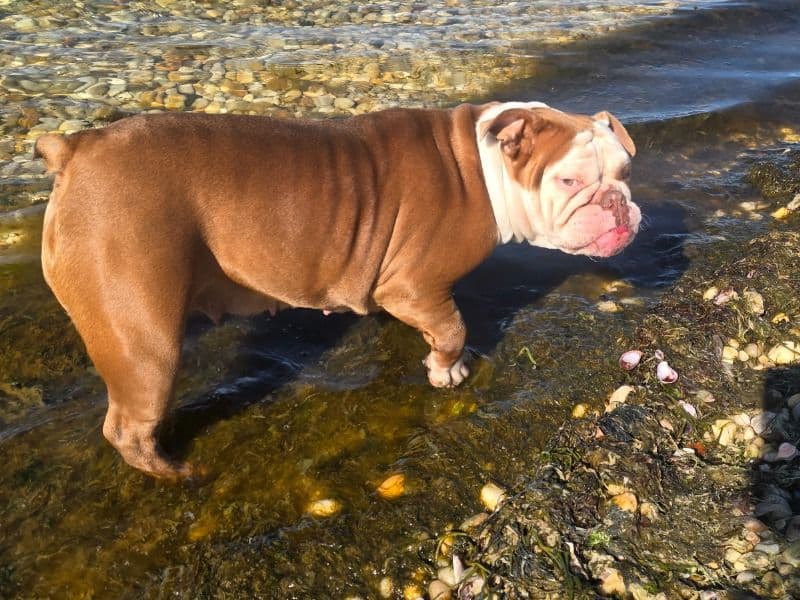
No swimming. Bulldog body shape cannot keep the head out of the water reliably.
Never leave a Bulldog in a parked car.Even a few minutes at moderate ambient temperatures is enough.
For the daily-care side of the breed (wrinkle hygiene, dental care, tail-pocket cleaning), Cornell's BOAS overview is a clean reference for buyers[21]. Add it to the puppy-pack you send home with the litter.
How do you choose a Bulldog breeding partner?
Short answer
Pick a mate with the OFA Bulldog CHIC trio (patella, cardiac, tracheal hypoplasia) plus ACVO eyes, PennHIP hips, and a DNA panel; an RFG Grade 0 or 1; a five-generation inbreeding score below 6.25%; and a stable temperament. Walk away from any pairing where one parent is RFG Grade 2 or worse, where the owner avoids sharing OFA numbers, or where the stud has never been bred by AI before.
Coefficient of inbreeding thresholds
Below 6.25%
Target zone. The Bulldog gene pool is small; aim lower than the toy-breed default.
6.25 to 10%
Caution. Recessive-disease risk climbs sharply on a breed already this homozygous.
Above 10%
Disqualifier in most BCA-aligned programmes.
Coefficient of inbreeding (COI) shows how closely the parents share ancestors[27]. Our dog breeding compatibility calculator gives a quick estimate; a kennel-club pedigree report is the official one.
The rest of your pre-pairing checklist
Verify the OFA patella, cardiac, and tracheal hypoplasia numbers at OFA.org.
Ask for the PennHIP distraction index in writing.
Ask for the RFG airway grade and who graded the dog.
Ask for the Embark or PawPrint DNA panel for HUU, DM, and Cystinuria.
Talk to the other owner's reproductive vet, if the owner agrees.
Confirm both dogs are signatories to (or aligned with) BCA Ethics[2].
If both breeders are in the AKC Bred with H.E.A.R.T. programme, they have agreed to follow a health-testing plan and ongoing breeder education[24]. Pair that with our step-by-step ethical breeding guide for the full pre-mating workup.
Expect $4,500 to $9,000 up front before the first mating: health workup, AI, and the elective C-section as a budgeted line item, not an emergency contingency. Then plan another $1,500 to $3,500 for prenatal care, whelping supplies, neonatal hand-feeding, and the first round of puppy shots and deworming. Combined with an average litter of 3 to 4 puppies, the per-puppy math is the tightest of any AKC breed.
Estimated cost of a first Bulldog litter
OFA patella$50 to $100
OFA cardiac (vet cardiologist preferred)$150 to $500
OFA tracheal hypoplasia radiograph$150 to $300
Annual OFA-CAER eye exam$95 to $200
PennHIP hip evaluation$300 to $600
DNA panel (HUU, DM, Cystinuria)$160 to $200
RFG airway assessment (US, university hospital)$200 to $400
Brucellosis blood test (both dogs)$100 to $200
Progesterone draws (2 to 4 per cycle)$150 to $600
Stud service$1,000 to $2,500
Champion-bloodline stud premium+ $1,000 to $3,000
AI (chilled vaginal / TCI / surgical)$500 to $3,500
Elective C-section (planned, day 60-62)$2,500 to $5,000
Emergency C-section uplift (if not booked)+ $1,500 to $3,500
Prenatal vet + whelping supplies$500 to $1,200
Neonatal hand-feeding + puppy milk replacer$200 to $600
Puppy vaccinations + deworming (litter)$400 to $1,000
Realistic total$6,000 to $12,500
Ranges are typical US pricing. The AI and elective C-section rows are baseline line items, not contingencies, because roughly 80 to 95 percent of Bulldog litters require surgical delivery[14].
What can the puppies sell for?
Pet-line Bulldog puppy, health-tested parents$2,500 to $4,000
Reputable breeder, full BCA-aligned testing$4,000 to $6,000
Champion bloodline / show-quality / rare pied$6,000 to $10,000+
Typical litter revenue (3 to 4 puppies)$10k to $24k
Market range only, not a Petmeetly endorsement. Average Bulldog litter is 3 to 4 puppies[23], which is half what a sporting breed delivers and means one neonatal loss can wipe out the litter's margin.
The Bulldog cost-to-revenue ratio looks healthy on paper and tight in practice. One emergency uplift (the dam needs the C-section at 2 a.m. on a holiday weekend), one hand-feeding-intensive puppy, or one neonatal loss flattens the spread. Our dog breeding checklist covers the rest of the pre-mating workup.
What does whelping a Bulldog litter actually look like?
A Bulldog pregnancy lasts about 63 days from ovulation. Day 28 ultrasound confirms the pregnancy and gives an early count. Day 55 X-ray confirms the final count and checks fetal skeletal maturity. That radiograph is what fixes the C-section date, typically day 60 to 62.
Final puppy count from skull and spine ossification.
Day 60-62
Elective C-section
Scheduled daytime surgery, brachycephalic-experienced team.
Call the surgical team early if any of these happen
Temperature drops below 100°F, no booked surgery
Labour is starting. Move to surgery before any contraction phase begins.
Green or dark discharge, no puppy
Green (uteroverdin) signals placental separation. A puppy is in distress[20].
Dam panting heavily, gums dusky or blue
BOAS-driven respiratory compromise on top of labour stress. Emergency, not "wait and see"[22].
Straining 20 to 30 minutes, no puppy
The pup is too large for the pelvis. Surgery, not medical management.
Why the planned surgery beats the emergency.A scheduled daytime C-section lets the practice pre-warm the theatre, dedicate one nurse per puppy for resuscitation, and avoid the staffing gaps of an out-of-hours emergency. Neonatal mortality after a planned C-section is lower than after an emergency C-section in brachycephalic litters (Adams et al., 2022)[15].
Weigh every Bulldog puppy three times a day in the first week. Average birth weight is 8 to 12 ounces (227 to 340 g). Healthy puppies gain 5 to 10 percent of birth weight per day in the first two weeks. Any puppy not gaining for 12 hours needs immediate supplementation with a commercial puppy milk replacer; expect at least one hand-feeder per Bulldog litter in practice. Cow milk causes diarrhoea and is not a substitute.
$1,000 to $2,500 cash, champion-line premium up to $3,000, or pick-of-litter in lieu.
Non-refundable deposit
Around $500 to lock in the pairing and reserve the AI date.
AI method and who pays
Vaginal, TCI, or surgical. Progesterone testing, semen collection, semen shipping, and storage broken out individually.
Definition of a successful breeding
Confirmed pregnancy by day-28 ultrasound, or at least one live puppy at eight weeks. Stud fee structure should not pivot on litter size alone.
Repeat-mating clause
What happens if conception fails or no live puppies result, and how many free repeats are included on the same dam.
Health-guarantee statement
Stud’s named OFA patella, cardiac, tracheal hypoplasia, eye, PennHIP, DNA results, and RFG airway grade.
Brucellosis and timing
Both dogs tested within 30 days of mating; results shared in writing before semen ships.
Put the stud deal in writing before the AI date is booked. The American Breeder template covers the parts above[25]. Both owners sign and keep a copy. Verbal agreements are the main reason stud deals end in arguments, and a Bulldog deal involves enough moving parts (semen shipping, AI method, vet bills, C-section booking) to multiply the failure modes.
Frequently asked Bulldog breeding questions
01
Can a Bulldog breed naturally, without artificial insemination?
Rarely, and most responsible Bulldog programs do not try. The breed standard pairs a heavy chest and short legs with a narrow rear. Most stud dogs cannot achieve a tie without handler assistance, and even then the success rate is low and exertion risks heat stress in a brachycephalic dog. Chilled or surgical artificial insemination is the planned route in almost every modern Bulldog mating.
02
Why do most Bulldog litters need a C-section?
Bulldog puppies have large round skulls and broad shoulders, and the dam has a comparatively narrow pelvis. Around 80 to 95 percent of Bulldog litters are delivered surgically. The Royal Veterinary College VetCompass programme found English Bulldogs have 2.04 times the odds of being diagnosed with at least one disorder compared with other dogs, with body shape driving the difference (O’Neill et al., 2022). Planning an elective C-section around day 62 is safer than letting the dam reach a stalled emergency labour.
03
What is the Respiratory Function Grading (RFG) scheme, and how do I get my Bulldog graded in the US?
RFG is a Bulldog airway grading scheme jointly run by the Royal Kennel Club and the University of Cambridge BOAS Research Group. A trained veterinarian assesses your dog with a stethoscope before and after a three-minute exercise test, then assigns Grade 0 (clinically unaffected), 1 (mild), 2 (moderate), or 3 (severe). Cambridge recommends not breeding from Grade 2 or 3 dogs. In the US the formal scheme is not yet available, but most veterinary teaching hospitals and reproductive specialists can perform an equivalent functional assessment using the Cambridge protocol.
04
How long is a Bulldog pregnancy?
About 63 days from ovulation, with a normal range of 58 to 68 days. A reproductive vet confirms pregnancy by ultrasound around day 28 and counts puppies by X-ray around day 55. Most Bulldog breeders schedule the elective C-section between day 60 and 62, once the count and fetal skeletal maturity are confirmed.
05
When can a Bulldog start breeding?
Wait until the female is at least 24 months old. OFA hip and cardiac evaluations are only valid from 24 months, and the BCA Code of Ethics encourages dams to be physically and emotionally mature before a first litter. Bulldog males are sexually mature around 12 months, but the same clearance window applies. Earlier mating raises the risk of dystocia, smaller litters, and poor maternal care.
06
How many puppies do Bulldogs usually have?
A Bulldog litter averages 3 to 4 puppies, with a typical range of 1 to 6. First litters are usually smallest (1 to 3 puppies). The small litter size combined with a near-mandatory C-section means the per-puppy cost is among the highest of any AKC breed.
07
Why does the BCA Code of Ethics matter for a first-time Bulldog breeder?
The Bulldog Club of America (BCA) is the AKC-recognised parent club for the breed and publishes the breeder ethics and health-testing baseline. It encourages OFA-CHIC testing (patella, cardiac, tracheal hypoplasia required; eyes, hips, thyroid recommended), refusal to register dogs from non-CHIC pairings, and lifetime take-back contracts for buyers. Following BCA Ethics is the difference between a breeder buyers can trust and a pet-shop pipeline.
08
What is the lifespan of an English Bulldog?
The RVC VetCompass 2022 study put median Bulldog lifespan at 7.2 years, compared with around 11 to 12 years for dogs overall. Heat stress, BOAS-related complications, cancer, and heart disease are the most common causes of death. Lean body condition, climate control, and breeding from RFG Grade 0 to 1 parents are the three biggest levers individual owners can pull.
09
How heat-sensitive is a Bulldog, really?
Severely. The brachycephalic skull restricts panting, the primary cooling system in dogs. Ambient temperatures above 75 degrees Fahrenheit can be dangerous, and heat stroke can become fatal within minutes. Exercise has to be moved to cool morning and evening windows; swimming is unsafe because Bulldogs cannot keep their heads above water reliably. Air conditioning is essential for the breeding home.
10
How much does a Bulldog puppy sell for?
US pet-quality Bulldogs from a BCA-aligned breeder typically sell for $2,500 to $5,000. Champion bloodlines and rare or pied coats push higher. Price tells you nothing about health either way, so ask for the parents’ CHIC numbers whatever the puppy costs.
ByPetmeetly Editorial Team•Published •Updated Reviewed against AKC, BCA, OFA, RVC VetCompass, and Cambridge BOAS research.
Success Stories from Bulldog Breeders
Real stories from dog owners who found perfect breeding matches on Petmeetly
Everything went smoothly! I’m excited and looking forward to her pregnancy!
AK
Amanda Knowles
California, US
Twice now, Petmeetly has helped me find the perfect mates for him. He’s a happy pup ❤️ and his adorable puppies are proof of how amazing this platform is. Thank you, Petmeetly, for making this possible!
Benji
Alberta, CA
We’ve had great success with Moose and his Petmeetly mate, Lola. They are now the proud parents of seven healthy pups!
More than half of all pre-weaning puppy deaths happen in the first week, and a dying puppy usually looks fine until it does not. This guide covers the three things that kill newborn puppies (cold, low blood sugar, and missed colostrum), the numbers that flag trouble a day early, and when to call the vet.
When can you breed your dog? A vet-informed timing guide covering male and female age windows, 50-breed reference table, OFA CHIC health tests, and heat-cycle protocols.
Behavior kills more US dogs under 3 than disease does. The 8 to 16 week socialization window, the AVSAB-approved checklist, and how to handle an adopted dog.