PetmeetlyPetmeetly
Find a match
Dog Breeders & Stud Dogs
Dogs For Sale
Dogs For Adoption
Cat Breeders & Stud Cats
Cats For Sale
Cats For Adoption
Rabbit Breeders
Rabbits For Sale
Rabbits For Adoption
Small Pet Breeders
Small Pets For Sale
Small Pets For Adoption
How It Works
Pet Blogs
Testimonials
About Us
Find a match

Dogs & Puppies

Dog Breeders & Stud DogsDogs For SaleDogs For Adoption

Cats & Kittens

Cat Breeders & Stud CatsCats For SaleCats For Adoption

Rabbits

Rabbit BreedersRabbits For SaleRabbits For Adoption

Small Pets

Small Pet BreedersSmall Pets For SaleSmall Pets For Adoption

Resources

How It WorksPet BlogsTestimonialsAbout Us
Find a MatchSign In
Petmeetly

Your platform for finding the perfect pet companion. Connect with pet owners and discover loving pets looking for homes.

App StoreGoogle Play

Quick Links

  • Home
  • How It Works
  • About Us
  • Editorial Team & Reviewers
  • Blog
  • Privacy Policy
  • Trust & Safety

Dogs

  • Dog Breeders
  • Dogs for Adoption
  • Dogs for Sale

Cats

  • Cat Breeders
  • Cats for Adoption
  • Cats for Sale

Rabbits

  • Rabbit Breeders
  • Rabbits for Adoption
  • Rabbits for Sale

Small Pets

  • Small Pet Breeders
  • Small Pets for Adoption
  • Small Pets for Sale

© 2026 Petmeetly. All rights reserved.

PrivacyTerms
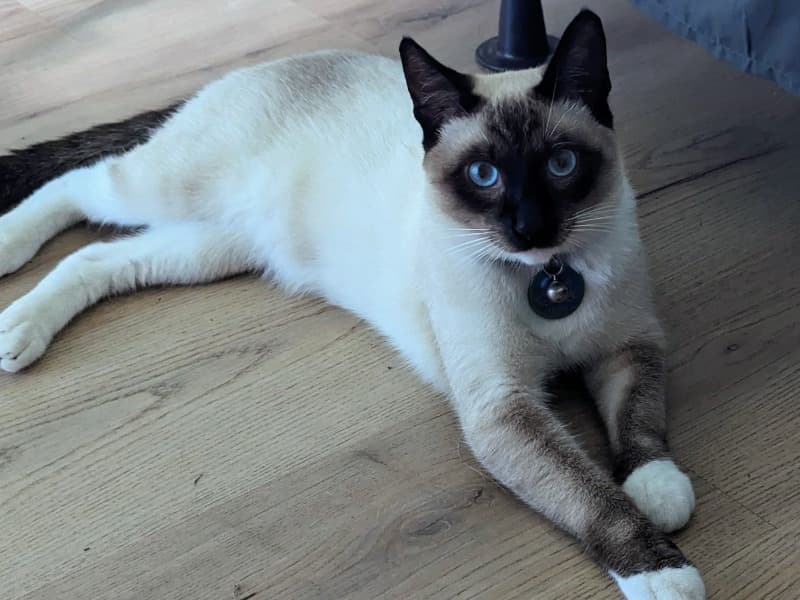
Adult seal point Siamese cat with a cream coat, dark mask and blue eyes sitting alert beside a sunlit window
764+ Siamese cats on Petmeetly

Siamese Cat Breeding

The test that matters most in this breed is not the one listings advertise.

Find a breeding matchSee what to test for
  1. Home
  2. /
  3. Cat Breeding
  4. /
  5. Siamese

Siamese cats available for breeding

Kuzia - Siamese | Petmeetly

Kuzia

Siamese

3 years 6 months old,male
Berks County, Pennsylvania, US
VaccinatedPedigreeMicrochipped
View Listing
Storm - Siamese | Petmeetly

Storm

Siamese

4 years 2 months old,male
Norfolk County, Massachusetts, US
VaccinatedPedigree
View Listing
snowball - Siamese | Petmeetly

snowball

Siamese

10 years old,female
Fort Myers, Florida, US
Vaccinated
View Listing
G.i. Jojo - Siamese | Petmeetly

G.i. Jojo

Siamese

1 year old,male
Fort McCoy, Wisconsin, US
Vaccinated
Stud Fee: $150.00
View Listing
Kairi - Siamese | Petmeetly

Kairi

Siamese

4 years old,female
Margate, Florida, US
VaccinatedPedigreeDNA Tested
View Listing
cracker - Siamese | Petmeetly

cracker

Siamese

3 years 1 month old,female
Woodbury, Georgia, US
Vaccinated
View Listing
Hotpocket - Siamese | Petmeetly

Hotpocket

Siamese mix

2 years 1 month old,female
Johns Creek, Georgia, US
Vaccinated
View Listing
Minnie Mouse - Siamese | Petmeetly

Minnie Mouse

Siamese

1 year 1 month old,female
Webster, Massachusetts, US
Vaccinated
View Listing
See every Siamese

Siamese breeding advice repeats the same handful of lines. They talk constantly. They live to twenty. They suck wool. Almost none of it has ever been measured. What has been measured is narrower, more awkward and far more useful, and it changes what you should be paying a lab for before you plan a mating.

Every test sold for this breed, graded by the evidence

  • rdAc inherited blindnessRun itAbout a third of gene copies in North American and European Siamese carry it[1]
  • FeLV and FIVRun itTwo contagious feline viruses. Standard before any mating, in every breed
  • Familial amyloidosisNo test existsHeritability is 0.56, so the family history is the only tool you have[2]
  • Heart disease DNA testSkip itThe two mutations sold belong to Maine Coons and Ragdolls, and ACVIM says testing them elsewhere is not recommended[3]
  • MPS VI, the D520N variantSkip itThe researchers who described it say selection against this variant is not warranted[4]
  • MPS VI, the L476P variantKnown lines onlyThis is the one that causes disease, and it was absent from 101 Siamese screened[4]
  • Blood typingNot needed hereNo type B Siamese appear in the published breed table, so the newborn blood clash has nothing to act on[5]
  • GM1 gangliosidosisKnown lines onlyReal, worldwide and rare. The same gene change turns up in Siamese and Korat cats[6]

Two tests to run every time, one condition you cannot test for, two that matter only in a line with a known case, and three certificates that prove nothing in this breed. Most Siamese listings get this list exactly backwards.

One test earns its place in this breed

Short answer

It is the test for rdAc, an inherited blindness that arrives in adult life. Roughly a third of the gene copies in Siamese populations on two continents are the faulty version. The test is a one-off cost per cat, and a clear result on one parent protects the whole litter.

Researchers screened 846 cats across 41 breeds and found this variant in 16 breeds. In North American and European Siamese, they measured an allele frequency of about a third. The authors wrote that it poses a significant health risk particularly in the Siamese breed group.[1] That is not a rare-disease footnote. Without a test on either cat, you are running a coin toss blind.

The condition is recessive, which means a kitten needs two copies to lose its sight, and a cat carrying one copy sees perfectly well its whole life. That is precisely why the variant spread so far. A carrier looks like a completely healthy cat, wins in the show ring, and passes the copy to half its kittens.

How the three results translate into a mating plan

  • Both cats clearMate freely. No kitten in the litter can be affectedA clear result holds for life, so the test is a one-off per cat.
  • One clear, one carrierSafe to mate. No kitten will lose its sightAbout half the kittens will carry a copy, so tell every buyer.
  • Both carriersDo not mate this pairRoughly a quarter of the litter would go blind as adults.

Carriers do not have to leave your programme. Paired with a clear cat they produce sighted kittens every time, which matters in a breed where removing every carrier would take a large bite out of the gene pool. What a carrier does need is disclosure, so the person who buys the kitten can test before they breed from it in turn.

Find a Siamese breeding match

The condition that matters most has no test at all

Short answer

In amyloidosis, a protein builds up in the liver until the organ turns fragile and can tear. It usually shows between one and seven years of age, so a cat can produce several litters before anything appears. No laboratory sells a test for it.

German researchers traced 17 affected cats through their pedigrees and confirmed the condition runs in families. What they found in the ten cats they examined after death was consistent and grim: pale, fragile, enlarged livers with tears in the capsule and blood pooling in the abdomen.[2] Owners often describe a young adult cat that seemed healthy until the day it collapsed.

The same team put the heritability at 0.56, give or take 0.09. In plain terms, more than half the difference between cats that develop it and cats that do not is explained by their genes. The best-fitting model combined one major gene with many small ones, which is why nobody has been able to turn it into a single DNA test.[2]

So the screening tool here is a conversation. Before you use a stud male or take on a breeding female, ask what her relatives died of and at what age. A breeder who cannot tell you, or who treats the question as an insult, is telling you something either way. Sudden death in a young adult, or a liver problem in a cat under seven, is the pattern to listen for.

Questions to ask before you use another breeder’s cat

  • How old were this cat’s parents and grandparents when they died, and what was the cause?
  • Has any cat in the line died suddenly between one and seven years old?
  • Has any relative had a liver problem, or been found to be bleeding internally?
  • Do you keep in touch with the homes your kittens went to, and would you hear if one died young?
  • Can I see the rdAc result on paper, from the lab, rather than a claim in a message?

What about the birth?

Short answer

Plan for a vet on call. In a survey of 853 pedigree litters, the breed group that includes the Siamese had a caesarean rate of 20 percent against 10.7 percent across all litters. An older and larger survey named Siamese-type litters among those with relatively high dystocia, meaning a birth that cannot finish without help.

The older survey collected 2,928 litters from 735 queens. Dystocia occurred in 5.8 percent of litters overall. Pedigree litters ran a much higher risk than litters from cats of mixed breeding, at an odds ratio of 22.6, which is a very wide gap. Siamese-type litters were named among those with relatively high levels.[7]

The same survey found that long-headed and flat-faced cats both had significantly more dystocia than cats with a middling skull shape.[7] The breed standard asks for a long tapering wedge,[8] which puts the Siamese in the long-headed group. This is the one place where the shape of this breed does appear to cost something.

The Balinese, Siamese, Oriental and Havana group, 70 litters

  • Mean litter size4.83 kittensLarger than the Abyssinian and Somali group at 3.49.
  • Mean gestation66 daysCount from the mating date so you know when to be watching.
  • Caesarean rate20.0 percent of littersAgainst 10.7 percent across all 853 pedigree litters in the study.
  • Kitten mortality to 12 weeks17.8 percentIn line with British Shorthair litters in the same study, at 18.1 percent.

The authors found no statistically significant difference between breeds on caesarean rate, and 70 litters is a small sample. Treat the gap as a reason to prepare rather than a settled fact.[9]

Read the two surveys together and the sensible plan is the cautious one. Know the mating date, count the days, and have a vet who will answer the phone at night. A first-time queen in this breed is not a birth to leave unattended.

What temperament are you actually handing over?

Short answer

A cat that wants company and may overgroom under strain. In a study of 5,726 cats, the Oriental group that Siamese belong to had the highest probability of excessive grooming. Along with Persians, it also reported the most behaviour problems.

That study grouped Siamese together with Balinese, Oriental Shorthairs and Longhairs, and Seychellois, so the findings describe the family rather than the Siamese alone.[10] Read with that caution, two results still stand out and neither one appears on a typical breed page.

The first is excessive grooming. Cats in this group were the most likely of any breed to overgroom, alongside Burmese, while British Shorthairs and Persians were the least likely. The second is that owners of these cats, along with Persian owners, reported a behaviour problem more often than any other group. Both are worth saying out loud to a buyer, because both are manageable and neither is what people expect to hear.

One popular belief did not survive the same study. Wool sucking, the habit most strongly associated with this breed in folklore, was commonest in house cats, Norwegian Forest Cats, Turkish Vans and Maine Coons. The Oriental group was not among the top groups at all.[10] Meanwhile these cats were likely to seek human contact, which is the trait buyers actually come for.

One more thing is worth mentioning to a buyer, and it concerns breathing. A review of feline asthma notes that the condition usually appears in young to middle-aged adults, at a mean age of four. It also notes that the Siamese breed appears to be overrepresented.[11] Asthma is treatable, and it is not a reason to avoid the breed. It is a reason to tell buyers that a cough is not a hairball.


How long do these cats actually live?

Short answer

Around 11 to 14 years, depending on which measure you use. The two large UK studies disagree, and both sit well below the 15 to 20 years that Siamese listings quote. Do not repeat a number you cannot stand behind.

The newer work built life tables from 7,936 cats that died between 2019 and 2021. It gives a Siamese a life expectancy of 11.7 years from birth, which is exactly the average for all cats in that dataset and slightly under crossbreeds at 11.9. Burmese and Birmans led on 14.4 years, and Sphynx cats came last on 6.8.[12]

The older study measured something different. It took 4,009 confirmed deaths and reported the median age at death, which put Siamese at 14.2 years against 14.0 for crossbreds. That figure rested on only 31 Siamese, so it carries much less weight than the headline suggests.[13]

Both numbers are honest measurements of different things, and the gap between them is a fair summary of what we actually know. What neither supports is the tidy claim that this breed routinely reaches twenty. If you sell kittens, sell them on something you can source.

Should you breed Siamese cats at all?

Short answer

On the evidence, this is one of the more defensible pedigree cats to breed, provided you test and plan the birth. There is no flattened face, no shortened limb and no folded ear. Its worst inherited risk has a cheap test, and its blood type removes a danger that kills kittens in other breeds.

Welfare researchers have argued that the pedigree cat debate should turn on the harmful physical features themselves, rather than on statements about individual breeds.[14] Judged that way, the Siamese comes out reasonably well. The breed standard asks for a long, fine, muscular cat rather than a flattened face or a shortened limb.[8] Nothing in that shape stops a cat breathing or moving normally. The birth is the one place the long head does appear to cost something, which the section above covers.

The honest caveats are the ones above. Test for the blindness variant and ask hard questions about liver disease in the line. Warn buyers that this cat wants company, and may overgroom when it does not get it. Say the lifespan out loud too, because a buyer who expects twenty years and gets twelve feels misled.

If the answer turns out to be no, neutering costs a fraction of what a litter does and settles the question. An adult cat that already exists is also a better fit for many homes than a kitten. You can rehome or adopt a Siamese through the same platform, or see what buyers are asking on our Siamese kittens for sale page.

Petmeetly connects owners to each other. If you go ahead, the first step is a test result on paper for both cats. The second is finding an owner who screens as carefully as you do.

Find a Siamese breeding partner

Siamese Cat Breeding FAQ

01

What is the one DNA test every Siamese breeding pair needs?

The test for rdAc, an inherited blindness that comes on in adult life. It is recessive, so a kitten needs two copies to lose its sight and a cat with one copy sees perfectly well. That is exactly why it spreads quietly through a breed until somebody tests.

02

How common is the rdAc blindness gene in Siamese cats?

Common enough that guessing is not an option. A survey of 41 breeds put the frequency at about a third of gene copies in North American and European Siamese populations. The authors wrote that it poses a significant health risk particularly in the Siamese breed group.

03

Is there a DNA test for heart disease in Siamese cats?

No. Labs sell two heart mutation tests, and both belong to Maine Coons and Ragdolls. The ACVIM consensus statement, which veterinary cardiologists work from, says testing them in other breeds is not recommended. Treat a heart DNA certificate on a Siamese as meaningless.

04

Do Siamese cats need blood typing before mating?

No, and this is one of the few places where the breed gets an easy ride. The published breed table records no type B Siamese at all. The newborn blood clash that kills British Shorthair and Devon Rex kittens needs a type B mother, so it has nothing to act on here.

05

Should you test a Siamese for mucopolysaccharidosis VI?

Only in a line with a known case. Two variants exist and only one of them causes disease. That one was absent from 101 Siamese screened in the general population. The researchers who describe the harmless variant say selection against it is not warranted.

06

What is amyloidosis in Siamese cats?

A protein builds up in the liver until the organ becomes fragile and can rupture. Signs usually appear between one and seven years of age, which means a cat can be bred from before anyone knows. There is no DNA test for it.

07

If there is no test for amyloidosis, what can a breeder do?

Ask about the family. Researchers put the heritability at 0.56, which means more than half the variation between cats traces to their genes. Honest talk about what earlier relatives died of, and at what age, is the only screening tool that exists here.

08

How long do Siamese cats actually live?

Less long than the listings claim. UK life tables built from 7,936 cats put a Siamese at 11.7 years from birth, matching the average cat and sitting just under crossbreeds at 11.9. An older study using a different measure put them at 14.2 years.

09

Do Siamese cats have difficult births?

Often enough to plan for it. In a survey of 853 pedigree litters, the breed group that includes the Siamese had a caesarean rate of 20 percent against 10.7 percent overall. The authors found no statistically significant difference between breeds, so treat it as a reason to prepare. An older and larger survey named Siamese-type litters among those with relatively high dystocia.

10

What behaviour problems do owners of these cats report?

Overgrooming, mostly. In a study of 5,726 cats, the Oriental group that includes the Siamese had the highest probability of excessive grooming. Along with Persians, it also had the highest rate of owner-reported behaviour problems. That is the one trait worth warning a buyer about.

11

Do Siamese cats suck wool more than other cats?

The evidence says no, which surprises most people. In the same 5,726-cat study, the groups most likely to suck wool were house cats, Norwegian Forest Cats, Turkish Vans and Maine Coons. The Oriental group was not among them.

12

Should you breed Siamese cats at all?

Only with the blindness test done on both cats and an honest account of what their relatives died of. Welfare researchers argue that pedigree cat breeding should be judged on the health of the cats produced. On that measure this breed is very manageable, provided you test.

Sources

  1. Menotti-Raymond et al. (2010), The Veterinary Journal, rdAc retinal degeneration across cat breeds
  2. Struck et al. (2020), The Veterinary Journal, familial amyloidosis in Oriental shorthair cats
  3. ACVIM consensus statement (2020), J Vet Intern Med, classification and management of feline cardiomyopathies
  4. Lyons et al. (2016), BMC Veterinary Research, mucopolysaccharidosis VI in cats, clarification on genetic testing
  5. Silvestre-Ferreira and Pastor (2010), Veterinary Medicine International, feline blood types by breed
  6. Uddin et al. (2012), J Feline Med Surg, the GLB1 mutation behind GM1 gangliosidosis in Siamese and Korat cats
  7. Gunn-Moore and Thrusfield (1995), Veterinary Record, feline dystocia by breed and skull shape (2,928 litters)
  8. Cat Fanciers’ Association, Siamese breed standard
  9. Cerna et al. (2024), J Feline Med Surg, feline dystocia and kitten mortality in pedigree cats (853 litters)
  10. Salonen et al. (2019), Scientific Reports, breed differences of heritable behaviour traits in cats (5,726 cats)
  11. Venema and Patterson (2010), J Feline Med Surg, feline asthma review
  12. Teng et al. (2024), RVC VetCompass, life tables for UK companion cats (7,936 cats)
  13. O’Neill et al. (2015), J Feline Med Surg, longevity and mortality of cats in England (4,009 deaths)
  14. Roberts et al. (2025), Animal Welfare, a framework to refocus the conversation around the welfare of UK purebred cats
ByPetmeetly Editorial Team•Published August 9, 2026

Fact-checked against peer-reviewed feline genetics, behaviour and epidemiology research, the ACVIM consensus statement on feline cardiomyopathies, and the published Cat Fanciers’ Association breed standard.

Success Stories
from Siamese Owners

Real stories from cat owners who found perfect breeding matches on Petmeetly

We’ve had wonderful experiences and great success finding the perfect mate for Salem Dexter. I’m very happy with the site and the safe, supportive interactions with potential mates

Autem Glover - Profile photo

Autem Glover

California, US

Nothing more to add — the platform is great, and I found it very helpful for my needs

Z

Zaeem

Ontario, CA

Yes, we found a mate for my male cat. We are waiting date and time

P

Pelin

Florida, US

Read More Success Stories

Explore Popular Cat Breeds

Discover breeding guides for different cat breeds and find the perfect match for your breeding program

American Shorthair BreedingBengal BreedingBritish Shorthair BreedingDomestic Shorthair BreedingMaine Coon BreedingPersian BreedingRagdoll BreedingScottish Fold BreedingTabby Breeding50+ breeds more

Find a Siamese breeding partner

764+ Siamese cats are on Petmeetly. Find a mate whose owner tests as carefully as you do.

Start a free listing