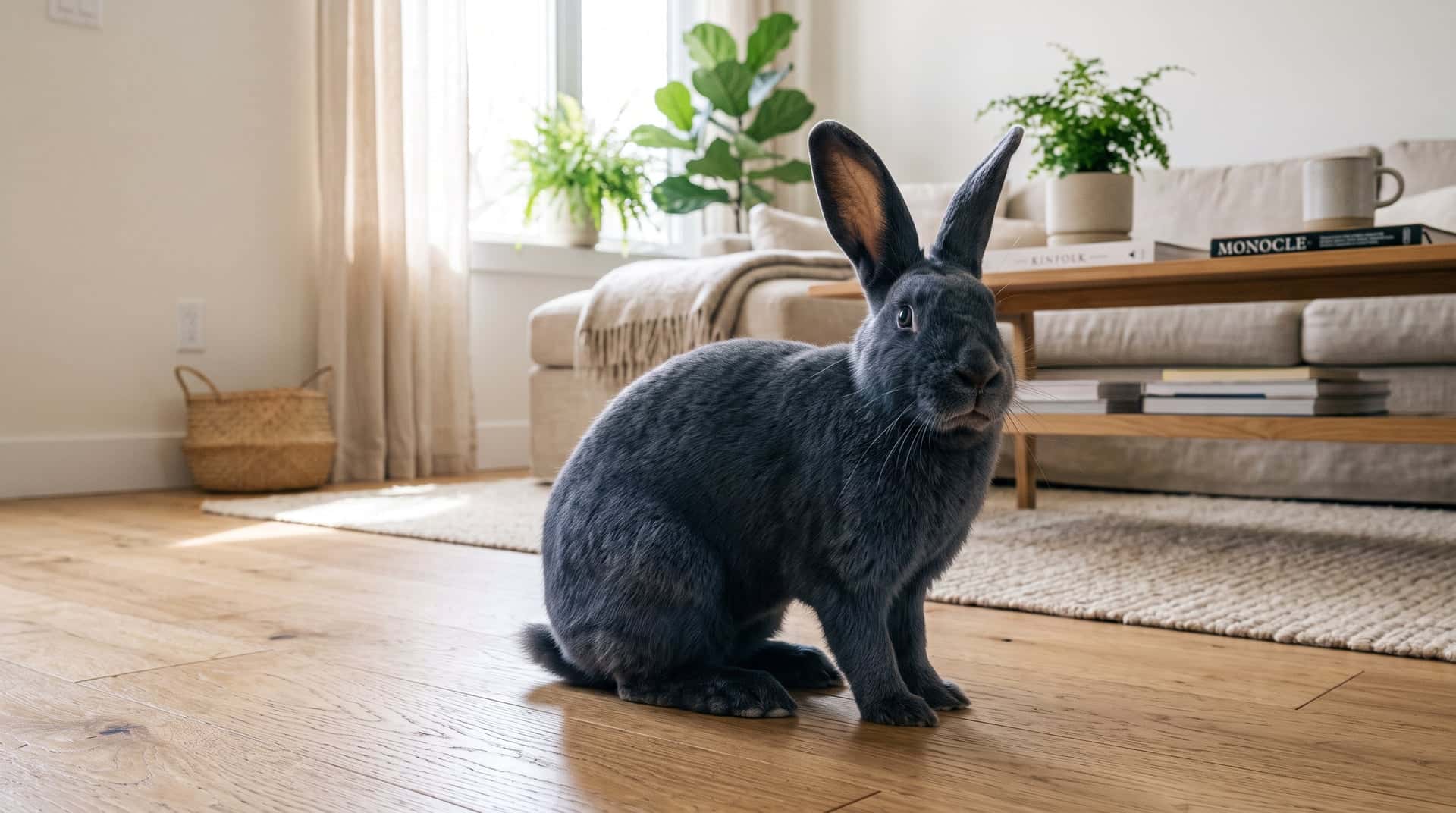
Browse American rabbits listed by owners and breeders near you, and learn how to confirm you are buying the real heritage breed.

American
American
American

American
American
American rabbits for sale fall into two very different groups: the rare heritage breed with pedigrees behind it, and everyday rabbits that picked up the name because it sounds generic. Both can be great pets. But they should not cost the same, and this page shows you how to tell them apart.
Heritage breed means an old farm breed that nearly disappeared and is now tracked by conservation groups. The Livestock Conservancy lists the American in its Watch category.[1] The listings above show what each seller typed in the breed box, which is a starting point rather than a verdict. Checking the breed is the buyer’s job, and the checks are below.
Americans at a glance
The quick version. Every number here is explained and sourced in the sections below.
Short answer
Pedigreed American rabbits from established breeders generally sell for $50 to $150. Recent marketplace listings without full pedigrees ran $30 to $60. Prices far above that band are not supported by the real market, no matter how rare the breed: rarity limits how many exist, not what one costs.
What the money actually buys
Rarity limits supply, not price. The Livestock Conservancy puts the American in its Watch category. That band means fewer than 200 registrations a year in the United States, fewer than 2,000 rabbits worldwide, and 31 to 60 breeders.[3] You feel that scarcity as travel and waiting, not as a four-figure price tag. A seller quoting far above $150 is charging for the word rare rather than for anything on the pedigree.
The pedigree should already be in the price. Heritage rabbitries hand the pedigree over with the rabbit, because the paper is what makes the animal a documented American. When a listing offers the pedigree as a paid add-on, the seller is charging you for the proof separately from the claim. Ask why, and read the answer carefully.
Adoption is the honest cheap route to a big calm rabbit. One Midwest rescue charges $100, a fee it says helps cover the spay or neuter, a surgery it prices at $250 to $500 at rabbit-experienced vets in its area.[4] Rescues are also where the name American most often lands on a mixed-breed rabbit, so adopting gets you a wonderful pet rather than a verified heritage animal. If that trade suits you, our American rabbit adoption page covers what to check on an adult.
The purchase price is the smallest number here. No cost survey exists for the American specifically, so use a rabbit of the same size class as the proxy. A 2026 cost guide for the New Zealand, another 9 to 12 pound breed, puts one-time setup at $500 to $650 and monthly running costs at $100 to $225.[5] Food scales with body weight, so a 12 pound rabbit eats roughly double what a 6 pound rabbit eats. Housing is the line item that costs the most to get right, and those numbers sit in the space section below.
Short answer
Check three things: color, size, and shape. Real American rabbits come in exactly two varieties, deep slate Blue and ruby-eyed White. Adults are big, 9 to 12 pounds, with a long body that rises in a curve peaking over the hips. Any other color, a small adult, or a round compact body means it is not this breed.
The name is the problem, and almost nobody means any harm by it. The encyclopedia entry for the breed says that rabbit keepers, and rescue organizations in particular, have been calling mixed breed or mutt rabbits American.[6] Most of them simply do not know the history of rabbit breeding in the US, and to most people the word describes where the rabbit lives. Meanwhile the actual breed’s conservation category implies somewhere between 31 and 60 breeders nationwide.[3] So a listing that says American is far more likely to mean a rabbit in America than a rabbit of this breed.
The confusion runs both ways. In September 2006 a herd of 38 rabbits advertised as New Zealand Whites came up for sale outside Edmonton, Alberta. A Hutterite community had kept the line since the 1920s. Two buyers looked at them and found they looked exactly like Americans, and the rabbits were later registered as the breed.[7] A whole line can spend decades under the wrong name. The lesson for a buyer runs the same way in both directions: the label is a claim, and the paperwork is the evidence.
Here is what that looks like on a live listing. Reading marketplace listings for this page, we found kits advertised under rare American Blue headlines. The fine print on one showed a grandparent from a different breed, and the pedigree was sold as a paid extra. We are not naming the seller, because that pattern is common and mostly careless rather than dishonest. It is still a crossbred rabbit at a rare-breed price.
What an American actually looks like
None of that works on a baby. An 8 to 12 week kit is still growing into its frame, and the arch over the hips is one of the last things to finish. Color helps, since a kit that is neither blue nor a ruby-eyed white is already out. Size and shape do not, because almost every large-breed kit looks similar at that age. So at sale age the pedigree does the work your eyes cannot.
Short answer
Three full generations, each ancestor listed with its ear number, variety, and weight. Weights should sit in the 9 to 12 pound band, and every ancestor should be an American. ARBA itself does not issue pedigrees; breeders keep them. For breeding stock, ask about ARBA registration, which adds a physical exam against the breed standard.
A pedigree is a record, not a certificate. The breeder writes it and the breeder stands behind it. The standard format runs three generations back, which means the rabbit, its parents, its grandparents and its great-grandparents. Every entry carries a name or ear number, the color, and the weight, and a pedigree listing fewer than three generations is incomplete.[9] The weight column is the one buyers skip and the one that tells you the most.
Registration is the stronger, separate step. ARBA keeps records on rabbits that have passed a registration examination, and licensed registrars carry out those exams against the breed standard.[10] A registrar is trained and licensed by the association to do exactly that. Rabbits are identified for life by a permanent tattoo inside the ear[11], so expect a registered rabbit’s paperwork and tattoo to match. Pet buyers rarely need this. If you plan to breed or show, ask for it.
Five checks, pedigree in hand
Six things worth a hard question
None of this makes an unpapered rabbit a bad rabbit. Plenty of the happiest house rabbits in the country have no documents at all. The paperwork only decides the price. It makes a rabbit a $30 to $60 pet rather than a $150 heritage animal, and knowing which one you are buying is the whole point.
Short answer
With this few breeders, distance is normal. The Livestock Conservancy’s category for the breed implies roughly 31 to 60 active breeders nationwide. Buyers routinely use specialized rabbit ground transporters, which run planned routes and charge about $75 to $120 per rabbit. Among heritage rabbitries, a non-refundable deposit of about half the price is the normal way to hold one.
Finding the breeders takes more than one search. Start with the listings on this page, then widen out. ARBA runs a Find a Breeder page, but the list represents only breeders who purchased a listing, so it undercounts badly.[14] The Livestock Conservancy keeps a breeders directory for heritage stock.[15] The breed club’s site publishes news, shows and sweepstakes results but no public breeder list, so club members surface through show results rather than a directory. Shows are where breeders and buyers actually meet.
Expect to wait, and expect gaps on the map. The club survey counted 183 Americans among 16 breeders in 2006, climbing to 446 among 37 breeders by 2009.[13] With numbers that small, one breeder retiring can leave a whole region without a litter for years. If nobody within driving distance has one, that is normal for this breed.
Getting the rabbit to you
Half up front is the normal shape of the deal. Among heritage rabbitries, a non-refundable deposit of about half the price holds the rabbit, and the balance is paid at handover. What should worry you is silence after the money moves. One rabbitry’s own long-distance buying story describes having to chase the breeder for a payment confirmation and the transporter’s phone number, and it names that silence as the warning sign.[17]
What a good long-distance seller does
The scam pattern is generic, not breed-specific. The Better Business Bureau logged 2,278 US pet scam reports in 2024, with a median reported loss of $680.[18] More than half started on a website the buyer found through a search engine or social media.[18] The shape is always the same: photos lifted from a real rabbitry, a deposit to hold the animal, then charges for crates, immunizations and transport that were never mentioned.[18] Run a reverse image search on every photo, and insist on that live video call. Stolen photos cannot talk back.
Short answer
More floor than furniture. US guidance keys space to the rabbit: a pen at least 3 to 4 times its stretched-out length, and an adult American stretches past 2 feet. The UK welfare standard asks for a 10 by 6.5 foot area available at all times. Standard shop hutches do not qualify.
Do the arithmetic before you buy, not after. The House Rabbit Society calls a 4 foot by 4 foot exercise pen with free roam time an ideal setup for most rabbits. Any cage should measure 3 to 4 times the stretched-out length of the animal, and the rabbit needs at least 4 hours of active play a day.[19] An adult American stretches past 2 feet, so that rule alone lands between 6 and 8 feet of run length. The UK welfare body sets its recommended minimum at 3m by 2m by 1m high, roughly 10 feet by 6 and a half.[20] A two-level hutch does not solve this, because the rabbit needs floor to run on rather than stairs to climb.
Food scales with the rabbit, and so does the grocery bill. Hay should be about 85% of an adult rabbit’s diet, and the House Rabbit Society suggests 1 to 2 cups of vegetables for every 4 pounds of body weight.[21] Run that for a 10 to 12 pound American and you get 2.5 to 6 cups of greens a day. That is a weekly grocery run, not a garnish. Pellets stay a small share of the diet[21], but the portion still rises with body weight. Water intake rises too, so offer a heavy bowl as well as a bottle.
Here is what you get for the space. The Livestock Conservancy describes a hardy breed, docile in nature, that produces large litters and makes a good mother.[1] ARBA calls the temperament calm and the breed an excellent project animal, which is why it turns up in 4H and FFA barns.[8] One breed profile reads the same way and puts the breed with older children rather than toddlers, since a startled rabbit may nip.[22] A 10 pound rabbit is a floor companion. Sit down, and it will come to you.
One more practical note for anyone weighing a kit against an adult. An adult arrives at full size with its temperament already visible. The day-one checks it needs, especially on the feet, are set out on our American rabbit adoption page.
Short answer
If you want a large, calm rabbit and do not care about papers, buy a New Zealand and save the search. If you want the biggest rabbit in the room, look at the Flemish Giant. If a deep blue coat is the draw, learn the difference between the American and the Beveren. If you want the heritage breed itself, that is the American.
The New Zealand is the honest, cheap answer. It sits in the same 9 to 12 pound class, it is everywhere, and a 2026 cost guide puts the purchase price at $20 to $100.[5] It is also the breed that displaced the American commercially, which is much of why this breed became rare in the first place. If your list reads big, calm and affordable, then New Zealand rabbits for sale is the shorter search and nobody will think less of you for it.
The Flemish Giant is bigger, and everything scales with it. Adults run 14 to 20 pounds and share the semi-arched build.[24] More rabbit means more hay, a larger pen, a larger carrier and a heavier animal to lift safely. Buy one because you want that scale, not because bigger sounds better in a listing.
If a blue rabbit is what caught your eye, learn the Beveren. It is the American’s closest lookalike, the other blue breed with a pronounced mandolin shape, and The Livestock Conservancy lists it as Watch too.[23] The tell is the shade. The Beveren blue is a light lavender[23], while the American blue is a deep, uniform slate, the deepest blue among breeds recognized in America.[1] If a seller cannot tell you which of the two you are looking at, the rabbit is probably neither.
And if this is a first rabbit for a family with young children, buy smaller. A 10 pound rabbit is a lot of animal for small hands, however calm it is. Our Holland Lop prices and seller checks page covers the breed most often recommended as a household’s first rabbit, and the rabbits for sale hub lists every breed we carry.
Which leaves the case for the American itself. You want a large, docile rabbit with a documented history, and you want the paperwork that proves it. You also accept that the right one may be several states away. That rabbit costs $50 to $150 from a real breeder[2], plus travel, and it is worth exactly that. Buying one also supports a breed that came back from 183 known rabbits.[13]
Happy with a big, gentle rabbit whose breed nobody can prove? An adult comes at full size with its personality already on show, and the current owner can tell you exactly how it behaves.
American rabbit adoptionFact-checked against The Livestock Conservancy, the American Rabbit Breeders Association, the Breeders of the American Rabbit National Specialty Club, the House Rabbit Society, the Rabbit Welfare Association and Fund, and the Better Business Bureau. Prices are what sellers advertise and they move with the market.
The questions worth answering before you send a deposit
Pedigreed American rabbits from established breeders generally sell for $50 to $150. Listings without full pedigrees ran $30 to $60 across the marketplaces we read in August 2026. Prices well above $150 only make sense when ARBA registration or a real show record comes with the rabbit.
The breed was a leading commercial rabbit into the 1940s, then the meat and fur trade moved to other breeds and numbers collapsed. A 2006 club survey counted 183 Americans among 16 breeders. Numbers have climbed since, and The Livestock Conservancy now lists the breed as Watch, a band it defines as 31 to 60 breeders nationwide.
Check color, size and shape. Americans come in deep slate Blue or ruby-eyed White only, adults weigh 9 to 12 pounds, and the back rises in a curve that peaks over the hips. A young kit cannot be judged on body shape yet, so at sale age the three-generation pedigree is your proof.
Two, and only two: Blue and White. The Blue is a deep slate, described by The Livestock Conservancy as the deepest blue of any breed recognized in America. The White is a ruby-eyed albino. A black, broken or chocolate rabbit sold as a rare American is not this breed.
Yes, in the right household. Sources describe the breed as hardy, docile, calm and laid-back, and ARBA calls the temperament excellent for a project animal. They are big, so they suit older children better than toddlers, and they are happier as floor companions than as lap pets.
Senior bucks weigh 9 to 11 pounds and does weigh 10 to 12 pounds, so the females are the larger sex. An adult stretches out past two feet. That length is what makes the housing math different from a dwarf breed.
Commonly cited at 8 to 12 years. No primary study covers this breed and published figures disagree, so treat it as a planning range rather than a promise. Neutering, indoor housing and a hay-first diet are what push any rabbit toward the top of a range.
A pedigree is the breeder’s own record of three generations, with each ancestor’s ear number, variety and weight. Registration is a separate step: a licensed ARBA registrar examines the rabbit against the breed standard, and a registered rabbit’s paperwork should match the permanent tattoo in its ear. Pet buyers need the pedigree. Breeding buyers should ask about both.
Eight weeks at the earliest, and many rabbitries hold kits to 10 weeks. Kits build their gut bacteria from their mother, and taken too early they can develop a gut infection they often do not survive. Some states set eight weeks in law, North Carolina among them. A seller offering a younger kit is not doing you a favor.
Specialized rabbit ground transporters run mapped routes and charge a flat $75 to $120 per rabbit, and a transporter can be on the road for two weeks at a time. General pet transport is priced per mile, around 65 cents. Air cargo works too, but it runs roughly $600 all in, plus a health certificate that is normally under $50.
Usually it is mislabeling rather than fraud. The word American gets attached to plenty of ordinary rabbits by people who mean no harm at all. Without a three-generation pedigree, treat the rabbit as a nice mixed breed and pay a mixed-breed price. Ask to see the pedigree before you send any money.
Adopt if you want a large, calm rabbit whose adult temperament is already visible. Rescue fees often land around $100 and usually include the spay or neuter, a surgery one Midwest rescue prices at $250 to $500 at local rabbit vets. Buy from a breeder if you specifically want the heritage breed with paperwork behind it.
Discover rabbits for sale from various breeds and find your perfect companion
49+ rabbits are listed as American on Petmeetly. Join free, ask each owner for the pedigree, and message them directly.
Get started on PetmeetlyNo card required to sign up.