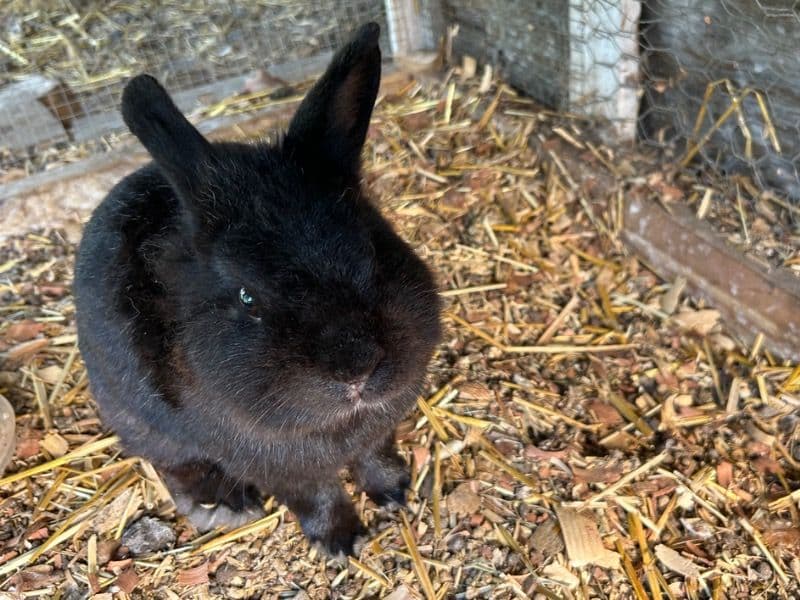
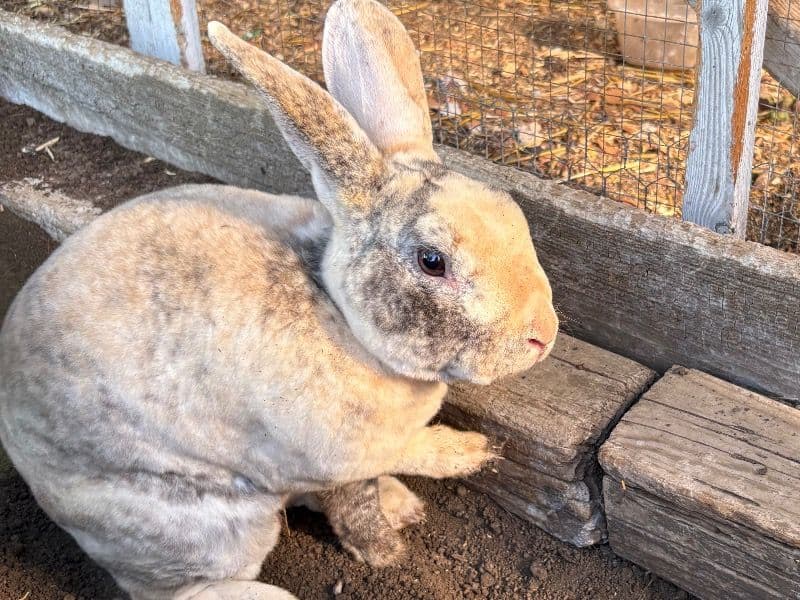
American rabbit adoption usually means one thing in practice: a large, calm adult rabbit whose owner’s circumstances changed. Whether it carries heritage-breed papers or just the name, a big settled rabbit is one of the easiest companions to size up honestly before you say yes. Here is how.
Why adopt an adult American rabbit?
Short answer
Because everything you need to know is already visible. An adult American’s 9 to 12 pound frame is fully grown, so the space you set up on day one is the space it needs for life. The calm, docile temperament this breed is known for is already there to meet, not promised.
The Los Angeles Rabbit Foundation, a House Rabbit Society chapter, makes the case in one sentence. Adult rabbits are what they seem to be, and they do not deceive you into thinking they will stay one way and then turn into someone else later.[1] That is the whole argument for adopting an adult, and it lands harder with a big breed.
A baby rabbit’s cuddly stage lasts two or three weeks. Then comes the adolescent stretch the same chapter calls the monster stage. Litter habits collapse, territory marking starts, and the teeth find every cord in the room. A friendly baby can turn skittish or bossy.[1] An adult has already crossed that bridge, and the average adult, neutered domestic rabbit has excellent house habits.[1]
Size is the second thing an adult settles. Enclosure guidance keys off the rabbit’s stretched-out length rather than its age, so with a grown rabbit you measure once and buy the pen once.[3] Guessing is affordable with a dwarf. With a rabbit that finishes somewhere between 9 and 12 pounds, guessing wrong means buying the whole setup twice.
Temperament is the third. The Livestock Conservancy describes Americans as a hardy breed, docile in nature, and its breed card lists the temperament as docile and gentle with an experience level of novice.[2] With an adult in front of you, none of that has to be taken on trust. Watch how the rabbit reacts to a hand near the pen, to a stroke on the top of the head, to a room with people moving through it.
Docile is not the same as a soft toy. A 10 pound rabbit startles like any other rabbit, and its own kick is powerful enough to injure it. Adults do the handling in a home like this, and the floor is where the friendship happens.
Rehoming usually says more about the household than about the rabbit. Almost every Petmeetly adoption is one owner handing a rabbit to the next. People move somewhere smaller, take a job that swallows the daily run time, have a baby, or develop an allergy. The House Rabbit Society names allergies among the top reasons rabbits get rehomed. It also notes that most people who react are reacting to the timothy hay.[3] None of that says anything bad about the animal you are about to meet.
How much space does a 10 to 12 pound rabbit need?
Short answer
Plan around its stretched-out length, which for an American is over 2 feet. US guidance calls for a pen at least 3 to 4 times that length with 4 or more hours of exercise time daily. The UK welfare standard asks for a 10 by 6.5 foot area available at all times. A shop hutch is not housing.
The House Rabbit Society writes its current housing guidance as ratios rather than one box size, which is exactly what a large rabbit needs. The sleeping and leisure area should be four times the size of the rabbit. Any cage should be three to four times its stretched-out length. On top of that the rabbit needs four or more hours of active play every day.[3] A 4 foot by 4 foot exercise pen, meaning the folding wire kind sold as an x-pen, plus free-roam time is the setup it calls ideal for most rabbits.[3]
Now run those ratios for an American. Stretched out on its side, a rabbit in the 9 to 12 pound class measures comfortably over 2 feet. The three-to-four-times rule therefore puts the resting pen between 6 and 8 feet long. Measure the actual rabbit while it lies flat, then bring that number to the conversation with its owner.
The UK standard skips the arithmetic and sets a floor instead. The Rabbit Welfare Association and Fund puts the recommended minimum at 3 metres by 2 metres by 1 metre high, roughly 10 by 6.5 feet.[4] The point of that campaign is that the space stays available at all times, not for one hour in a run. The same page lists what small hutches do: spines deformed by never standing upright, obesity from having nowhere to move, and nails that overgrow because the rabbit never digs.[4]
Space math for a 9 to 12 pound rabbit
Resting pen
Three to four times the rabbit’s stretched-out length, so roughly 6 to 8 feet for an American[3]
Ideal setup
A 4 by 4 foot exercise pen with access to free-roam time[3]
Exercise
Four or more hours of running, jumping and digging every day[3]
UK minimum
3m by 2m by 1m high, about 10 by 6.5 feet, available at all times[4]
Flooring
A blanket or other cushioned surface, never bare wire[3]
Height
Enough headroom to sit up on the hind legs without ducking[4]
Not housing
A shop hutch on its own.[4] Upper levels are no substitute for floor to run on
A big rabbit is more of everything else, too. Oxbow’s guide to large breeds is blunt about the budget. Expect much more hay, far more fresh produce and more pellets than a small rabbit would ever eat.[6] The House Rabbit Society diet guide turns that into numbers you can shop for. Hay is 85% of an adult rabbit’s diet and is offered unlimited, and greens work out at 1 to 2 cups for every 4 pounds of body weight.[5] For a 10 to 12 pound American, that is roughly 2.5 to 6 cups of greens a day.
Containment scales too. Oxbow warns that a standard baby gate or light playpen will not hold a rabbit with back legs this strong.[6] Plan on a taller pen, a secured room, or free roam.
Heat is the seasonal risk that scales with size. House Rabbit Network puts rabbits at risk of heat stress once the heat index, meaning the temperature it feels like once humidity is counted, passes 90 degrees Fahrenheit. High humidity can push that index into dangerous territory when the air itself reads 80 degrees or cooler.[9] Oxbow adds that giant breeds are more susceptible to heat stress than smaller ones, partly because thicker coats hold heat.[6] Rabbits shed heat through their ears, so misting the ears with cool water helps on the worst days. A rabbit in real distress needs tepid water and a vet, never ice-cold water.[9]
This breed’s ancestors were farm hutch rabbits, and an adopted American may still be coming from a hutch. Welfare groups are clear about where it should end up: the House Rabbit Society looks for indoor homes so that rabbits have lives that are safe and social.[10] Make the move gradual, keep the first indoor spot quiet and away from radiators, and let the rabbit choose when to explore. Our guide to adopting a rabbit covers the settling-in week for any breed.
If those numbers are already more floor than your home has, that is better to know now. A smaller rabbit is not a lesser one, and Netherland Dwarfs are rehomed for the same everyday reasons.
What are sore hocks, and why check a big rabbit’s feet first?
Short answer
Sore hocks (pododermatitis) are pressure sores on the weight-bearing undersides of a rabbit’s hind feet, and heavier rabbits press harder. Ask to see the feet on day one. A pale furred callus is normal to monitor, red raw skin needs a vet soon, and an open or oozing sore is urgent. Then ask what flooring the rabbit lived on.
Rabbits do not have paw pads. PetMD’s write-up by Melissa Witherell, DVM, describes their entire cushioning system as thick fur over thin skin.[8] The hocks are the ankle joints a rabbit rests on. Wear that fur away and the skin underneath takes the pressure directly. Left alone, pressure and friction progress to ulcers, infection and tissue death.[8]
Weight is what turns a general rabbit problem into a large-breed one. House Rabbit Network states it plainly: larger breeds inherently carry more weight on their hocks, and that promotes the development of sores.[7] PetMD lists large and giant breeds as a standing risk factor alongside wire or hardwood floors, obesity, a small cage or too little exercise, damp bedding and overgrown nails.[8]
The day-one foot check, stage by stage
A pale pink callus under a fold of fur
Monitor
House Rabbit Network describes pale pink calluses as common on the bottoms of rabbits’ paws, and says rabbits live comfortably with them.[7] Note where it is, then check the same spot monthly.
Fur loss and red skin on the undersides
Vet soon
This is early pododermatitis, and PetMD lists fur loss plus redness on the feet and hocks as the first signs.[8] Book the appointment and fix the flooring in the same week.
An open, weeping or crusted sore
Urgent
Oozing ulcers leave the rabbit open to infection, and the condition is painful and often irreversible by this stage.[7] Call the vet this week rather than watching it for another one.
Feet you cannot inspect yet
Watch behavior
A rabbit in pain eats less, grinds its teeth, passes fewer droppings, sits hunched with its eyes tightly closed, and holds its ears back.[8] Any of those in a new arrival earns a look at the feet.
Prevention is the new home’s job, and it is cheap. PetMD names five: soft flooring, a clean enclosure, a healthy body weight, daily exercise of up to four hours, and room at least four times the rabbit’s size. An attached exercise area of around 24 square feet is the ideal it describes.[8] House Rabbit Network adds the detail people forget. Trim the nails regularly, because long nails tip the rabbit’s weight back onto the rear of the paw.[7] If any part of the pen is wire, cover it with fleece or faux sheepskin so the pressure spreads.[7]
The condition is often progressive and cannot always be reversed, which is why this check belongs on day one rather than at the first limp.[8] Ask three things while you look: what has this rabbit been standing on, when were the nails last trimmed, and has a vet ever mentioned its feet? Wire floors and damp bedding are the answers to slow down for.[7]
None of this is a reason to walk away. A callus on a rabbit that has lived on a blanket is a monitoring job. A raw hock on a rabbit that has lived on wire means a vet visit and a new floor, and you can fix both in the first fortnight.
What should the current owner hand over?
Short answer
Ask for the vet record with spay or neuter proof, any RHDV2 vaccination records, and the exact pen dimensions and flooring the rabbit lived on. Then ask for its daily hay, pellet, and vegetable amounts, the nail-trim routine, and an honest note on its personality and quirks. Good rehomers have most of this ready.
The New Mexico House Rabbit Society tells owners preparing a rabbit for rehoming exactly what to gather. The list runs: the vet record showing proof of spay or neuter, records of any RHDV2 vaccination, a written note on personality, age and quirks, and plenty of photos.[10] Turn that list around and it becomes your ask list. RHDV2 is a fast-fatal rabbit virus with a vaccine the House Rabbit Society strongly recommends, so the dates matter.[11]
The handover, in one message
1The vet record. Clinic name, spay or neuter proof with the date, and anything treated since.[10]
2RHDV2 vaccination records. Whether the rabbit has had the vaccine at all, and the date of the last booster.[11]
3The honest personality note. What frightens this rabbit, what it likes, who it currently lives with, and the quirks a stranger would not guess.[10]
4Diet specifics. Hay type, pellet brand, the daily amounts, and which greens agree with it. Ask for a bag of both to travel with the rabbit.
5Litter habits and the current setup. Which box, which litter, and how reliable the rabbit actually is.
6Bonded partner status. If this rabbit is half of a bonded pair, meaning two rabbits who live as a couple, take both or keep looking.
The extras a large rabbit needs you to ask
Pen dimensions in feet, so you can match or beat them
Flooring type, and whether any of it is bare wire
Nail-trim cadence, and whether the rabbit tolerates it
Any history of calluses or sore hocks on the hind feet
Current weight, and when it was last weighed on a scale
How the rabbit prefers to be handled, since many big rabbits dislike being carried
An already-neutered adult is a real head start. The New Mexico chapter tells rehoming owners to spay or neuter before they advertise. The surgery makes a rabbit calmer, easier to litter train and more likely to settle as an indoor companion.[10] For you that is a vet bill already paid and house habits already formed. It matters medically too. PetMD notes that unspayed females carry a high risk of uterine cancer and often live shorter lives, and that spaying can significantly extend life expectancy.[14] If the rabbit is not fixed, ask your own vet for a price before you agree on a fee.
The fee is worth settling early. A modest one is normal, and it protects the rabbit. The same chapter tells owners to ask at least $50, because a free rabbit attracts people looking for a free meal for a pet reptile.[10] Organized rescues charge more, since their fee usually covers a spay or neuter and a vet check already done. Ask what is included. Owner to owner, the pen, the litter box and the carrier often come along, and for a rabbit this size that pen is worth real money.
Then agree how the rabbit gets moved. The House Rabbit Society handling guide, written by Holly O’Meara, is built for exactly this moment. Kneel, slide one hand under the chest, support the hindquarters with your other arm, and hold the rabbit against your body.[12] Rabbits struggle most when they feel suspended in the air, and a rabbit skeleton is light for the body it carries.[12] If the rabbit does start to fight, hug it in and use your body as a splint rather than letting go.[12] With a 10 pound rabbit the household policy is simple: carry rarely, sit on the floor often.
Is an adopted “American rabbit” really the heritage breed?
Short answer
Usually not, and for a pet home it truly does not matter. Rescue groups often label big mixed-breed rabbits “American”, while the real heritage breed, with only a few dozen breeders nationwide, rarely appears in rehoming. You are adopting this rabbit: its size, temperament, and health history are what count, and all three are checkable.
The collision is documented. Wikipedia’s article on the breed records that rabbit keepers, and rescue organizations in particular, have taken to calling mixed-breed rabbits American. Those keepers are unfamiliar with the history of rabbit breeding in the US, and the habit has confused the real breed’s status.[13] Read that kindly. A volunteer looking at a big blue rabbit reaches for the name that fits, and nobody is being misled on purpose.
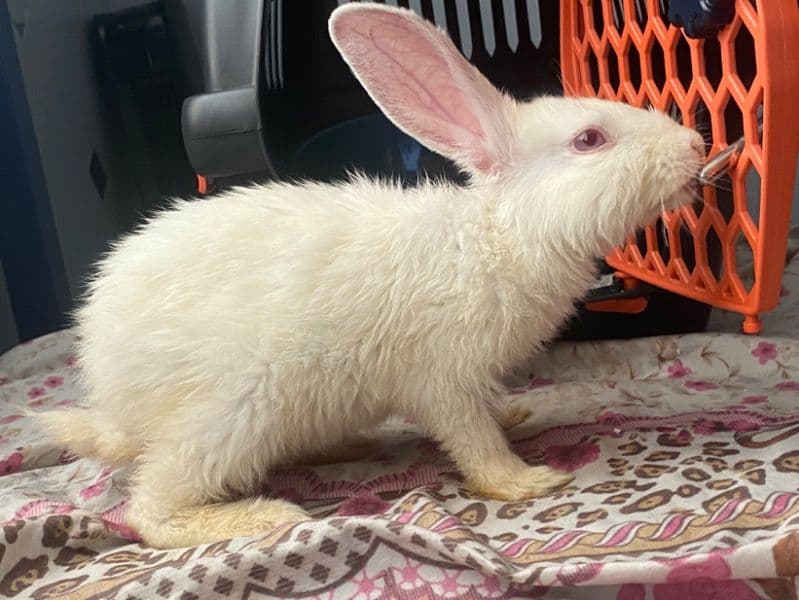
The heritage breed itself is narrow. The Livestock Conservancy recognizes two varieties only, Blue and White, with bucks at 9 to 11 pounds and does at 10 to 12.[2] It calls for the mandolin body shape written into the ARBA standard, a long body whose highest point rises over the hips.[2] American Whites have pink eyes, and the breed sits at Watch status on the Conservancy’s Conservation Priority List.[2] Without a three-generation pedigree from a breeder, nobody can promise you the breed, and pedigrees rarely travel with a rehomed rabbit.
None of that changes what is sitting in front of you. Papers matter to show breeders and to the conservation programs rebuilding a rare breed’s numbers. They do not change how a rabbit behaves in your living room. A calm 10 pound adult with a known diet, a known enclosure and a vet record is the better prize for a pet home. Every item on that list is checkable in a conversation.
Set on the pedigreed breed? Our guide to American rabbits for sale covers what a real pedigree shows, what breeders charge, and how to check a Blue or White before you pay a deposit. If the size is the draw rather than the name, New Zealand rabbits sit in the same weight class and appear in rehoming listings far more often.
One question is left before you commit: how many years? No published lifespan figure exists for this breed on its own, and the numbers that circulate contradict each other. PetMD puts the average pet rabbit at seven to ten years and spayed or neutered rabbits at eight to twelve; its one breed-specific caution is that Flemish Giants may live five to eight.[14] So an adopted three-year-old is likely a commitment of five years or more. Ask about this rabbit’s vet history instead of trusting a breed average.
Bringing a big rabbit home
Set the full-size pen up before the rabbit arrives. This is the adult advantage at its most practical. There is no upgrade to plan and no second purchase coming, because the rabbit you collect is the size it will always be.[3] Put cushioned flooring down from the first hour, since that is also the cheapest foot insurance there is.[7]
Keep the diet exactly as it was for the first couple of weeks. A sudden change of hay or pellets on top of moving stress is how a rabbit stops eating. A rabbit that stops eating is heading for gut stasis, meaning the digestive system slowing down or stopping. Ask for a bag of the current hay and pellets to travel with the rabbit. Our rabbit adoption guide walks through the rest of the settling-in week.
Meet the rabbit at floor level for the first fortnight. Sit down, put a few greens near your foot, and let it come to you.[12] Book a checkup with a rabbit-savvy vet, meaning one who treats rabbits regularly, in the first few weeks. Take the handed-over records along, and ask for the feet and the teeth to be part of the exam.
If the rabbit is half of a bonded pair, take both. Bonded rabbits groom each other and sleep pressed together, and splitting them leaves you with two unsettled rabbits instead of one settled pair.
Spare a thought for the person on the other side. Most people rehoming a rabbit loved it and ran out of room, time or luck. They are not offloading a problem, and the questions on this page are not an interrogation. Take the notes, take the pen and the half bag of pellets, and send a photo a week later. A good handover is the best adoption insurance there is.
The American rabbits listed at the top of this page are living with their current owners right now. On Petmeetly you talk to that person directly, ask everything above, and decide together whether your home is the right next one. If a smaller rabbit suits your space better, Holland Lops are rehomed for the same everyday reasons.
Yes, in a home with floor space. The Livestock Conservancy describes the breed as hardy and docile in nature, lists its temperament as docile and gentle, and rates it suitable for novices. Bucks weigh 9 to 11 pounds and does weigh 10 to 12. That is a large companion, and it would rather meet you on the rug than be carried around the house.
02
Why adopt an adult rabbit instead of a baby?
Because an adult is finished. The Los Angeles Rabbit Foundation puts it well: adult rabbits are what they seem to be. Babies pass through an adolescent stretch of territory marking, chewing and collapsed litter habits, while the average adult neutered rabbit has excellent house habits. With a large breed you also get the finished size, so the pen you buy on day one is the pen the rabbit needs for life.
03
How big do American rabbits get?
Mature bucks weigh 9 to 11 pounds and does weigh 10 to 12, according to The Livestock Conservancy, which makes the does the larger sex. That is a large rabbit rather than a giant one. Stretched out on its side it measures more than 2 feet, and that stretched length, not the weight, is the number that sets the pen size.
04
How much space does a large rabbit need?
The House Rabbit Society asks for a resting cage 3 to 4 times the rabbit’s stretched-out length, plus 4 or more hours of exercise every day. It calls a 4 by 4 foot exercise pen with free-roam time the ideal setup for most rabbits. The UK standard from the Rabbit Welfare Association and Fund is a 3m by 2m by 1m area, roughly 10 by 6.5 feet, available at all times. A shop hutch on its own is never enough.
05
What are sore hocks in rabbits?
Sore hocks, or pododermatitis, are pressure sores on the weight-bearing undersides of a rabbit’s hind feet. Rabbits have thick fur over thin skin there instead of paw pads, so hard floors and extra weight wear the fur away. House Rabbit Network notes that larger breeds carry more weight on their hocks. A pale furred callus is worth monitoring, red raw skin needs a vet, and an open sore is urgent.
06
What should I ask the current owner before adopting a rabbit?
Ask for the vet record with spay or neuter proof, any RHDV2 vaccination records, and the exact pen dimensions and flooring the rabbit lived on. Then ask for the daily hay, pellet and vegetable amounts, the nail-trim routine, the litter habits, and an honest note on personality. Ask whether the rabbit is half of a bonded pair, because bonded rabbits should move together. Owners who prepared properly have most of this ready.
07
How long do American rabbits live?
No published lifespan figure exists for this breed on its own, and the numbers circulating online contradict each other. PetMD puts the average pet rabbit at seven to ten years and spayed or neutered rabbits at eight to twelve. Treat an adopted adult as a commitment of several more years, and ask the current owner about vet history rather than trusting a breed average.
08
Is my adopted American rabbit the rare heritage breed?
Usually not. Wikipedia’s breed article records that rabbit keepers, and rescue groups in particular, have taken to calling mixed-breed rabbits American. Those keepers are unfamiliar with US rabbit breeding history, and the habit has blurred the real breed’s status. A heritage American is Blue or ruby-eyed White only, weighs 9 to 12 pounds, carries a long mandolin body shape and comes with a pedigree. For a pet home, the label changes nothing that matters.
09
How do I pick up a heavy rabbit safely?
Kneel first. The House Rabbit Society handling guide says to slide one hand under the chest and support the hindquarters with your other arm. Hold the rabbit against you so it is never left dangling in the air. If it struggles, hug it in and use your body as a splint rather than letting go, because a rabbit skeleton is light for the body it carries. With a 10 pound rabbit, carry rarely and sit on the floor often.
10
Do rabbits cope with hot weather?
Not well, and big rabbits cope worst. House Rabbit Network puts rabbits at risk of heat stress once the heat index passes 90 degrees Fahrenheit, and warns that high humidity can make 80 degrees dangerous. Oxbow notes that giant breeds are more susceptible than smaller ones, partly because thicker coats hold heat. Keep the rabbit indoors and out of direct sun, and mist the ears with cool water on the worst days.
11
Should an adopted rabbit already be spayed or neutered?
Ideally yes. The New Mexico House Rabbit Society tells owners to spay or neuter before they advertise a rabbit, because the surgery makes a rabbit calmer and easier to litter train. For you that is a vet bill already paid. It matters medically too: PetMD notes that unspayed females carry a high risk of uterine cancer, and that spaying can significantly extend life expectancy. If the rabbit is not fixed, price the surgery locally before you agree on a fee.
12
What does a rabbit adoption fee cover?
It varies, so ask. The New Mexico House Rabbit Society advises rehoming owners to ask at least $50, because a free rabbit attracts people looking for a free meal for a pet reptile. Organized rescues charge more, since their fee usually covers a spay or neuter and a vet check already done. Owner to owner, the fee often brings the pen, the litter box, the carrier and the current food along with the rabbit.