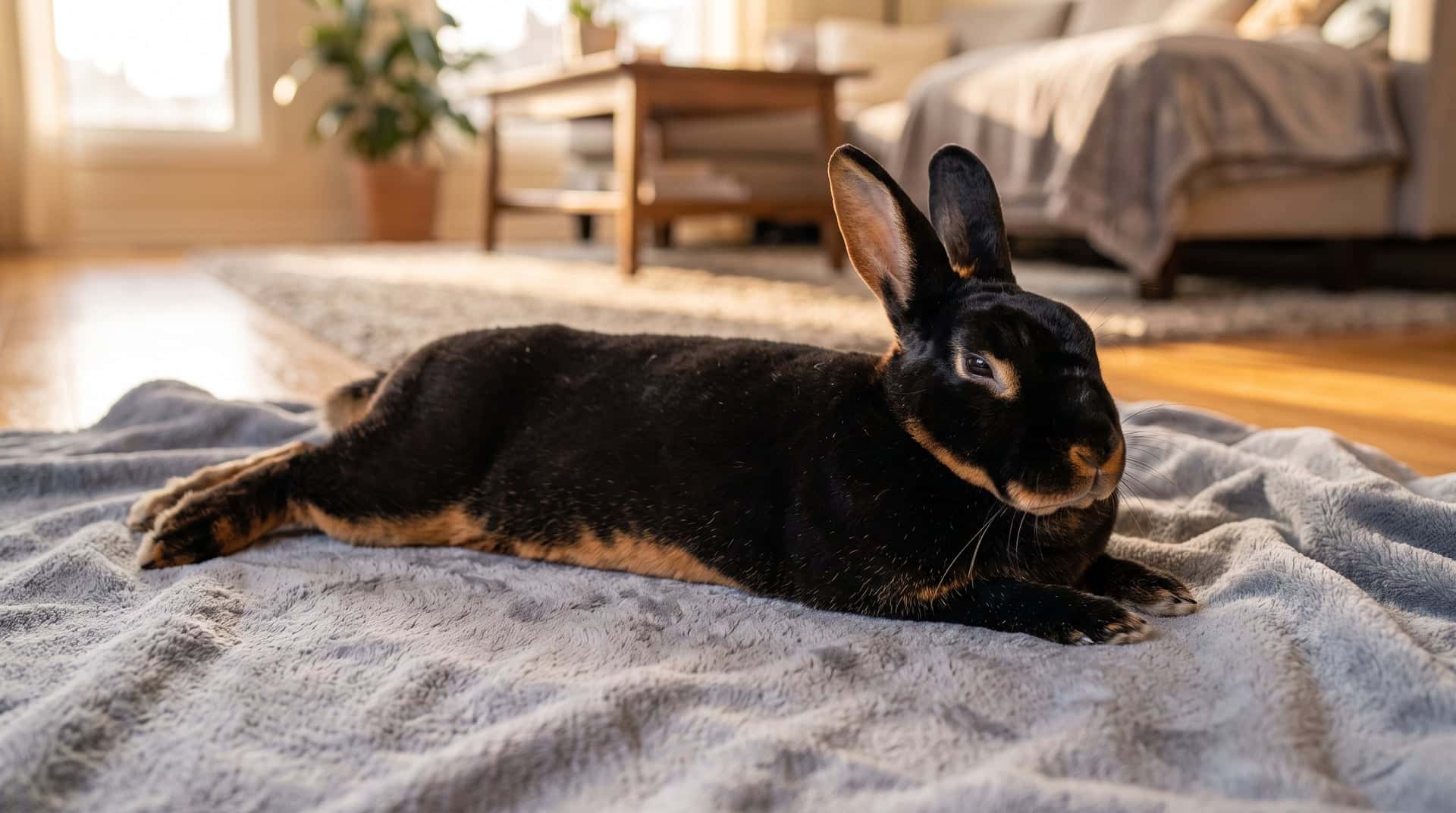
Meet adult Mini Rex rabbits being rehomed by their owners near you, with their real personalities already on display.
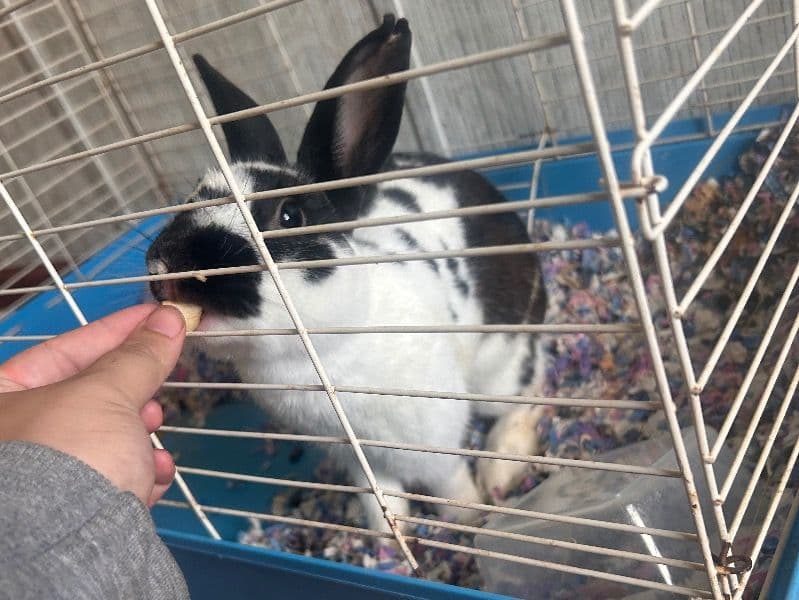
Mini Rex mix
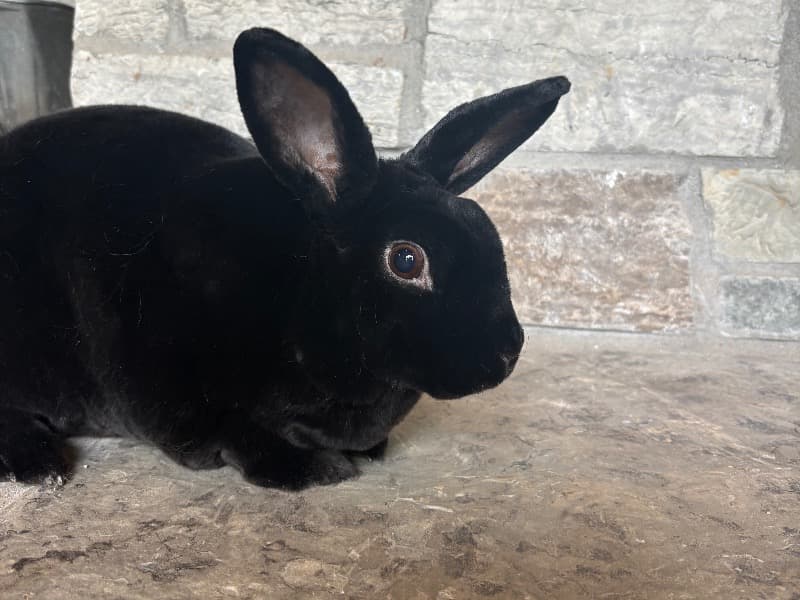
Mini Rex
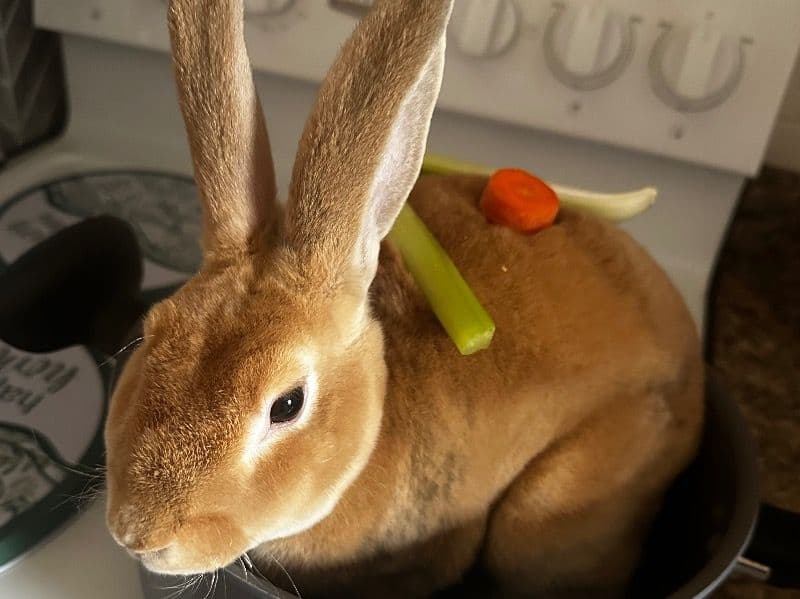
Mini Rex
Mini Rex adoption has a quiet advantage over buying: everything that matters about this breed, the velvet coat, the adult size, the temperament, is finished and visible on a grown rabbit. The owners above are rehoming theirs directly. Here is how to meet one well and what to check on day one.
Short answer
An adult Mini Rex shows you exactly what you are getting: the velvet coat is finished, the size is final at four pounds and change, and the personality is already visible. As one rabbit adoption group puts it, adult rabbits are what they seem to be. A kit promises those things; an adult proves them.
Start with the coat, because it is why people want this breed and the one thing a young rabbit cannot show you. A Mini Rex is born in a wiry, uneven baby coat. The first major molt, meaning the shed in which a rabbit swaps one coat for another, starts around 12 weeks and finishes between 18 and 24 weeks. Breeders call it the junior prime, and it is the first point at which anyone can judge fur quality honestly. The adult coat then keeps gaining density until it settles at roughly 9 to 12 months.[1] A kit goes home at eight weeks, before any of that has happened. On a grown rabbit, the coat you stroke at the meeting is the coat you keep.
The Los Angeles Rabbit Foundation makes the general case in one line. Adult rabbits are what they seem to be, and they do not deceive you into thinking they will stay one way and then turn into someone else later on.[2] Size behaves the same way. A fully grown Mini Rex weighs 3 to 4.5 pounds, and the rabbit in front of you is already there.[3] There is a timing argument too. House Rabbit Society reports that the majority of rabbits surrendered to shelters are between six and twelve months old, the stretch when chewing, spraying and mood swings all arrive together.[4] An adult has finished that phase, and its owner can tell you how it came out.
Why are adult Mini Rex available at all? Because there are so many of them. The breed is one of the most popular pet rabbits in the United States.[3] Then ordinary life happens. Someone moves somewhere that bars pets, an allergy shows up late, a child loses interest, a job swallows the evenings. Nobody publishes surrender figures by rabbit breed, and we are not going to invent any. The listings at the top of this page are simply where those rabbits meet their next owner directly.
Temperament is the last unknown, and an adult answers that one too. PetMD has no Mini Rex page. Its vet-reviewed profile for the standard Rex, this breed’s larger relative with the same coat, calls rex rabbits friendly and patient. It says they suit homes with children as long as kids are supervised.[5] Dae Williams, president of the National Mini Rex Rabbit Club, says the breed has a very even temperament. Few pets, he adds, enjoy a gentle rubbing of the forehead more than a Mini Rex.[6] Treat both as the breed’s reputation, then check it against the actual rabbit. Adoption is what lets you do that.
Short answer
Flip-check the feet. Rex-coated rabbits grow thinner fur on their footpads, so they are more prone than other rabbits to pressure sores on the hocks, the rabbit’s ankles. Pale pink calluses under a fold of fur are normal; fur loss, red skin, scabs, or a rabbit rocking its weight forward means a vet visit first.
Rabbits have no paw pads. PetMD’s write-up by Melissa Witherell, DVM, describes the whole cushioning system as thick fur over thin skin. It defines pododermatitis, the clinical name for sore hocks, as inflammation of the feet caused by pressure, friction or moisture damaging that skin.[7] The same page names two groups of rabbits at raised risk, and separates them by cause. Short-coated rex breeds are listed because the fur is thin. Large giant breeds are listed for the pressure and weight on their feet.[7] A four-pound Mini Rex belongs to the first group. The risk comes from its coat, not from what it weighs.
That velvet coat comes with a trade-off. The mutation that shortens the guard hairs, meaning the long coarse hairs that normally sit above the undercoat, shortens the fur on the soles too. CottonTails Rescue states it directly: rex rabbits have less fur on their feet than breeds with normal fur, which can result in sores.[8] House Rabbit Network agrees, calling rexes naturally more vulnerable because the fur pads protecting the paw bottoms are thinner.[9] Keep this in proportion, though. It runs in lines rather than across the whole breed, and plenty of Mini Rex go a full life without a single foot problem.
Reading the sole of a Mini Rex
Watch the rabbit settle in its own pen for a minute before anyone picks it up. A rabbit shows that sitting posture while it is quiet and doing nothing in particular. That is the moment most visitors stop paying attention.
The rest of the once-over
One thing looks wrong and is not. Rex rabbits do not grow normal whiskers. They carry short curly ones, and some have none at all.[8] That is the same mutation that gives the coat its velvet feel. It shows from birth, and it says nothing about how the rabbit has been kept.
Short answer
Ask what flooring the rabbit lived on, whether it has ever had sore hocks, when its nails were last trimmed, which vet has seen it, what it eats, and how it uses its litter box. Peer-to-peer adoption’s advantage is the person handing you the rabbit has lived with the honest answers for years.
Six questions, and why each one earns its place
Expect a fee, and take it as a good sign. House Rabbit Society tells owners rehoming a rabbit to ask for a modest adoption fee. It confirms the new home is serious, and it filters out anyone hunting for free feeder animals.[10] Nobody makes money at that level. There is no published fee data for this breed, so treat the number as the owner’s own and ask what comes with it.
Then ask for three things to travel with the rabbit: a bag of its current food, some of the litter it already uses, and one item that smells of home. The rest of the first week, from pen setup to the settling-in routine, sits on the rabbit adoption guide.
Short answer
Like any rabbit, with two breed twists. Feed unlimited hay, about one to two cups of vegetables and a quarter cup of pellets a day at its size, and give it soft flooring, never bare wire. The twist is grooming: brushing can damage a rex coat, so groom with a slightly damp hand instead, mainly during molts.
The portions are unusually easy to get right at this size. House Rabbit Society sets vegetables at 1 to 2 cups for every 4 pounds of body weight, and puts hay at 85 percent of an adult diet, offered unlimited.[11] A Mini Rex weighs about 4 pounds, so the rule is the ration. PetMD puts pellets at about a quarter cup per 4 to 5 pounds of body weight per day.[5] Grass hay covers the rest, and the pile should never run out.
Food and floor, run for a four-pound rabbit
Space does not shrink with the rabbit. The Rabbit Welfare Association and Fund puts the recommended minimum living area at 3 metres by 2 metres by 1 metre high, roughly 10 feet by 6.5 feet and 3 feet high.[12] A small breed does not mean a small pen. What does change for a rex is the surface underneath. Give it solid flooring with grip, deep soft bedding, and resting mats where it likes to sit. A rex has less fur between bone and floor than other breeds do.[8]
Now the counterintuitive part. This is one of the lowest-maintenance coats a rabbit can wear, and the usual way to ruin it is to brush it like a normal coat. Brushing can damage the texture of a rex coat, so CottonTails advises a quick going-over with a slightly damp hand or a soft cloth, which is usually all that is required.[8] Do it more often during a molt. PetMD notes that rex rabbits generally shed less than longer-haired breeds, so there is less loose fur to deal with anyway.[5] The opposite problem, a coat that punishes under-grooming, belongs to the Lionhead.
Then the years. House Rabbit Society writes that well-cared-for indoor rabbits can live seven to 10 or more years, and calls adopting one a long-term commitment for that reason.[13] Published lifespans for this breed vary far too much to print a single number, so ask when a vet last saw this rabbit instead. Pair housing, exercise hours and the rest of the species baseline live on the rabbit adoption hub.
Short answer
Rehoming fees for rabbits are modest and normal; they screen out bad-faith takers rather than make anyone money. Buying the same breed runs $20 to $60 from working barns, $80 to $100 from a specialist rabbitry, and up to $300 for show lines. Either way, the purchase is the cheapest part; setup and vet care are where the money goes.
Owner to owner, the fee is whatever the person rehoming decides, and it usually sits low. House Rabbit Society’s advice to those owners is to charge something rather than nothing, purely for the screening it does.[10] For a wider frame, Hepper’s Mini Rex cost guide puts shelter and rescue adoption at $10 to $150.[14] That is institutional pricing, not what a private owner will ask.
The real money is in what already happened to the rabbit. The Los Angeles Rabbit Foundation describes what a well-prepared adult arrives with: neutered, litter box trained, microchipped and vaccinated.[2] A private rehome may cover all of that, some of it, or none, so ask rather than assume. The neutering alone is a few hundred dollars that a kit buyer still has in front of them, and the litter training is weeks of somebody else’s patience.
Buying is not expensive either, which is worth saying plainly. Small working rabbitries sit at the bottom of the market. Hepper puts the full breeder range at $25 to $300 and above, once rare colors and show lines are counted.[14] Our Mini Rex for sale page breaks those tiers apart and shows what each one buys. Whichever route you take, the rabbit is the cheap part. Hepper notes that rabbits can be just as expensive as cats and dogs once you add up housing, food, insurance and vet care.[14]
Adopt this breed if you want the famous coat and the easy temperament with the guesswork already answered. You give up the fun of raising a baby. You get certainty instead, plus a rabbit that is often neutered and litter trained before it arrives.
Skip it if anyone in the house needs the rabbit to be hypoallergenic. No rabbit is. A rex coat carries shorter guard hairs and, as PetMD puts it, generally sheds less than longer-haired breeds.[5] Less loose hair is not the same thing as allergy-safe, and the sites that call this breed hypoallergenic have nothing behind the claim. Skip it too if you are picturing a small rabbit that lives quietly in a corner. This is a confident, sociable animal that wants floor space, company and most of a decade of your time.
Set on a young kit instead, or on one specific show variety? That is a fair choice. A named variety is the one thing adoption cannot promise you. Our Mini Rex for sale page covers fair prices, how to read a rabbitry, and exactly what an eight-week coat can and cannot tell you.
The rabbits at the top of this page are with their owners right now. Message the person who has lived with one, ask the questions on this page, and meet the rabbit before you decide anything.
Buying a kit instead?
See what Mini Rex actually cost, and how much an eight-week coat really predicts.
Sources
Fact-checked against PetMD, the House Rabbit Society, the House Rabbit Network and CottonTails Rescue.
The questions worth answering before you meet the rabbit
Ordinary life, mostly. The Mini Rex is one of the most popular pet rabbits in the United States, so a lot of them are living in a lot of homes. Then someone moves, an allergy shows up, a baby arrives or a job eats the evenings. House Rabbit Society reports that the majority of rabbits surrendered to shelters are between six and twelve months old, during adolescence. Nobody publishes surrender figures by rabbit breed, and we do not invent them.
Everything that matters about this breed is already finished and visible. The velvet coat has completed its adult molt, the size has settled at around four pounds, and the personality is on display rather than promised. The Los Angeles Rabbit Foundation sums up the general case: adult rabbits are what they seem to be. A kit promises those things, and an adult proves them.
The feet first. Turn the rabbit over gently and look at the soles of the hind feet. Pale pink calluses under a fold of fur are normal, and rabbits live comfortably with them. Fur loss, red skin or scabs are not. Then check the eyes and nose are clear and the rear end is clean and dry. Finish with the front teeth, the nail length, and a hand over the spine and hips.
Because of the coat, not the body weight. Rabbits have no paw pads, only thick fur over thin skin. The rex mutation shortens that fur, including the fur on the soles, so there is less cushion between bone and floor. PetMD lists short-coated rex breeds at raised risk because the fur is thin. It lists giant breeds separately, for pressure and weight. Hard or wire flooring is what turns the risk into a sore.
No. Rex rabbits do not grow normal whiskers. They have short curly ones, and some have none at all, which CottonTails Rescue describes as standard for the breed. It is visible from birth and comes from the same mutation that makes the coat feel like velvet. It is not a sign of neglect, poor health or careless breeding, and it needs no treatment.
As little as possible. Brushing can damage the texture of a rex coat, so CottonTails Rescue advises a quick going-over with a slightly damp hand or a soft cloth instead. Do that more often during a molt, meaning the seasonal shed when the coat is replaced. PetMD notes that rex rabbits generally shed less than longer-haired breeds, so there is less loose fur to manage in the first place.
The same as any rabbit. Space follows the animal’s need to run, stretch out and stand up, not its weight on a scale. The Rabbit Welfare Association and Fund puts the recommended minimum living area at 3 metres by 2 metres by 1 metre high, roughly 10 feet by 6.5 feet and 3 feet high. A small breed does not mean a small pen. For a rex, the flooring matters as much as the floor area: solid and soft, never wire mesh.
Unlimited grass hay first, which House Rabbit Society puts at 85 percent of an adult rabbit’s diet. Then 1 to 2 cups of vegetables a day. That comes from its rule of 1 to 2 cups per 4 pounds of body weight, and a Mini Rex weighs about 4 pounds. Pellets are the smallest part, about a quarter cup a day at this size according to PetMD. Change any of it slowly.
Plan for most of a decade. House Rabbit Society writes that well-cared-for indoor rabbits can live seven to 10 or more years, and calls adopting one a long-term commitment for that reason. Published figures for this breed specifically run anywhere from five years to twelve depending on who is writing, which is too wide a spread to print as one number. Ask when a vet last examined the rabbit you are meeting.
Modest, and set by the owner. House Rabbit Society advises people rehoming a rabbit to charge a fee, because it confirms the new home is serious and filters out anyone collecting free feeder animals. Nobody profits at that level. For context, Hepper’s Mini Rex cost guide puts shelter and rescue adoption fees at $10 to $150, which is institutional pricing rather than what a private owner asks.
Vet-reviewed sources are positive, with one condition attached. PetMD has no Mini Rex page, so the credit belongs to its profile for the standard Rex, this breed’s larger relative with the same coat. That page calls rex rabbits friendly and patient, and good in homes with children as long as kids are supervised. Supervision is the operative word. Rabbits have fragile spines and dislike being carried, so company at floor level works far better than a child holding one.
Adopt if you want certainty. An adult shows you the finished coat, the final size and the real temperament, and it often arrives already neutered and litter trained. Buy if you want a particular show variety or a specific color, or if you want to raise a rabbit from eight weeks. Our Mini Rex for sale page covers fair prices and what an eight-week coat can and cannot promise.
Find loving rabbits of various breeds waiting for their forever homes
Talk directly to the owners rehoming their Mini Rex, and meet the rabbit before you decide.
No card required to sign up.