01
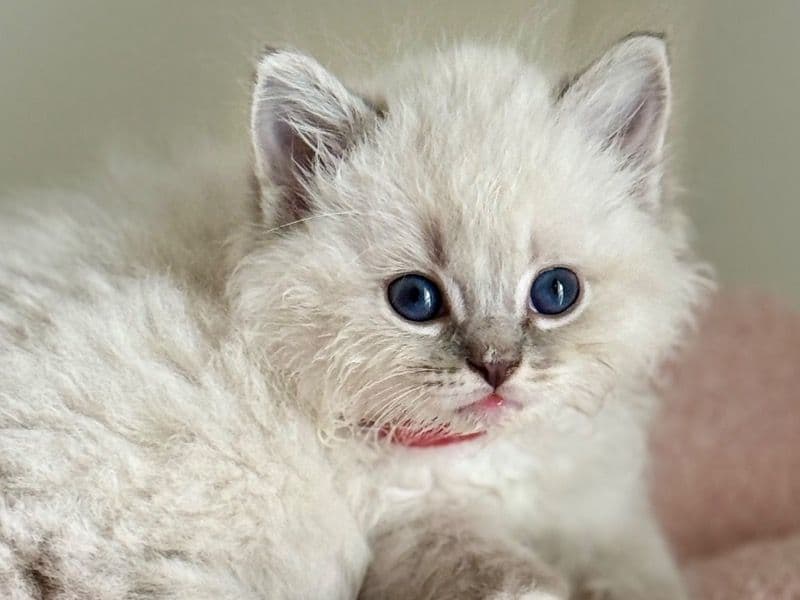
How much does a Ragdoll kitten cost?
Pet-quality kittens from a registered breeder commonly run $1,200 to $3,000, and show or breeding-rights kittens $3,000 to $6,000 and up. No registry publishes price data, so treat these as market observations. Color, pattern, breeding rights, health testing and your region all move the number.
02
What should I ask a Ragdoll breeder before buying?
Ask to see both parents' R820W heart test results and their most recent echocardiograms. Then ask for negative FeLV and FIV results, vaccination and worming dates, the registration paperwork, and a written contract. A breeder who has these sends them without hesitation.
03
Does a clear heart DNA test mean a Ragdoll kitten is safe from HCM?
No. The R820W test looks for one known mutation, and Ragdolls that test negative have still been reported with hypertrophic cardiomyopathy. A clear result is good news, not a guarantee. That is why the parents' heart scans matter as much as the DNA swab.
04
How big do Ragdoll cats actually get?
Smaller than the reputation suggests. The CFA standard allows males to reach or exceed 20 pounds. But in UK veterinary records covering 2,025 Ragdolls, the median adult male weighed about 11 pounds and the median female about 8.4 pounds. Very large males exist, but they are not typical.
05
At what age should a Ragdoll kitten leave the breeder?
The CFA advises 16 weeks, and 12 weeks at the absolute minimum. A kitten's own immune system takes over at about 12 weeks, so it needs its first vaccination before then. Rabies vaccination cannot be given earlier than 12 weeks. A breeder pushing an 8-week handover is a warning sign.
06
How do I spot a Ragdoll kitten scam?
Watch the payment method and the video call. Scammers ask for Zelle, Venmo, wire transfers, gift cards or crypto, because those payments are hard to reverse. Many also refuse to video call. Run a reverse image search on the photos, and be suspicious of any price far below the going rate.
07
What are the extra fees scammers ask for after a deposit?
A fake shipping company starts asking for a climate-controlled crate, travel insurance, customs clearance or vaccinations, at $100 to $2,000 a time. The fees keep coming until you stop paying, because there is no kitten. Verify any claimed shipper in the IPATA directory rather than trusting a logo.
08
Do Ragdoll cats need a lot of grooming?
Comb once a week with a steel comb, and daily while the cat is dropping coat. The claim that Ragdolls have no undercoat and never mat is overstated. The CFA standard says minimal woolly undercoat, not none, and mats do form at the ruff, the armpits and the back-leg fur.
09
Do Ragdoll cats have to live indoors?
They are normally kept as indoor cats, and the reason is their temperament. The CFA describes the breed as gentle, calm and sociable. A cat that walks up to strangers and does not run from trouble is poorly equipped for a street. A catio, window perches or harness walks are the usual compromise.
10
Do Ragdoll cats really go limp when you pick them up?
Many do, but not all, and it is temperament rather than anatomy. Ragdolls have the same pain threshold and the same muscle tone as any other cat. Do not take the nickname as license to handle one any less carefully than you would handle any cat.
11
How long do Ragdoll cats live?
Ragdolls live a median of 12.85 years in the largest study of the breed in general veterinary practice, with females reaching 13.7 years and males 11.4. That is about a year less than the 14.0 years recorded for UK cats overall, which is normal for a pedigree breed.
12
How much does a Ragdoll cost each year?
Budget roughly $1,100 to $2,400 a year for a healthy adult. That covers food, litter, routine vet care and parasite treatment, with more in the first year for neutering and equipment. These are commonly quoted ranges rather than published rates, and they exclude emergencies.