Browse Syrian hamsters from owners near you, and get the enclosure right before the animal arrives.
Syrian Hamster

Syrian Hamster

Syrian Hamster

Syrian Hamster

Syrian Hamster

Syrian Hamster
The hamsters listed above are more alike than they look. Colour and coat length barely move the outcome. The enclosure decides almost everything: whether a Syrian hamster thrives, or spends its nights chewing the bars. Unlike most of pet keeping, that part has actually been measured. Start there, then come back and pick an animal.
Short answer
Somebody has measured what a Syrian hamster builds when nobody helps it. A team working near Aleppo mapped 30 wild burrows and found none holding more than one adult. The burrows ran 36 to 106 cm deep, with a mean of 65 cm, and tunnel systems averaging 200 cm.
The Syrian hamster, Mesocricetus auratus, is not a domesticated animal in the way a dog is. Merck notes that most hamsters sold as pets today descend from three littermates caught in 1930.[12] Ninety-odd years of pet keeping have not changed what a hamster does with a floor of loose material.
In 1997 and 1999, Rolf Gattermann and colleagues ran two expeditions into northern Syria to confirm that wild golden hamsters still existed. They caught thirteen animals and, more usefully for anyone buying one, they dug out the burrows. Their published findings read like a build specification: “Altogether, 30 burrows were mapped and the structures of 23 golden hamster burrows investigated. None of the inhabited burrows contained more than one adult. Burrow depths ranged from 36 to 106 cm (mean 65 cm).”[1]
The layout was consistent too. One vertical entrance shaft dropped to a nesting chamber, with at least one separate food chamber alongside it. The whole tunnel system averaged 200 cm and could reach 900 cm.[1] That is a nest, a pantry, a corridor, and one occupant.
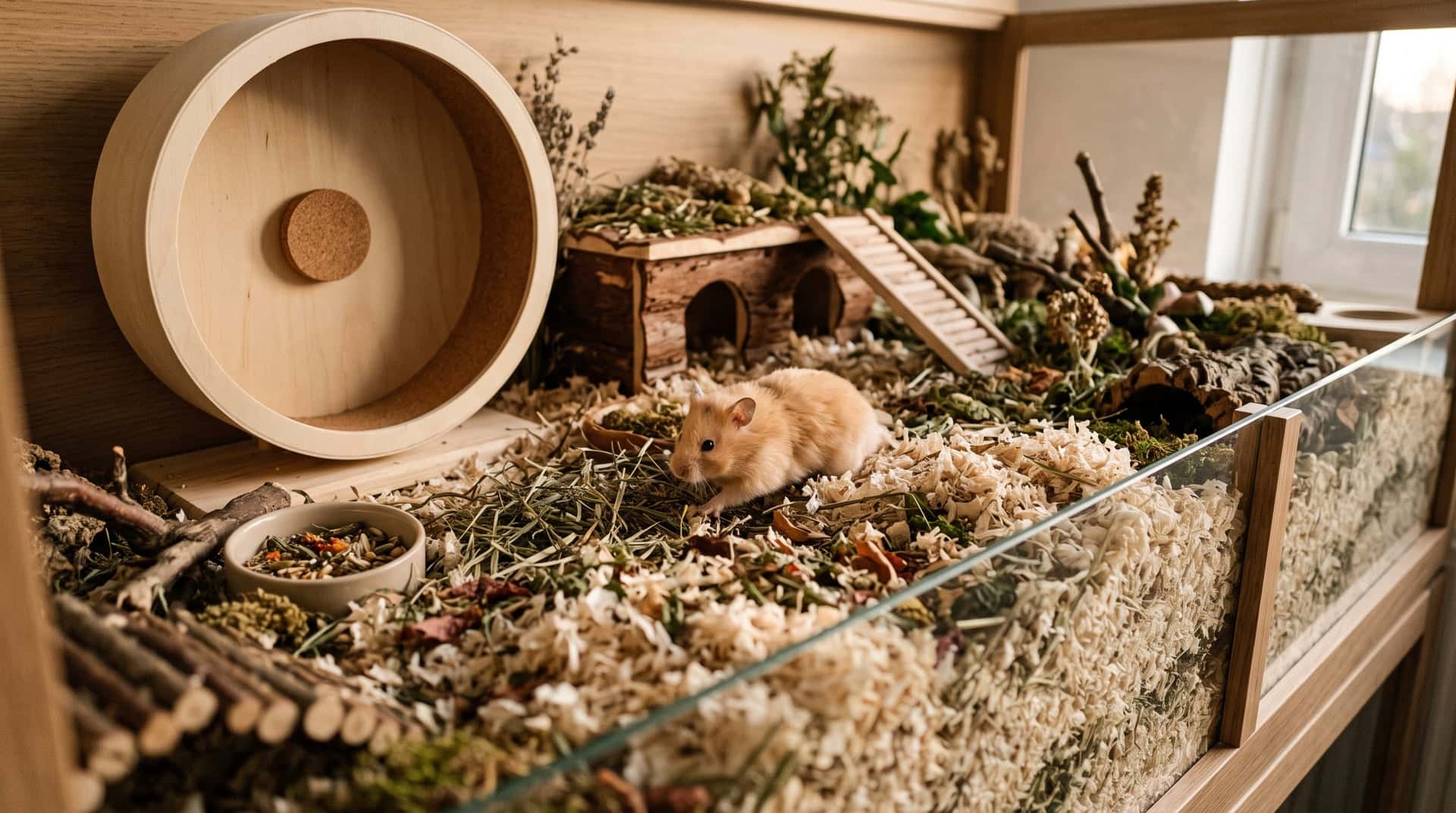
The wild burrow, and what the guidance says to copy
Read the right-hand column again. Every welfare recommendation in the rest of this page is that burrow written down by somebody else. That is the useful thing about buying a Syrian hamster: you are not guessing at preferences. You are copying measurements.
Short answer
Fischer and colleagues kept 60 golden hamsters in cages of four sizes and filmed them. Bar-gnawing appeared in every size, but hamsters in small cages gnawed significantly longer and more often. Welfare looked better at a floor area of at least 10,000 cm2.
The study is worth knowing in detail, because it is the only place these numbers come from. Sixty female golden hamsters were housed individually in cages of 1,800, 2,500, 5,000 and 10,000 cm2. Litter depth, enrichment and a 30 cm running wheel were the same in every cage, so size was the only thing that varied. The authors’ conclusion: “the welfare of pet golden hamsters in cages with a minimal ground floor area of 10,000 cm2 seemed to be enhanced compared with smaller cages.”[2]
The thing they were counting matters as much as the conclusion. Wire-gnawing is a stereotypy, which means a repeated behaviour with no purpose that animals develop when they cannot cope. It showed up at every cage size. It just got worse as the cage got smaller.[2] If you have ever watched a hamster chew the same bar for twenty minutes, that is what you were watching.
PDSA, working from Veterinary Association for Animal Welfare guidance, gives pet keepers a minimum of “100x50cm” and calls it “a MINIMUM size but bigger is always better!”[3] Worth being straight about the gap: 100 by 50 cm is 5,000 cm2, which is half the floor area Fischer’s study supports. Both figures are still well above what most shops stock, and PDSA says that part plainly: “Most hamster cages sold in shops aren’t big enough to meet a hamster’s most basic needs.”[3]
What to buy before the hamster
Here is one number nobody prints on the box. A 100 by 50 cm footprint filled to PDSA’s 25 cm minimum holds 125,000 cm3 of substrate, which is 125 litres for the first fill. That is arithmetic on two published figures, not a manufacturer’s claim, and it is the reason a shop starter kit cannot work. The kit is not sized for the volume the animal needs.
For contrast, and only for contrast: the NC3Rs puts the minimum permitted enclosure for adult laboratory hamsters at 800 cm2, with a recommended height of 17 cm.[8] That is a regulatory floor for research housing, not advice for a pet. It sits more than ten times below the figure the welfare study supports, which tells you how far a legal minimum can be from a good life.
Short answer
Chewy’s cost guide, reviewed by two veterinarians, puts a pet-store hamster at $15 to $25 and the setup around it at $102 to $394. The first year runs past $540 once food, bedding and vet care are counted. The animal is the smallest number involved.
Most hamster price guides online are written by nobody in particular. The figures below come from Chewy’s cost guide, which names its reviewers. Two are veterinarians: Dr Joanne Fernandez DVM, who treats small animals, and Dr Susan Tyson VMD MS, who treats birds and exotic pets. A hamster rescue founder reviewed it too.[9] That is the strongest sourcing available for pet hamster costs.
What it costs, smallest line last
Two honest adjustments to those numbers. Chewy’s cage line tops out at $200, but an enclosure that actually meets 100 by 50 cm normally sits at the top of that range or above it. And the $10 to $15 bedding line is a routine top-up, not the 125 litre first fill worked out above. Budget the enclosure and the opening bedding as one purchase, then let the running costs settle.
You will notice this page quotes no Petmeetly median price. That is deliberate. The only price median we hold for small pets covers the whole category at once, and guinea pigs and ferrets make up most of it. Published here, it would overstate a hamster by roughly three times. A number that misleads is worse than no number.
Short answer
The disease that kills young Syrians is proliferative ileitis, an inflammation of the small intestine that owners call wet tail. Merck calls it the most consequential intestinal disease of 3 to 10 week old Syrian hamsters, and says it causes high mortality.
The organism behind it is Lawsonia intracellularis, a bacterium that lives inside the cells lining the gut.[4] Merck’s owner-facing page is blunt about how it goes: “Proliferative ileitis progresses rapidly, and many hamsters with this infection die.”[10] Tyzzer disease, a separate infection with similar signs, is also “more common in hamsters that are young or stressed.”[10]
Now put that against the age at sale. Merck puts weaning at about 20 days.[4] So a hamster on a shop shelf is usually four to six weeks old. That sits in the middle of the wet tail window, and it is about to be moved to a new home. That is why the enclosure matters before the purchase rather than after it. A settled animal in a properly sized, properly bedded space is not being asked to absorb two stresses at once.
A healthy hamster, by Merck’s own list
Walk away if
Short answer
Every source that has looked at this agrees. Merck says Syrians are normally housed singly. The RSPCA says they should always live on their own. PDSA says two that meet will fight, and it can end in death. The field team near Aleppo never found two adults sharing a burrow.
The wording is worth reading rather than summarising. Merck: “Hamsters are normally housed singly except during breeding periods. Sexually mature females are territorial and aggressive and frequently fight each other.”[5] The RSPCA, on Syrian and Chinese hamsters: “they aren’t naturally sociable and are better kept on their own.”[14] PDSA: “If they meet, they will fight, leading to injury or possibly even death.”[13]
The NC3Rs adds the detail that surprises most people: where there is aggression, “both sexes are capable of inflicting severe injuries, but females tend to be the more aggressive sex.”[8] The female is also the larger of the two, in a species that runs 110 to 140 g.[4] This is the opposite of most pets, and it is why a pair is not a kindness.
There is one practical consequence at the point of sale. Syrians can reproduce at 7 to 8 weeks old,[4] so a mis-sexed pair produces a litter faster than most people expect. If two hamsters have been sharing a tank at the shop, treat any claim about their sexes as an opinion rather than a fact.
Three questions worth more than the price
Short answer
A Syrian hamster sleeps through most of the time you are awake. Merck puts them at their most active in the evening and at night. PDSA is blunt about the consequence: never wake one to handle it, because a startled hamster bites.
Merck: “Because they are nocturnal, hamsters are most active in the evening and at night and prefer to sleep during the day.”[5] The NC3Rs narrows it slightly to “the low-light hours of night, dawn and dusk.”[8] Plan your handling for the evening. The rest of this gets much easier.
PDSA puts the handling rule in one sentence: “Only try to handle your hamster when they’re awake and active, never when they’re sleeping as they’re likely to be scared and bite you.”[13] They are also honest about the wider question, and so is this page: “If you’re looking for a pet that usually enjoys being picked up and held, consider rats or ferrets instead.”[13] A hamster is a prey animal, and being lifted is not its favourite part of the day.
Temperature is the other thing to settle before the animal arrives. Merck’s range is 64 to 79 F, which is 17 to 26 C.[5] Below about 5 C a Syrian can go into hibernation,[4] and the NC3Rs names 3 to 5 C as the trigger and lists the Syrian among the true hibernators.[8] That rules out an unheated garage, a conservatory or a porch in winter.
Two smaller habits are worth building. Hamster incisors grow continuously,[11] so something to gnaw is equipment rather than a toy, and the RSPCA suggests cardboard tubes, wood blocks or hay.[6] And resist the urge to deep clean. Hamsters produce very little waste, so the RSPCA notes cleaning is needed less often than for other small rodents.[6] If you would rather take on an adult whose habits are already known, our Syrian hamster adoption page covers how to move one without resetting everything it knows.
Short answer
A Syrian hamster lives alone, works nights and would rather not be picked up. If that list is a problem rather than a quirk, PDSA names the alternatives itself: rats or ferrets, both of which usually enjoy being handled.
It is worth being direct. A hamster that does not suit the household is not a happy hamster, and it usually ends up listed for rehoming instead. The RSPCA writes that hamster needs “are quite complex” and that “looking after a hamster is too much responsibility for a child.”[14] PDSA adds that children should always be supervised, because hamsters need careful handling and can bite.[13] A hamster can be a wonderful pet for a household that keeps evening hours and enjoys watching an animal rather than holding it.
If company is what you want, rats and guinea pigs both live in groups rather than alone, and both of those pages set out what that involves. If it is the age you are unsure about, an adult hamster arrives with its temperament already visible, and our hamster adoption page explains how to take one on.
Whichever way you go, keep the order. The enclosure is the decision. The animal is the easy part.
Sources
Fact-checked against the Merck Veterinary Manual, the RSPCA, PDSA, the NC3Rs, and peer-reviewed research published in Animal Welfare and the Journal of Zoology.
What first-time buyers want to know before they hand over money
Chewy puts a pet-store hamster at $15 to $25, a private breeder at $50 to $75, and a rehoming fee at $10 to $30. The setup around the animal costs far more: $102 to $394 before the first year of food, bedding and vet care.
PDSA gives a minimum floor of 100 by 50 cm and says bigger is always better. The research goes further. Fischer and colleagues found welfare improved at a floor area of at least 10,000 cm2, which is double the PDSA minimum.
PDSA says at least 25 cm so a hamster can burrow, sleep and store food. Merck goes deeper still and says 40 to 80 cm enhances welfare. Wild burrows near Aleppo were measured at 36 to 106 cm deep, with a mean of 65 cm.
At least 30 cm, which is about 12 inches, according to PDSA. Dwarf hamsters need at least 20 cm. The RSPCA adds that the running surface must be solid rather than mesh or rungs, because open wheels cause injuries.
No. Merck says Syrians are normally housed singly, and the RSPCA says they should always live on their own. PDSA says that if two meet they will fight, and it can end in injury or death. A field team near Aleppo never found two adults sharing a burrow.
Merck puts weaning at about 20 days, so anything younger is too young to leave its mother. Ask for the age in weeks rather than a guess, because the age also tells you how much of the wet tail risk window is still ahead of you.
Wet tail is proliferative ileitis, an inflammation of the small intestine caused by the bacterium Lawsonia intracellularis. Merck calls it the most consequential intestinal disease of 3 to 10 week old Syrians. Look for a wet, soiled tail area and a hunched posture.
Merck lists the warning signs: inactivity, weight loss, discharge from eyes, ears or nose, hunched posture, an abnormal walk, a scruffy coat or hair loss, diarrhoea, and trouble breathing. A healthy hamster shows none of them and moves easily.
About two to three years, so a hamster you buy today is a short commitment by pet standards. Merck gives 18 months to 3 years overall and 2 to 3 years for Syrians. The RSPCA is more cautious and says up to two years.
Not as a child-managed pet. The RSPCA says looking after a hamster is too much responsibility for a child. PDSA says children should always be supervised, because hamsters need careful handling and can bite. An adult has to own the care.
They can, and the usual trigger is being woken. PDSA says to handle a hamster only when it is awake and active, never while it sleeps, because a startled hamster is likely to bite. Hamsters are prey animals, so being picked up is frightening.
Chewy puts the running cost past $540 a year. Vet care is the biggest line at $360 or more, then bedding at $120 to $180 and food at $60 to $144. A routine wellness visit runs $30 to $100 and emergency care starts at $80.
Discover other small pets for sale and find your perfect companion
Message owners directly, ask how old the hamster is and how it has been housed, and arrange to see it in the evening when it is awake.
No card required to sign up.