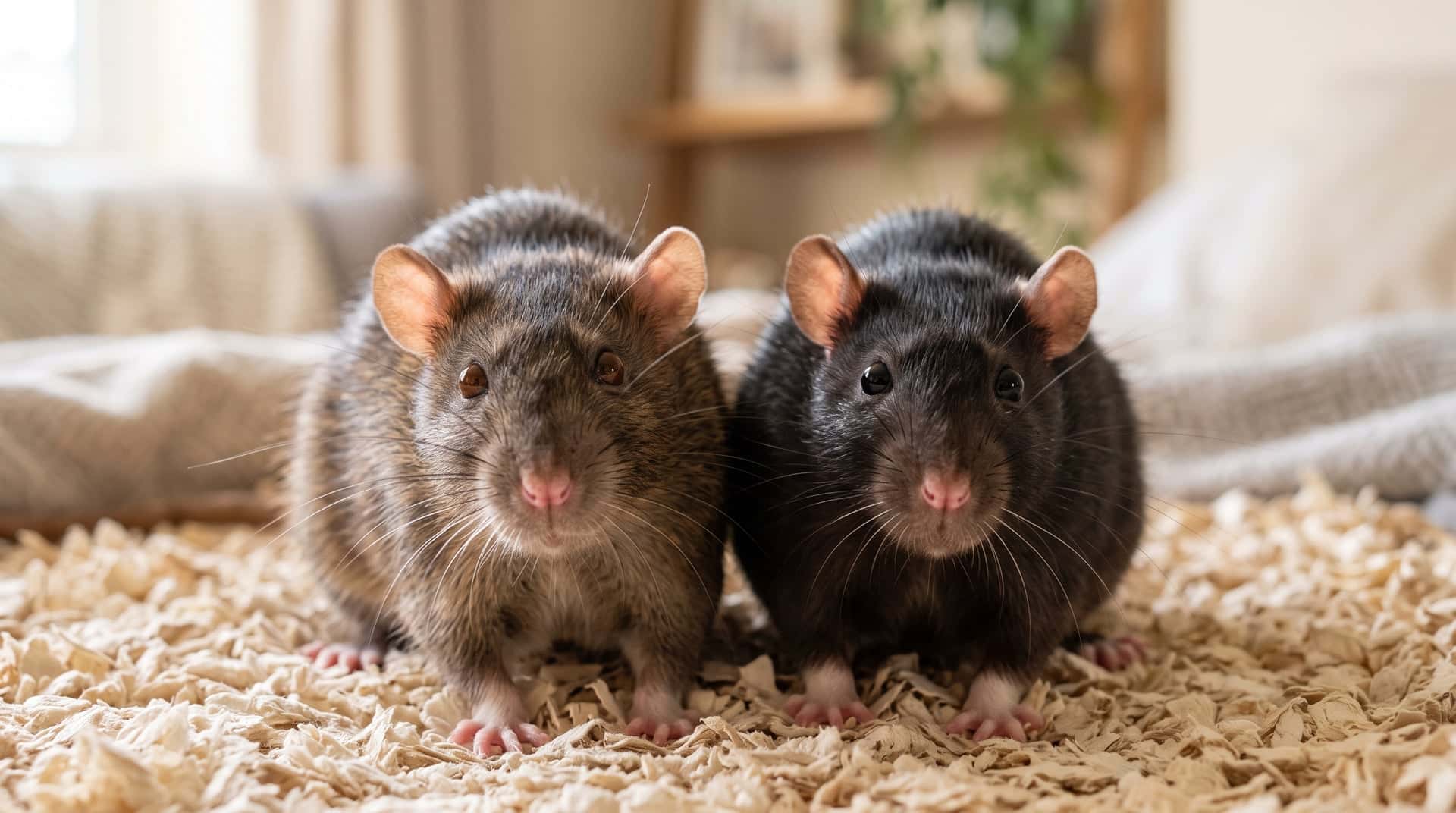
Browse rats from real owners near you, and learn the two-minute check that tells you more than any price tag.
Common Rat
Common Rat
Common Rat
Common Rat
Common Rat
Common Rat
A rat costs less than a bag of its own bedding, so price is the least useful thing on any listing above. What separates a rat that reaches three years from one that struggles at eighteen months is almost always its lungs. That is checkable in two minutes, and it is free.
Short answer
Sit down near the cage and do nothing for two minutes. RSPCA Australia’s advice is exactly that: sit still, look, and listen, because it gives the rats a chance to stop pretending they are healthy. Sneezing, clicking or effortful breathing in that window is the most useful thing you will learn all visit.
Rats are prey animals, and RSPCA Australia is blunt about what that means for a buyer: “Because they are a prey species, they will try and hide signs of illness, so when they look sick, they’re really sick!”[1] A rat that has just been lifted out of its cage for you is alert, adrenalised, and showing you its best performance. Two quiet minutes beforehand is how you get past that.
Two minutes, before you say a word
Why does this outrank everything else on the page? Two reasons. RSPCA Australia names upper and lower respiratory tract disease as the most common health problem in rats. And once it shows, it is done: “By the time the problem is noticed, the changes in the lung are permanent and the infection cannot be eliminated.”[2] Treatment can buy comfortable time, sometimes years of it, but “this infection always comes back” and eventually the disease is terminal.[2] You cannot undo this after you get home. You can only notice it beforehand.
Short answer
It is porphyrin, a pigment made by glands behind the eyes, and RSPCA Australia says plainly that it is not blood. Rats produce it when they are stressed or unwell. A trace after a car journey is not the same finding as dried crusts on a rat sitting quietly in its own cage.
The proper name is chromodacryorrhoea, which just means red tears. The Harderian glands behind a rat’s eyes make porphyrin pigments, and when a rat is stressed or ill those pigments turn the tears rusty red.[2] It dries around the eyes and nostrils and looks exactly like dried blood, which is why it frightens new owners and why sellers sometimes wave it away. RSPCA Australia’s instruction is neither: “Check that they do not have any red staining around the eye and nostrils... It is not blood, but rather a pigment... and seeing this should prompt you to seek advice from your veterinarian.”[1]
Be fair about what it proves. Porphyrin appears with plain stress as well as illness, so a rat that has just been driven across town in a carrier may show a trace of it honestly. What you are looking for is different: a settled rat, in its own home cage, with dried crusts around the nose and eyes. That matters most when you also heard something in the two minutes before. One sign is a question. Two signs together is an answer.
Underneath both is the same disease, and the order of events is worth knowing because it tells you what to inspect. RSPCA Australia describes the airway lining being damaged first, by dust, by the aromatic oils in pine and cedar bedding, and by ammonia rising from urine in dirty bedding. Mycoplasma, a bacterium, then invades the damaged lining, and other bacteria follow it in. The lining thickens and stiffens, thick mucus fills the airways, and the change is permanent.[2] So when you walk in, the smell of the room is evidence. Ammonia you can smell at the door has already been working on those lungs.
One thing not to hope for: a mycoplasma-free rat. Rat Guide notes the bacterium passes from mother to pups and cannot be effectively cured.[3] A British veterinary laboratory tested samples that vets sent in for rats and mice across 2021 to 2023, and found 77.6 percent, 218 of 281, positive. Those were samples from animals a vet already suspected of respiratory disease, not a survey of healthy pets. The same lab notes the published figure for pet rats generally sits near 70 percent.[4] The realistic goal is a well-kept rat from a well-kept room, not a clear one.
Once the two minutes are up, ask to hold one. RSPCA Australia publishes a checklist for exactly this moment, and it is short enough to memorise.[5]
A healthy rat should
Add one thing the list does not spell out. Run your fingers gently over the whole body, not just the belly, feeling for lumps. RSPCA Australia recommends this as a routine owner habit. It matters more in rats than in most pets, because their mammary tissue runs from the neck all the way to the groin.[1][2] A lump on the shoulder or the flank can still be a mammary tumour.
Flattened ears and a squinting face are worth learning too. RSPCA Australia notes that a stressed or painful rat pulls its ears back flat and squints. It points to the Rat Grimace Scale, a standard way of reading pain from a rodent’s face. The scale came out of laboratory work and applies just as well to pets.[1]
Walk away if
Short answer
Ask one question before you ask the price: where did these rats come from? RSPCA Australia warns that pet shops often buy from multiple suppliers, which raises the risk of taking home a sick animal. Rat Guide says store rats are often bred mill style, with no eye on health or temperament.
RSPCA Australia lists the realistic sources and is honest about each one. Shelters and rescues often have rats available. So do rehoming groups that place rodents retired from research institutions, which is a route with no equivalent in any other pet species. Rat interest clubs hold regular meetings and their members are an excellent source. Breeders rarely advertise and are usually found by word of mouth. Pet shops are convenient and carry the multiple-supplier risk. Online sales can be unreliable and unsafe, particularly sight unseen.[5]
Rat Guide, the hobby’s own medical reference, is more pointed about the two ends of that range. On shops: rats there are “often bred ‘mill’ style and unfortunately are not bred with health and temperament in mind.” On breeders: “Local breeders are probably your best bet if you want to get a rat from a known breeding line.”[6] The phrase that matters there is “known breeding line”. Rats have no registry and no breed standard, so a line is only known if somebody wrote down what happened to it.
That gives you three questions worth more than the price:
Ask the seller
Look at the room while you ask. RSPCA Australia’s premises test is simple: is it clean, with minimal odour, does the housing look good, are the rats fed well?[5] One more thing to notice on the shelf. RSPCA Australia treats visible hairless or tailless rats as a possible sign of inbreeding, which can affect the health of the animals you are looking at.[5]
Short answer
Two at least, of the same sex. RSPCA Australia says rats should always be kept in small groups, and the UK RSPCA warns that a rat living alone can get depressed even with plenty of human company. Then check the sex yourself, because RSPCA Australia says even vets, breeders and shelters get it wrong.
Rats are colony animals. The UK RSPCA states it directly. Rats “can get depressed and develop abnormal behaviour if they live on their own, even when they have lots of contact with people.” They “should be kept in pairs or small same-sex groups and are perfectly happy without the opposite sex.”[7] RSPCA Australia adds that a group of siblings is ideal, and that rats settle together best when they are housed together young.[8] If you are buying, buy the pair or the trio, and buy them from the same group where you can.
Take the introduction timing seriously if you are combining rats from different places. The UK RSPCA recommends introducing cage mates soon after weaning, at around three weeks old, because they fight less at that age.[7] Adults can be introduced, but expect a period of high aggression while they sort out a dominance order.[7]
Now the check that prevents the phone call three weeks later. RSPCA Australia does not hedge: “Even an experienced veterinarian, breeder, pet store owner, or animal shelter can make sexing mistakes, so take a look yourself to double check.”[8] Four checks, in order of how reliable they are.
How to sex a rat in thirty seconds
Getting this wrong is not a small inconvenience. A doe can be pregnant within a day of meeting a buck, carries for three weeks, and can have six to thirteen pups.[8] If you already have a mixed pair and want to keep them together, desexing is the fix RSPCA Australia recommends.[8] If a surprise litter has already arrived, our rat adoption page covers placing them with people who are already looking.
Short answer
The rat is the cheapest thing you will buy. Rat Guide puts shops at $2 to $10 and breeders at $8 to $25, and published rescue fees run $10 to $30. Setup runs $100 to $300 before food, so never let a few dollars decide where you buy.
What the money actually looks like
Read that table once and the buying strategy writes itself. If the animal costs five dollars and the cage costs two hundred, spend your attention on the cage and your questions on the seller. The gap between a five-dollar rat and a twenty-dollar rat is not worth a second thought. A rat that needs respiratory treatment for a year costs more than every line in that table combined.
Budget for a vet before you need one, too. Not every practice sees rats, and RSPCA Australia recommends a vet experienced with rats, visited straight after you get them and at least annually after that.[17] Find that clinic while everyone is healthy.
Short answer
There is no evidence-based standard for rat cage size. RSPCA Australia says so directly, and notes that the published guidelines cover laboratory rats rather than pets. AFRMA and Chewy give workable minimums, and bigger is genuinely better.
Start with the honest gap, because most cage guides online will not tell you about it. RSPCA Australia writes: “Unfortunately, there are currently no evidence-based recommendations for the optimal size of companion rat housing. Published guidelines for rat housing size are generally limited to those for rats kept in laboratory settings rather than as companions.”[12] Any specific number you see, including the ones below, is experience rather than evidence.
The numbers that do exist
Bedding is where this page closes its own loop. RSPCA Australia names the aromatic oils in pine and cedar, along with dust and ammonia from soiled bedding. Those are the irritants that damage the airway lining before Mycoplasma gets to invade it.[2] That makes bedding choice and cleaning frequency part of the same decision as everything in the first two sections. Paper-based bedding and low-dust alternatives keep the airways out of the story. So does emptying the tray before you can smell it.
Ventilation matters as much as material. Rat Guide lists overcrowding, poor ventilation and ammonia buildup among the conditions that turn a carried infection into a clinical one.[3] A tall wire cage in a room you actually use, cleaned often, is doing more for a rat’s lifespan than any amount spent on the animal itself.
Two last things to plan around. Rats are most active in the evening and at night, and RSPCA Australia recommends 8 to 12 hours of quiet dark time each day. Keep cats and dogs well away too, because even the sight and smell of a predator is stressful.[12][16] If a young rat is not what you want after reading all this, an adult with a known history may suit you better. Our rat adoption page covers what an adult shows you that a baby cannot. And if you would rather have a quieter, daytime small pet, guinea pigs for sale is worth a look.
Sources
Fact-checked against RSPCA Australia, the RSPCA in the United Kingdom, the Merck Veterinary Manual, Rat Guide, the American Fancy Rat & Mouse Association, and published rescue fee schedules.
What first-time buyers want to know before they hand over money
Rat Guide puts pet shops at $2 to $10 and breeders at $8 to $25. Rescues published fees of $10 to $30 depending on age, and more for an already desexed rat. The cage is the real expense: setup runs $100 to $300 before food.
It is porphyrin, a pigment produced by glands behind the eyes, and RSPCA Australia says plainly that it is not blood. Rats produce it when stressed or unwell. Dried crusts on a rat sitting quietly in its own cage are a reason to walk away and a reason to call a vet.
Sit still and listen for two minutes first, because rats hide illness. You want quiet effortless breathing, no sneezing or clicking, clear eyes and nose with no red staining, a clean full coat, nothing stuck under the tail, and easy movement with no limping.
Yes. RSPCA Australia says rats are not solitary animals and should always be kept in small groups. The UK RSPCA adds that a rat kept alone can get depressed and develop abnormal behaviour even when it has plenty of human company. Two of the same sex is the minimum.
The most reliable early check is nipples: females have them and males do not, and they show on females from 8 to 10 days old. The gap between the anus and the genital opening is about twice as long in males, and a scrotal sac appears from 3 to 4 weeks.
It carries more risk. RSPCA Australia notes shops often buy from multiple suppliers, which raises the chance of taking home a sick animal, and Rat Guide says store rats are often bred mill style without health or temperament in mind. Run the health checks either way.
About two to three years. Merck gives 1.5 to 3 years and Veterinary Times two and a half to three. Chewy says two to four. RSPCA Australia is more optimistic at 4 to 5 years. Budget your plans around the shorter figure.
There is no evidence-based standard. RSPCA Australia says published guidelines cover laboratory rats rather than pets. AFRMA gives a two-rat minimum of about 14 by 24 by 18 inches and calls a 40 to 60 gallon tank a good size for two. Bigger is genuinely better.
Avoid pine and cedar. RSPCA Australia names their aromatic oils, along with dust and ammonia from dirty bedding, as the irritants that damage the airway lining before Mycoplasma invades it. Paper-based bedding and low-dust alternatives keep the airways out of the story.
Rat Guide puts weaning at a minimum of four weeks. Introducing cage mates works best soon after weaning at around three weeks, so young rats settle together more easily than adults do. Anything sold below four weeks is a red flag.
Neither. Males are roughly twice the size, tend to be calmer and heavier in the lap, and scent mark more. Females are smaller, faster and busier. Keep whichever you choose in same-sex groups, and never mix undesexed males and females.
Not safely. RSPCA Australia says dogs and cats will generally always want to chase and catch rats, so they must be kept apart, and that even the sight, smell and sound of a predator nearby is stressful. Rats and mice should not share an enclosure either.
Discover other small pets for sale and find your perfect companion
Message owners directly, ask what the room sounds like and how old the parents got, and arrange to meet the rats in person.
No card required to sign up.