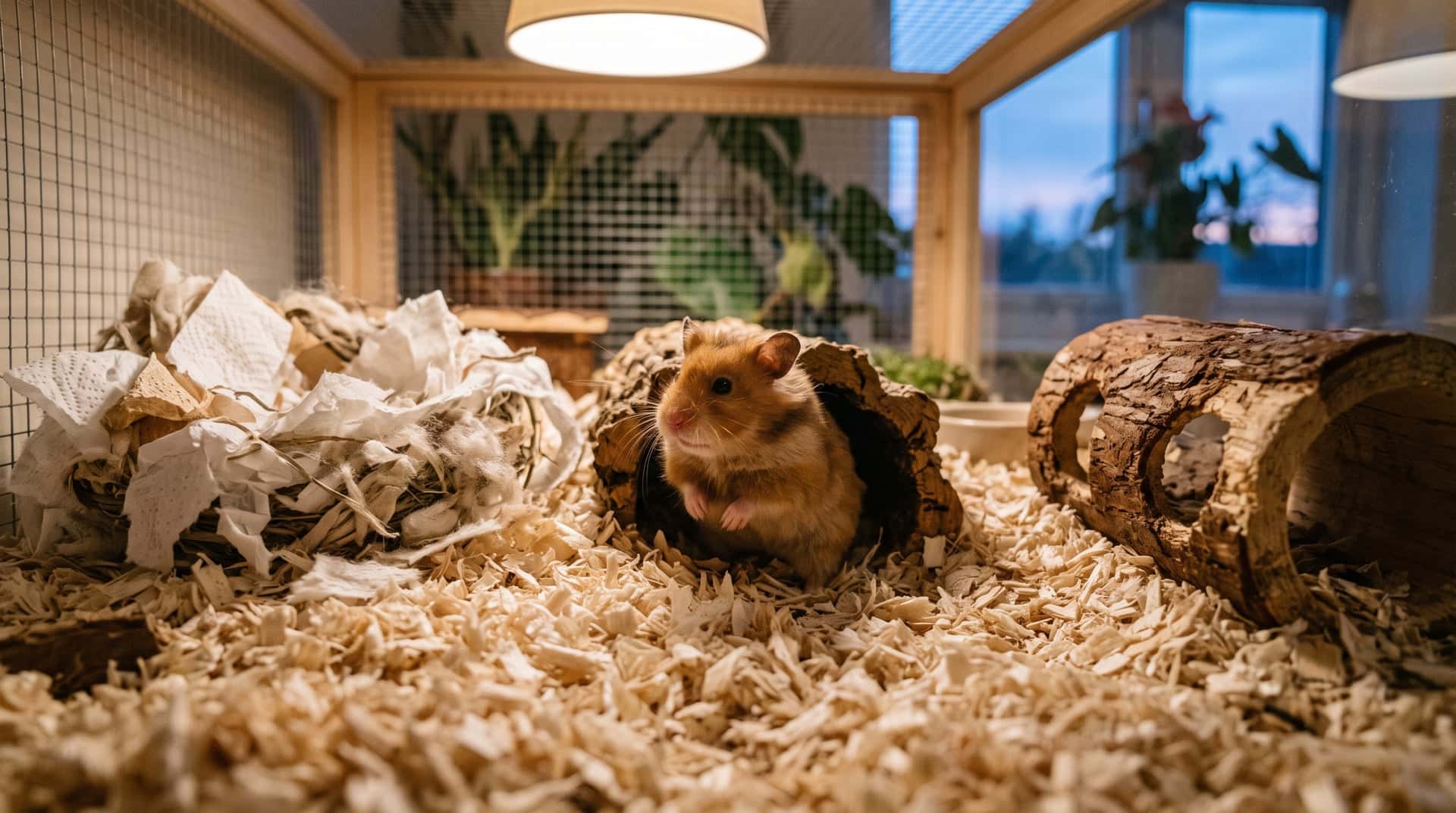
Meet adult Syrian hamsters being rehomed by their owners near you, and take their nest home with them.
Syrian Hamster
Syrian Hamster

Syrian Hamster
Most of the hamsters above are being rehomed by the people who own them, not by an institution. That makes the handover unusually valuable, because you can take more than the animal. You can take the smell of its home, which for this species is most of what settling in means.
Short answer
Hamsters mark their territory with scent glands on their flanks, and the RSPCA notes that cleaning a hamster’s enclosure is disruptive for that reason. Its advice is to move some of the used nesting material across into the clean cage. On moving day, that nesting material is the most useful thing you can carry.
The RSPCA’s guidance for people housing hamsters professionally puts it in one sentence: “Transferring some of the used nesting material (but not litter) from the soiled into the clean cage may reduce stress associated with cage cleaning.”[1] That is written about a routine clean-out. A rehoming is the same problem at a much larger scale, so the same fix applies with more force.
Start from what the animal is actually losing, because it is not what most people assume. A Syrian hamster has no companion to lose. Merck says they are normally housed singly.[3] The RSPCA says they should always live on their own.[4] A field team that mapped 30 wild burrows near Aleppo found that “none of the inhabited burrows contained more than one adult.”[5] What a rehomed Syrian loses is a territory: a smell, a layout and a routine.
That is genuinely good news. It is also the opposite of the advice on our guinea pig and rat pages, where breaking up a bonded group is the thing to avoid. Here there is no group. There is a scent map, and you can pack it into a bag.
Ask the owner for these, not just the hamster
None of this costs anything, and most owners are glad to hand it over. Nest building is not a hobby for a hamster either. The RSPCA describes hamsters as “highly motivated to build nests, even when kept in warm conditions”. Nesting material goes in on top of the litter, not instead of it.[1]
Short answer
Rehoming from a private owner gives you something a shop cannot: the animal’s history from the person who lived with it. Six questions get you most of it, and every one of them changes something practical about the first week.
Six questions, and why each matters
One question deliberately not on that list: whether it has ever lived with another hamster. If the answer is yes, that is a housing problem the previous owner had, not information about your hamster. Syrians live alone either way.[4]
Short answer
Have the new enclosure finished before you collect the hamster. Bed it deep, bury the old nest in it, put the hide where the hamster can reach it, then step back. The most useful thing you can do on day one is very little.
The sequence
A wild burrow gives you the shape to aim for. Those measured near Aleppo ran 36 to 106 cm deep, with a mean of 65 cm. Each one had a nest chamber and at least one food store off a single tunnel.[5] Deep bedding and a dark hide are not enrichment extras. They are the animal’s natural architecture, and giving it back is what turns a new box into a home quickly.
Short answer
There is no survey of hamster surrenders, so this page quotes no statistic. The mechanism is well documented though. Hamsters work nights, bite when startled and do not enjoy being carried. The cages sold for them are usually too small.
Take those one at a time. Each explains a different household that gave up. Merck: “Because they are nocturnal, hamsters are most active in the evening and at night and prefer to sleep during the day.”[3] A pet bought for a child who is asleep by eight is a pet the child rarely sees awake.
PDSA on handling: “Only try to handle your hamster when they’re awake and active, never when they’re sleeping as they’re likely to be scared and bite you.”[6] A bite from a woken hamster can end the relationship, and the hamster usually gets blamed for it.
PDSA is also honest about what kind of pet this is: “If you’re looking for a pet that usually enjoys being picked up and held, consider rats or ferrets instead.”[6] The RSPCA adds that hamster needs “are quite complex” and that “looking after a hamster is too much responsibility for a child.”[10]
And the housing. PDSA states that “most hamster cages sold in shops aren’t big enough to meet a hamster’s most basic needs.”[7] A hamster in a cage that small chews the bars at night. The noise is one more reason it ends up listed for rehoming.
Read that list again and notice what is missing. None of it is about the animal being difficult. A rehomed Syrian is usually a normal hamster in the wrong setup. The setup is where an adopter should spend their attention.
Short answer
A young hamster is a guess. An adult has already told somebody what it is like: when it wakes, whether it bites, whether it uses a wheel, how it reacts to a hand. You are trading potential for information, and the information is the better half of that deal.
Be clear-eyed about the timeline first, because it is short for every hamster. Merck says pet hamsters “may live from 18 months to 3 years”[11] and puts Syrians at 2 to 3 years in its professional reference.[12] PDSA agrees at two to three years.[6] The RSPCA is more cautious: “Hamsters usually live for up to two years, although some may live for longer.”[10] Ask the owner for the age in months and plan from the shorter figure.
What you get in exchange is worth listing plainly. Temperament is already visible. Bite history is knowable. Whether the animal uses a wheel, digs, hoards or sleeps through the evening is a matter of record rather than hope. Adult size and coat are settled. And you can watch it move before you commit, which is the best health check anyone gets.
There is a fairness point too. A hamster listed at ten months is rarely a problem animal. A common story is a household that discovered too late what a nocturnal, solitary pet involves. Taking that animal on, with its own nest, is a straightforwardly good outcome for it.
Short answer
Merck publishes a short list of the signs that matter in a hamster. Learn it in the first week. A sick hamster hides the signs until it cannot, and then it goes downhill fast.
Call a vet if you see
Adults get a different set of problems from pups. That is worth knowing before your first appointment. Merck notes that diarrhoea in adult Syrians is associated with Clostridioides difficile enterotoxemia, a gut infection, and not with the disease that affects young hamsters.[12]
Two age-related findings are worth having a name for. The first is amyloidosis, the build-up of an abnormal protein in the liver and kidneys. Merck describes it as the principal cause of death in long-term research studies, reaching 80 percent among females over 18 months in that laboratory setting.[12] That is a research population rather than a survey of pets. Treat it as an indication of what ages hamsters, not as your hamster’s odds. Polycystic liver disease turns up in Syrians over a year old and is usually silent, causing no clinical signs at all.[12]
Skin is the other thing to check. Merck names two mites, Demodex criceti and Demodex aurati, which cause mild to moderate hair loss, itching and reddened skin.[12] Part the coat over the back and rump while the hamster is awake.
Raise this at the first vet visit
Short answer
Bar-chewing is the sign most adopters meet first. Fischer and colleagues filmed 60 golden hamsters in four cage sizes and found that hamsters in small cages gnawed the wire significantly longer and more often. Treat it as a measurement of the enclosure, not a habit of the animal.
The study tested floor areas of 1,800, 2,500, 5,000 and 10,000 cm2, with everything else held constant. Welfare, the authors concluded, “seemed to be enhanced” at a minimum floor area of 10,000 cm2.[14] Wire-gnawing appeared at every size. It simply got worse as the space shrank.
The RSPCA groups this with the other behaviours worth reacting to: “Abnormal or undesirable behaviours such as stereotypies (e.g. back-flipping or circling), anxiety or apathy can indicate that an animal’s environment is inappropriate and that the animal is unable to cope.”[1] A stereotypy is a repeated behaviour with no purpose, and it is a signal about the enclosure rather than a quirk of the animal.
What to change, in order
Short answer
Chewy puts a rehoming fee at $10 to $30, and plenty of private rehomings ask nothing at all. The fee is never the number that matters. Setting up properly costs $102 to $394, and keeping a hamster runs past $540 a year.
Those figures come from Chewy’s cost guide, reviewed by a small animal veterinarian and an exotics veterinarian who are both named on the page.[15] The annual total is dominated by vet care at $360 or more, then bedding at $120 to $180 and food at $60 to $144.
Adopting shifts the money rather than removing it. You often save on the animal and on some equipment, since many owners pass on the enclosure, the wheel and the hide. What you should not assume you have saved is the enclosure size. If the hamster is being rehomed from a shop cage, budget for a proper one, because that is the change most likely to fix the behaviour that got it listed.
You will notice this page quotes no Petmeetly median rehoming fee. That is deliberate. The only median we hold for small pets covers every species in the category at once, and larger animals dominate it. On a hamster page it would simply mislead.
If you had your heart set on a young hamster instead, that is a fair choice. Our Syrian hamsters for sale page walks through the enclosure and the health checks in the same detail. And if the solitary part is what puts you off, try our guinea pig adoption page. Guinea pigs run by the opposite rule, and a single animal is the thing to avoid there.
Sources
Fact-checked against the RSPCA, PDSA, the Merck Veterinary Manual, the NC3Rs, and peer-reviewed research published in Animal Welfare and the Journal of Zoology.
What adopters want settled before they collect a rehomed hamster
Ask for the used nesting material, the hide and the wheel. The RSPCA says transferring used nesting material into a clean enclosure reduces the stress of the change, because hamsters scent mark their territory. Take the food it is already eating too.
No. Syrian hamsters live alone by nature. The RSPCA says they should always live on their own, and a field study near Aleppo never found two adults sharing a burrow. A rehomed Syrian loses a territory, not a companion.
Give it a few quiet days before you expect anything. Set the enclosure up before collection, bury the old nest in the fresh bedding, and let the hamster come out on its own in the evening. Do not lift it out to check on it.
Clean the equipment, but keep the smell. The RSPCA notes that cage cleaning is disruptive for a species that scent marks, and recommends moving some used nesting material, though not soiled litter, across into the clean enclosure.
Usually somewhere between a few months and a year and a half, which is when a first pet stops being novel. Merck puts the whole life span at 18 months to 3 years, so ask the owner for the age in months and take the answer seriously.
The common reasons are predictable rather than dramatic. Hamsters are nocturnal, they bite when woken, they are not a pet that enjoys being held, and PDSA says most shop cages are too small. Usually the setup failed, not the animal.
Merck says pet hamsters live from 18 months to 3 years, and gives 2 to 3 years for Syrians specifically. PDSA agrees at two to three years. The RSPCA is more cautious and says up to two years, although some live longer.
Not necessarily, and you get something in exchange: an adult shows you its temperament straight away. Ask the current owner whether it has bitten and in what situation. Handle it in the evening when it is awake, never while it sleeps.
Merck names amyloidosis as the principal cause of death in long-term laboratory studies, with 80 percent prevalence among females over 18 months in that setting. Polycystic liver disease is common after a year and usually silent. Diarrhoea in adults has different causes than in pups.
Chewy puts a rehoming fee at $10 to $30, and many private rehomings ask nothing. The real number is what comes after: $102 to $394 to set up properly, then more than $540 a year for food, bedding and vet care.
No. PDSA says two Syrians that meet will fight, and it can end in injury or death. Merck says they are normally housed singly, because sexually mature animals are territorial. Two hamsters means two enclosures, in separate rooms if either seems unsettled.
Usually that the enclosure is too small. Fischer and colleagues found hamsters in smaller cages gnawed the wire significantly longer and more often. Increase the floor area first, then the bedding depth, then add a burrow-shaped hide.
Find loving small pets of every species waiting for their forever homes
Message owners directly, ask when their hamster wakes up, and ask them to keep the old nesting material for you.
No card required to sign up.