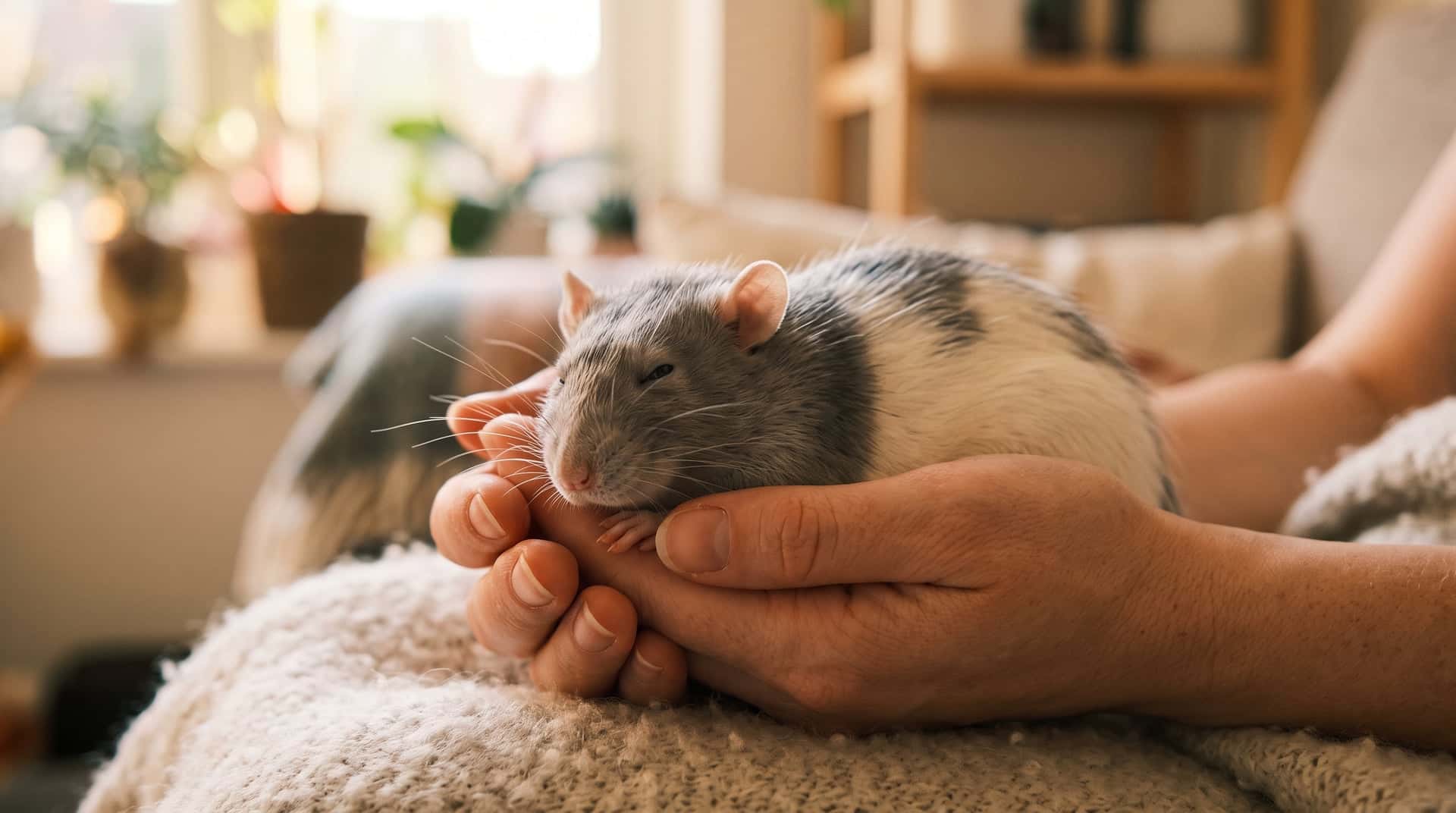
Meet adult rats rehomed by their owners near you, and see honestly how much time you are taking on.
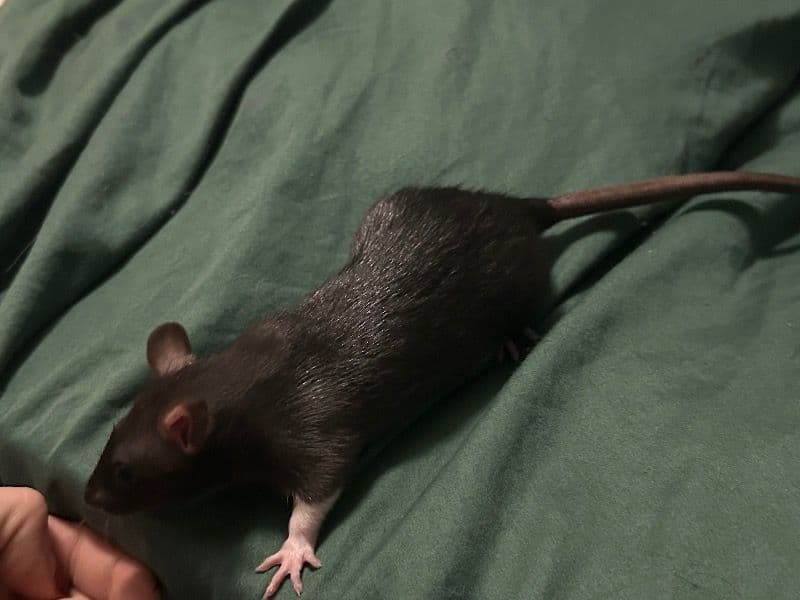
Common Rat
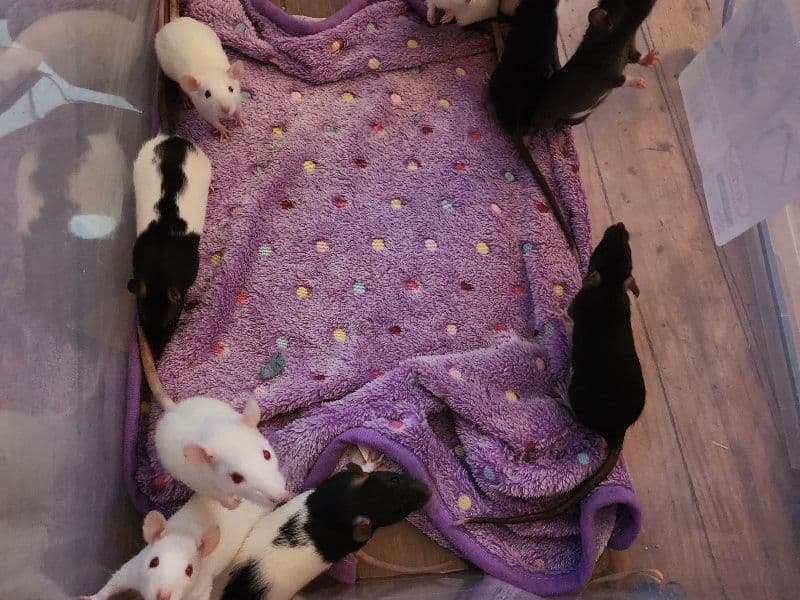
Common Rat
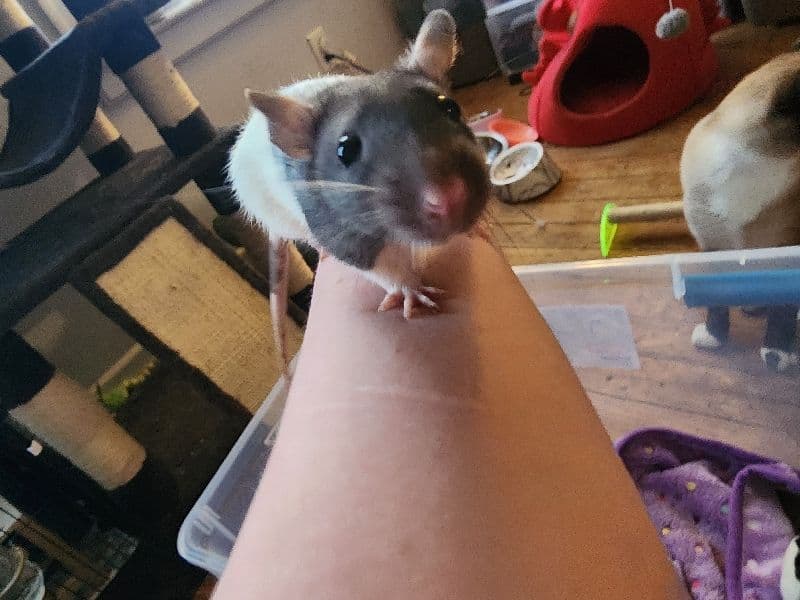
Common Rat
Common Rat

Common Rat

Common Rat

Common Rat

Common Rat
Most of the rats above are being rehomed by their owners, and most are somewhere between six and eighteen months old. That matters more here than on any other page on this site, because a rat’s whole life is about two to three years. Knowing that up front changes what you check, what you ask for, and how fast you move.
Short answer
Less than most people expect, and it is worth knowing before you meet anyone. Merck puts a rat’s life at 1.5 to 3 years and Veterinary Times at two and a half to three. Adopt an eighteen-month-old and you are signing up for months. That is not a reason to say no. It is a reason to plan differently.
Age at adoption, and what is left
Those middle columns are arithmetic rather than measurement. They subtract an age from a published life span, and the life span itself is not agreed. Merck’s reference table gives 1.5 to 3 years.[1] Veterinary Times gives about two and a half to three.[2] Chewy’s medically reviewed guide says two to four.[3] RSPCA Australia is the outlier and says about four to five.[4] This page uses two to three, because that is where the veterinary references cluster, and because planning for the short version and being pleasantly surprised is the right way round.
Here is what the short clock actually changes, and it is most of this page. There is no leisurely settling-in month, because a month is a meaningful fraction of what you have. The health check happens on day one instead of at a first annual visit. You find a vet who sees rats in week one, not the week you need one. And you take the group as it comes, because a rat left alone at two years old does not have time to be introduced to anybody new.
None of this is an argument for adopting a baby instead. An adult rat hands you information a baby cannot: a settled temperament, a health history, and a group that already works. You are trading length for certainty. If you would rather have the length, our rats for sale page covers choosing a young one, including the checks to run before you pay.
Short answer
Almost always the owner’s circumstances, not the animal’s behaviour. AFRMA’s list is people getting tired of them, children losing interest, unplanned litters, moving house, allergies and school projects ending. Rats also lose homes to landlords, which has nothing to do with the rat.
The most complete list anyone has published comes from AFRMA, the American Fancy Rat & Mouse Association. It is worth reading with its date attached: it ran in the club’s magazine in the summer of 2000. The reasons it gives are all about the household: people getting tired of the rats, children losing interest, unplanned litters, moving, allergies, school projects finishing, and complaints about smell or mess.[5] Nothing on that list is about the rat.
A quarter of a century later the modern version looks much the same. DFW Rat Rescue names “a new living situation, a new baby, or a new allergy” on its own surrender page. It confirms the accidental-litter route too, by keeping what it calls a maternity ward for pregnant or nursing does and their pups.[6] We are not going to invent a statistic here. Nobody publishes intake numbers for pet rats the way shelters publish them for dogs, so the honest statement is that the pattern is consistent and the counts do not exist.
That pattern is why adopting an adult rat carries so little risk to you. A dog surrendered for behaviour is a real category. A rat surrendered because a landlord said no is a rat with nothing wrong with it. Ask what changed in the owner’s life and you will usually get a straight, slightly embarrassed answer.
Most rehoming here is owner to owner, which is what the listings at the top of this page are. One route exists for no other pet species. RSPCA Australia lists rehoming groups that place rodents retired from research institutions, alongside shelters, rescues, rat clubs and breeders.[7] Those rats are usually young, usually handled daily, and usually placed in groups.
Short answer
Do it the day they arrive, not at a first annual visit. RSPCA Australia warns that because rats are a prey species they hide signs of illness, so when they look sick they really are. Mammary tumours can double in size in two weeks, and the small ones are the ones that come out well.
RSPCA Australia puts the problem in one sentence: “Because they are a prey species, they will try and hide signs of illness, so when they look sick, they’re really sick!”[8] A rat arriving in a new home is also stressed, which masks more. So you check deliberately rather than waiting to notice something.
Day one, ten minutes
Lumps deserve their own note, because the timing genuinely matters. RSPCA Australia records rat mammary tumours doubling in size in two weeks or less. Most do not spread to other organs, and better results come from removing them while they are still small.[9] A lump you find on day one and a lump you find in month three are different medical situations. Feel for them weekly and it stays the first kind.
Find the vet in week one. Not every practice sees rats, and RSPCA Australia recommends a veterinarian experienced with rats, seen straight after you get them and at least once a year after that.[4] Ring around while everyone is healthy and ask two questions: do you see rats, and do you do soft-tissue surgery on them.
Ask the person rehoming them for a practical handover too. Take the food the rats are eating now, so you can change it gradually rather than overnight. Ask for the current weight, and for anything a vet has already looked at.
Short answer
Adopt the pair or the trio as they come. The UK RSPCA says a rat kept alone can get depressed and develop abnormal behaviour even with plenty of human company. Rescues that publish policies refuse to break up bonded groups, and there is unusually good published evidence behind that rule.
Start with the welfare position, which is not hedged. The UK RSPCA puts it this way. Rats “can get depressed and develop abnormal behaviour if they live on their own, even when they have lots of contact with people.” They should be kept in pairs or small same-sex groups.[10] RSPCA Australia agrees and adds that rats are not solitary animals and should always be kept in small groups of their own species.[4] Human company is not a substitute, and no amount of daily handling makes it one.
What makes rats unusual is that somebody tested what a cage mate actually means to them. In a study published in Science in 2011, researchers put a free rat in an arena with a cage mate trapped inside a restrainer. The free rats learned to open the restrainer and release the trapped rat. They did not open empty restrainers or ones containing an object. They kept opening it even when they were prevented from touching the freed rat afterwards, which rules out doing it just for company. And when the choice was a trapped cage mate or a second restrainer full of chocolate, the rats opened both and typically shared the chocolate.[11]
That study is about rats and other rats, and this page is not going to stretch it into a claim about how a rat feels about you. It does one job here: it is why splitting a bonded pair to make two adoptions out of one is a worse outcome than it looks on a listing page.
The rescues that publish policies have arrived at the same place. DFW Rat Rescue writes: “No rat should be kept alone. For this reason, we ask that you either adopt more than one or have a current rat at home of the same sex.”[12] Rattie Ratz will not split bonded groups at all.[13] If you are rehoming your own rats through Petmeetly, the same rule is worth applying: list them as a group and say so in the listing.
The practical news is good. Two rats are barely more work than one, they entertain each other, and a pair costs a little more to feed rather than twice as much. The one thing to avoid is a rat kept alone because you did not want the responsibility of two.
If the rats are going straight into their own cage and you have no other rats, this section is short. Set the cage up before they arrive, keep the room quiet, and leave them to explore. The sequence below is for the harder case, where you are adding rats to a group you already have.
Adding rats to a group you already have
One warning most adopters have not heard. The UK RSPCA advises avoiding disruption to stable social groups by permanently removing familiar rats or adding unfamiliar ones, because it is stressful.[10] That cuts against the instinct to keep topping a group up as members die. If you have a settled trio, adding a young rat every time you lose one is a decision with a real cost, not an obvious kindness. Adopting an already-bonded pair alongside them, or replacing the group when it has fully gone, is usually calmer.
Stop and separate if
Rehomed rats usually settle in days. RSPCA Australia describes rats as intelligent, highly social, quick learners with excellent memories, and says they can form close bonds with their human carers.[15] Chewy’s medically reviewed guide adds that many domestic rats genuinely enjoy being held and petted.[3] There is no rat version of the three-day, three-week, three-month script people quote for rescue dogs, and no rat source uses one. Sit by the cage, let them come out to you, and hand over food. Most rats are climbing on you inside a week.
The part worth preparing for is the other end. Veterinary Times describes what tends to arrive in an aging rat, and none of it is sudden. Hind limb weakness from degeneration of the nerve roots, with a wide stance and stumbling, is reported in 75 to 90 percent of rats over 24 months.[2] Pituitary tumours, meaning growths on a gland at the base of the brain, are common in older rats of both sexes and can show as head tilt, circling or seizures.[2] Mammary tumours are common in older does and are mostly benign fibroadenomas, which are non-spreading lumps of gland and fibrous tissue, at 80 to 90 percent.[2] Chronic kidney disease is called probably the most common disease of aged rats, seen in as many as 75 percent of males.[2]
Read that list as a maintenance schedule rather than a warning. Most of it is slow, and most of it is manageable for a good while.
Adjusting the cage for an older rat
One kind of adoption deserves naming. A rat whose cage mates have all died is the hardest listing to place. It is also one of the best adoptions you can make, particularly if you already have an older rat of the same sex. Matching two seniors avoids handing a young rat a companion it will outlive by a year, and it gets both of them out of living alone. Our guinea pig adoption page covers the same problem in a species that lives roughly twice as long, if that suits your household better.
Short answer
A small fee is a filter, not a profit. Rescues that publish their fees set them between about $10 and $30 for an unaltered rat, and more when the rat is already desexed. A rat advertised free attracts people who were not planning to spend money on a vet either.
What rescues actually charge
If you are the one rehoming, put a modest number in the listing rather than writing free. The reason is not money. A free small animal attracts people who want an animal that costs nothing, and rats cost something, mostly at the vet. A fee also gives you a natural reason to have a conversation before anyone drives over.
There is a harder reason people in the rat world talk about, and it deserves to be stated carefully. Rats are also sold as food for reptiles. AFRMA lists selling unsold babies cheaply to a pet store, to be used as snake food, among the things that happen to litters nobody found homes for.[16] How often free-to-good-home pet rats end up that way is not something anyone has measured, and this page is not going to pretend otherwise. The concern is real, the number does not exist, and a fee plus a short conversation handles it either way.
What to ask an owner rehoming their rats: how old are they, how long have they lived together, what are they eating, and has any of them seen a vet? What to hand over if you are the one rehoming: the food they are on, something from their cage that smells of them, and an honest account of anything you have noticed. Both sides of that exchange take five minutes and save months.
If a young rat with a longer run ahead of it suits you better after all, our rats for sale page covers what to check before you pay. It starts with two minutes of sitting still and listening.
Sources
Fact-checked against the Merck Veterinary Manual, Veterinary Times, RSPCA Australia, the RSPCA in the United Kingdom, peer-reviewed research in Science, and published rescue policies.
What adopters want to know before they meet an adult rat
About two to three years. Merck gives 1.5 to 3 years and Veterinary Times two and a half to three. Chewy says two to four, and RSPCA Australia is more optimistic at 4 to 5. Plan around the shorter figure and treat anything beyond it as a bonus.
Yes, and you get information a baby cannot give you. An adult rat has a known temperament, a known health history and a proven group. Rats also bond quickly, so the trade is a shorter run in exchange for knowing what you are getting from week one.
Only if you already have a same-sex rat at home for it to join. The UK RSPCA says rats can get depressed and develop abnormal behaviour living alone, even with lots of human contact. DFW Rat Rescue puts it as policy: no rat should be kept alone.
Quarantine first, for at least two weeks, then expect a noisy few days. The UK RSPCA says adult rats meeting for the first time go through a period of high aggression that settles once they establish a dominance relationship. Injuries mean stop.
Usually days rather than weeks. Rats are quick learners with excellent memories, and RSPCA Australia says they form close bonds with their people. There is no rat version of the dog three-day, three-week, three-month script, and no rat source uses one.
Run your fingers over the whole body for lumps, listen to the breathing, look for red staining around the eyes and nose, and watch how the rat moves. Also write down the weight. RSPCA Australia warns that rats hide illness until they are genuinely unwell.
Almost always the owner’s circumstances. AFRMA listed people getting tired of them, children losing interest, unplanned litters, moving, allergies and school projects ending. DFW Rat Rescue names a new living situation, a new baby or a new allergy.
Between about $10 and $30 for an unaltered rat. Rattie Ratz publishes $30 for youngsters, $25 for adults and $10 for seniors; DFW Rat Rescue charges $30 for a single rat and $15 each for two or more. Already desexed rats cost more, which reflects the surgery.
Veterinary Times reports hind limb weakness from nerve root degeneration in 75 to 90 percent of rats over 24 months, along with pituitary tumours, mammary tumours that are mostly benign, and kidney disease. Most of it is manageable rather than sudden.
Probably, since RSPCA Australia describes rats as quick learners with excellent memories. It rarely causes a problem. Most rehomed rats settle with new people within days, particularly if they arrive with their cage mates and familiar-smelling bedding.
Only with strict separation. RSPCA Australia says dogs and cats will generally always want to chase and catch rats, and that even the sight, smell and sound of a predator nearby is stressful. A closed room the other pets never enter is the practical answer.
It is one of the kindest adoptions available, and it works best when the ages match. A rat alone after losing its group needs company more than it needs anything else, and pairing two older rats avoids saddling a young rat with a partner it will soon outlive.
Find loving small pets of every species waiting for their forever homes
Message owners directly, ask how old the rats are and how long they have lived together, and take the group as it comes.
No card required to sign up.