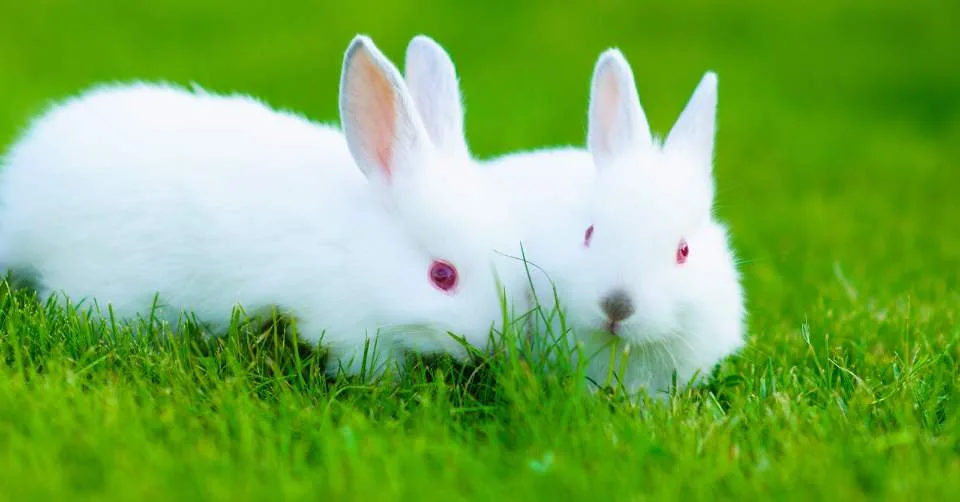
Lionhead rabbit breeding is decided in the first three days after kindling, the rabbit word for giving birth. That is the only window when you can tell which kits carry two copies of the mane gene, and it closes as soon as the wool grows in. The Lionheads above are listed by owners looking for a breeding match.
How does the Lionhead mane gene work?
Short answer
The mane gene is dominant. A Lionhead with two copies is a double mane and keeps a thick mane and wool skirt for life. One copy makes a single mane, which usually thins after the first adult molt. Unlike the dwarfing gene in other breeds, the mane gene has no lethal form.
In this breed, kindling starts a three-day clock. What that clock is counting was settled much earlier, at the pairing. One gene does almost all of the work.
Breeders call it the mane gene. Dominant means one copy is enough for the trait to appear, so a rabbit needs only one copy to grow a mane and two to keep one. Every Lionhead is one of three types, and the type is fixed the moment the kit is conceived.[1][2]
What a Lionhead inherits, and what the adult looks like
Two copies of the mane geneDouble maneA full mane for life, plus wool along the flanks that breeders call the skirt.
One copy of the mane geneSingle maneManed as a junior. Usually loses all but a few wisps at the adult molt around 5 to 6 months, and the skirt goes with it.
No copy of the mane geneNo maneAn ordinary-coated rabbit. Still a purebred Lionhead, sells as a pet, cannot be shown.
The pairing math is short enough to keep in your head. Double bred to double gives a litter of double manes with no exceptions. Double bred to single averages half and half. Single bred to single averages one double mane in four, two single manes, and one kit with no mane at all.[3] Those are averages across many litters. They are not a promise about the litter in your nest box.
Most serious US breeders now run double-mane-only programs, and the show table is the reason.[5] A single mane that thins out at six months stops being competitive exactly when it becomes a senior.[4] Breeding double to double takes that risk out of every litter.
One contrast is worth pausing on. In dwarf-gene breeds, pairing decisions exist to avoid losses in the nest box. In Lionheads, the mane gene costs you nothing at birth. What it costs is record-keeping, and the window for that record is very short.
How do you tell double-mane kits from single-mane kits?
Short answer
Only at birth. A double-mane newborn looks half bald, with bare skin on its cheeks and flanks that forms a V shape, because wool grows in slower than normal fur. Single-mane kits look like ordinary newborns. Once manes come in around 3 to 4 weeks, the difference disappears.
This is the one job in a Lionhead litter that cannot be done late. Pick each kit up in the first day, turn it over, and look at the flanks and the rear.
The identification window, day by day
First 24 hoursCheck every kit. A double mane shows a V pattern around the flanks and rear that its single-mane littermates do not have. A single mane looks like an ordinary rabbit kit.[1]
Days 1 to 7The pattern stays readable. Wool comes in slower than normal fur, so a double mane can look half shaved next to the rest of the litter.
Weeks 2 to 3Wool fills in the sparse areas and the V starts to fade.
Weeks 3 to 4Manes are in on every maned kit. From here it is almost impossible to tell a double mane from a single mane by looking.[1]
So mark them while you can still see them. Breeders use a dab of non-toxic marker, or a nest card with a sketch of the litter and which kit is which, or both. An unmarked litter at four weeks is guesswork forever, and the guesswork is what the buyer inherits.
That birth record is the most valuable piece of paper you will produce from the litter. Every Lionhead kit is fluffy at eight weeks, so a photo proves nothing about what the adult will look like. We tell buyers to ask for exactly this record on our page for Lionhead rabbits for sale. Bring it to the conversation before anyone has to ask.
One more outcome to plan for. A no-mane kit from two purebred parents is still a purebred Lionhead. It cannot be shown, because a missing mane is a disqualification, but it makes an ordinary pet with a fraction of the grooming its littermates need. Describe it and price it as what it is.
Do Lionheads carry the dwarf gene too?
Short answer
Many show lines do. Lionheads were developed from Netherland Dwarf crosses, and compact show-type rabbits often carry one copy of the dwarfing gene. If both parents carry it, about a quarter of the litter can be peanuts, kits that are born too small to survive. Ask before you pair.
Published breeder references disagree here, and the disagreement is worth knowing about. One widely used list of dwarf-gene breeds names the Lionhead.[5] Another leaves it off and lists the Netherland Dwarf instead.[6] Both can be right, because the gene runs by line rather than by breed. The Lionhead was developed in Belgium in the 1990s by crossing Netherland Dwarfs with a breed called the Swiss Fox.[7] Those Netherland Dwarf ancestors carried the dwarfing gene, and some Lionhead lines still do.
You will not find the answer on a pedigree, because no registry records dwarf-gene status. The practical read is the rabbit itself. A very compact, short-eared, show-type animal is more likely to carry a copy than a longer, larger littermate. The reliable answer comes from whoever bred your stock, so ask what their lines throw before you book a mating.
If your line does carry it, the fix costs you nothing. Pair a compact show-type rabbit with a larger, longer partner and no kit can inherit two copies. On average you still get half show-type kits, and no peanuts at all.[6] For the full mechanics, including why the larger rabbit is the safer half of the pairing, read our Holland Lop breeding page.
A peanut is recognizable once you know what to look for: a domed head, bulging eyes and pinched hindquarters on a kit noticeably smaller than its littermates.[6] Nothing saves a peanut, and no feeding schedule changes that. The Holland Lop page covers what to do when one arrives.
How many kits do Lionheads have, and how does kindling go?
Short answer
Small litters. Breeders report 2 to 5 kits, sometimes just one, with pregnancy running 30 to 33 days like every rabbit breed. The doe pulls fur from her chest, her belly, and her dewlap, the skin fold under her chin, to line the nest. Her mane stays. Give her the nest box by day 26.
No authoritative average litter size exists for the breed, which is itself worth knowing. Any number you read is one breeder’s experience. Plan homes for a small litter and treat a sixth kit as a surprise rather than a target.
She strips nest fur from those three places only, and her mane stays where it is. A first-time doe sometimes pulls nothing at all, so keep clean bedding on hand to line the box yourself.
From mating to go-home day
Day 0Mating. Does are induced ovulators, meaning the mating itself triggers the release of eggs, so one meeting is usually enough.
Day 26 to 28The nest box goes in with clean bedding. With a small doe, early is safer than late.
Day 30 to 33Kindling, usually early in the morning. The doe pulls chest, belly and dewlap fur to line the nest, never her mane.
Days 0 to 3The mane window. Check flanks and rear on every kit and mark the double manes before the wool starts.
Day 10 to 12Eyes open.
Weeks 3 to 4Kits leave the box and manes come in. The identification window is now closed for good.
Weeks 6 to 8Weaning.
Week 8 and afterThe earliest a kit should leave, with its mane type recorded from the day it was born.
Size the pairing to the doe. A compact doe carrying kits sired by a bigger buck raises the risk of a kit getting stuck. Experienced breeders keep the buck no bigger than the doe. Straining with no kit, or a bloody or greenish discharge, is a call to the vet that hour. It is not something to sleep on.
Wool adds two jobs a smooth-coated breed does not. Wet or soiled wool around the nest invites flystrike, which is flies laying eggs in dirty fur and the maggots then eating into the skin. Keep the nest area dry and clean. A doe in molt also swallows more wool while she grooms, and a slowed gut is what kills rabbits. Brush her through the nesting weeks and keep hay in front of her.[2]
Counting days on a phone gets old fast. The rabbit breeding calculator turns a mating date into this whole calendar, including the nest box date and the day to start worrying.
The rest of the schedule is species-level rather than breed-level, so it is the same for every rabbit. A doe gets her first litter at 6 months at the earliest and before she turns 2. Three to four litters a year is the ceiling for a hobby rabbitry. Most breeders retire a doe at 3 to 4 years old, and she then lives as a pet, since Lionheads usually live 7 to 9 years.[2]
Which Lionheads can you actually show?
Short answer
ARBA recognizes seven Lionhead varieties: Tortoise, Ruby-Eyed White, Chocolate, Seal, Siamese Sable, Black, and Smoke Pearl. A show Lionhead also needs a full unbroken mane of wool and must stay under 3¾ pounds as an adult. Most pet colors cannot be shown at all.
The short list has a long history behind it. The breed needed years and several presentations before it passed at the ARBA Convention in Harrisburg, Pennsylvania in 2013, in Tortoise and Ruby-Eyed White only.[9] The standard took effect the following year, which is why ARBA describes the Lionhead as a recognized breed in the United States since 2014.[8] The other five varieties were added one at a time over the next nine years.
The seven ARBA-recognized varieties
TortoiseAccepted 2013All four tortoise colors.
Ruby-Eyed WhiteAccepted 2013
ChocolateAccepted 2016
SealAccepted 2016
Siamese SableAccepted 2016
BlackAccepted 2019
Smoke PearlAccepted 2022
Anything else, blue-eyed white included, is a pet color in the United States, whatever a sales listing says about rarity.[9]
The British Rabbit Council went the other way. It recognized the Lionhead in 2002 in all colours, which is why British care articles list colors a US judge will never place. If you are buying stock for a show program from a UK-influenced pedigree, check the variety against the list above rather than against the seller’s description.
The standard’s headline rules are easy to check at home before you plan a litter. Transcriptions of the full standard vary in the details, so treat this as the shape of the rules. Buy the current ARBA Standard of Perfection before you enter a show.
No mane, a broken mane, or normal fur where wool should be.
A mane shorter than about 2 inches, or one that does not run in a full circle around the head.
Wool in the saddle area, meaning the back behind the shoulders.
Ears longer than about 3½ inches in most transcriptions.
A senior over 3¾ pounds, which is the maximum senior weight ARBA sets for the breed.[8]
Any color outside the seven recognized varieties.
Two documents get confused constantly, so keep them apart. A pedigree is the three-generation family record you write out yourself and hand to a buyer. ARBA registration is a hands-on examination by a licensed registrar. The rabbit has to be at least 6 months old and hold a complete pedigree before it can sit one. A no-mane kit or an unrecognized color can carry a pedigree and never register or show.
The North American Lionhead Rabbit Club is the ARBA-chartered breed club, and its accepted-varieties list is the one to check before you buy stock for a show program.[9] On the legal side, one line covers most hobby breeders. Face-to-face pet sales are exempt from USDA licensing, the same federal rule covered in depth on our Holland Lop breeding page.[10]
Is breeding Lionheads worth it financially?
Short answer
Treat it as a paid hobby at best. Litters run 2 to 5 kits, pet-quality Lionheads sell for $25 to $125 in most of the country, and feed, housing, and grooming time go out every week. A litter usually covers the feed bill. Show stock and titles are the real return.
Walk the numbers once and the argument ends. Take three kits at pet-quality prices, which run $25 to $125 across most of the country.[11] Against that, put ten or more weeks of feed for the doe and the litter, plus bedding. Add the setup a first rabbitry buys before a single kit exists, which the same 2026 price guide puts at $375 to $825.[11] Then add the hours. A wooled breed needs brushing two or three times a week, and daily through a molt. That time is real even though it never appears on an invoice.[2]
A higher tier exists, and it is worth being honest about it. Established rabbitries publish $75 to $250 across pet and show stock, and a few boutique breeders ask $380 and up.[14] Those prices rest on years of show placements and on double manes documented at birth. A first litter has neither of those things yet.
Dog breeders expect a second income stream from stud fees. Rabbits barely have one. Stud service is rare, and biosecurity is the reason. A rabbit that comes home from a show or a visit is normally kept apart from the rest of the herd for at least 30 days. RHDV2, a rabbit virus that spreads easily and usually kills, is what made that precaution standard. Most small breeders never send a doe out or take one in.
So what does a good Lionhead program return? Shows on the NALRC circuit, a line that moves a little closer to the standard each year, and kits placed with paperwork that says exactly what they are. That is the honest answer. Anyone selling you a rabbitry business plan is selling you something else.
One breed-specific fact belongs in front of every Lionhead pairing decision. The Rabbit Welfare Association and Fund lists the Lionhead among brachycephalic breeds, meaning flat-faced ones, where the skull is shorter than the teeth and jaw were built for. Crowded cheek teeth, out-of-alignment front teeth and blocked tear ducts follow from that shape.[12] The misalignment has a name, malocclusion, and it means the top and bottom teeth never meet properly, so they never wear down and keep growing.
That is not a theory about the breed. A rescue in England logged every Lionhead that arrived over nineteen years, 494 rabbits between 2001 and 2019. It found significant dental disease in 26 percent of them, and the congenital form can show from around four weeks old and last for life.[7] Breeding a flatter face and a rounder head is breeding a vet bill that somebody else pays for the next 7 to 9 years.
At the pairing stage, that turns into something you can act on. Look at the bite on both rabbits and have your vet look too, before the mating rather than after the kits arrive. Skip the most extreme round-faced, short-nosed animals even when they photograph beautifully. Choose the rabbit with clean incisor alignment over the one with the showier head.
The second promise is about the mane. Sell a kit as a double mane only when you marked it in the first days. Tell every buyer plainly that a single mane will thin at the adult molt. Every kit you place is a 7 to 9 year grooming commitment for whoever takes it home. That means two or three brushings a week, and daily work through the molts.[2]
The House Rabbit Society is blunt about where the mismatch ends. Lionheads reach shelters because people fall in love with the fluff and do not realize that keeping the fluff is a full-time job.[13] Breed for homes you already have, not for homes you hope will appear. If you decide against a litter, an adult through Lionhead adoption comes with its coat already settled and its history known.
None of that is an argument against breeding Lionheads. It is an argument for breeding them on purpose. Here is what ready looks like.
A vet has checked the bite on both rabbits, and neither has a history of dental work.
You know the mane type of both parents and what that pairing can throw.
You will be at the nest box in the first three days, with a way to mark the double manes.
Homes are lined up before the mating, and every buyer has been told what grooming a maned rabbit costs in time.
A rabbit-savvy vet is in your phone, found before the doe is due rather than on the night.
Petmeetly connects Lionhead owners to each other directly. If you go ahead, the listings at the top of this page are where a well-planned pairing starts.
Fact-checked against the American Rabbit Breeders Association, the North American Lionhead Rabbit Club, PetMD, the Rabbit Welfare Association and Fund, and the House Rabbit Society.
Lionhead breeding questions, answered
The questions first-time Lionhead breeders ask most often
What is the difference between a single-mane and a double-mane Lionhead?
A double mane carries two copies of the mane gene, so it keeps a thick mane and a skirt of wool on its flanks for life. A single mane carries one copy. It looks maned as a youngster and then usually thins to a few wisps at the adult molt around 5 to 6 months. Both are purebred Lionheads, but only a double mane is a safe bet for a lifelong mane.
How can you tell if a baby Lionhead is double-mane?
Only in the first days after birth. A double-mane newborn shows a V pattern of coat around the flanks and rear that a single-mane kit does not have, because the wool comes in slower than ordinary fur. Mark those kits straight away. Once the manes come in at 3 to 4 weeks, nobody can tell a double mane from a single mane by eye.
Will a single-mane Lionhead lose its mane?
Usually, yes. At the adult molt around 5 to 6 months, most single manes lose all but a few wisps of mane and bib, and the wool skirt goes entirely. Some keep a fuller bib than others. A buyer who wants the lion look at three years old needs a rabbit that was identified as a double mane at birth.
Can two single-mane Lionheads produce a double-mane kit?
Yes. Pairing two single manes averages one double mane in four, two single manes, and one kit with no mane at all. Those are averages across many litters, so any one litter can land anywhere. It is also the only pairing that produces no-mane kits from two maned parents.
Are no-mane Lionheads purebred?
Yes, if both parents are purebred Lionheads. A no-mane kit simply inherited no copy of the mane gene. It cannot be shown, because a missing mane is a disqualification, so it should be described and priced as a pet. It also needs far less grooming than its maned littermates.
Do Lionheads carry the dwarf gene?
Many lines do, because the breed was developed from Netherland Dwarf crosses. Published breeder references disagree about the breed as a whole, which tells you the gene runs by line rather than by breed. Ask whoever bred your stock what their lines throw. The risk only exists when both parents carry a copy, and then about a quarter of the kits can be born too small to survive.
How many babies do Lionheads have?
Breeders report 2 to 5 kits, and a single kit happens. No authoritative average exists for the breed, so treat any number you read as a report rather than a rule. Plan homes for a small litter and treat a sixth kit as a surprise.
How long are Lionheads pregnant?
Pregnancy runs 30 to 33 days, the same as every rabbit breed, and most does give birth around day 31. Put the nest box in between day 26 and day 28, because a kit born outside the box chills within minutes. If the doe has not given birth by day 32, call your vet that day.
What age can you breed a Lionhead?
Six months is the usual minimum for a doe, and most breeders give her a first litter before she turns 2. Bucks are ready at 6 to 7 months. Three to four litters a year is the hobby ceiling, and most does retire from breeding at 3 to 4 years old. Condition matters as much as the calendar, and an overweight doe is a common reason a mating fails.
What colors of Lionhead can be shown?
ARBA recognizes seven varieties: Tortoise, Ruby-Eyed White, Chocolate, Seal, Siamese Sable, Black and Smoke Pearl. Everything else, including blue-eyed white, is a pet color in the United States and cannot be shown. The British Rabbit Council accepts all colours, which is why UK articles list colors a US judge will never place.
Do you need a license to breed and sell Lionheads?
Not for face-to-face pet sales. Federal rules treat a seller whose buyers see the rabbit in person as a retail pet store, and retail pet stores are exempt from USDA licensing. Shipping rabbits to buyers who never saw them is the regulated activity. State and local rules sit on top of that, so check yours before you take deposits.
Why do Lionheads have dental problems?
The breed has a small skull and a slightly longer lower jaw inherited from its dwarf ancestry, so the teeth are crowded and often do not meet properly. The Rabbit Welfare Association and Fund lists the Lionhead among flat-faced breeds for that reason. One English rescue found significant dental disease in 26 percent of the 494 Lionheads it took in between 2001 and 2019. Have a vet check both bites before you pair two rabbits.
Keep reading
More vetted material for owners planning a Lionhead litter
A first-litter guide built on ARBA standards, USDA RHDV2 surveillance, and Merck veterinary references. Covers when a rabbit is ready, what tests and vaccines are non-negotiable, the 31-day pregnancy day-by-day, post-kindling care, ethics, and real costs.