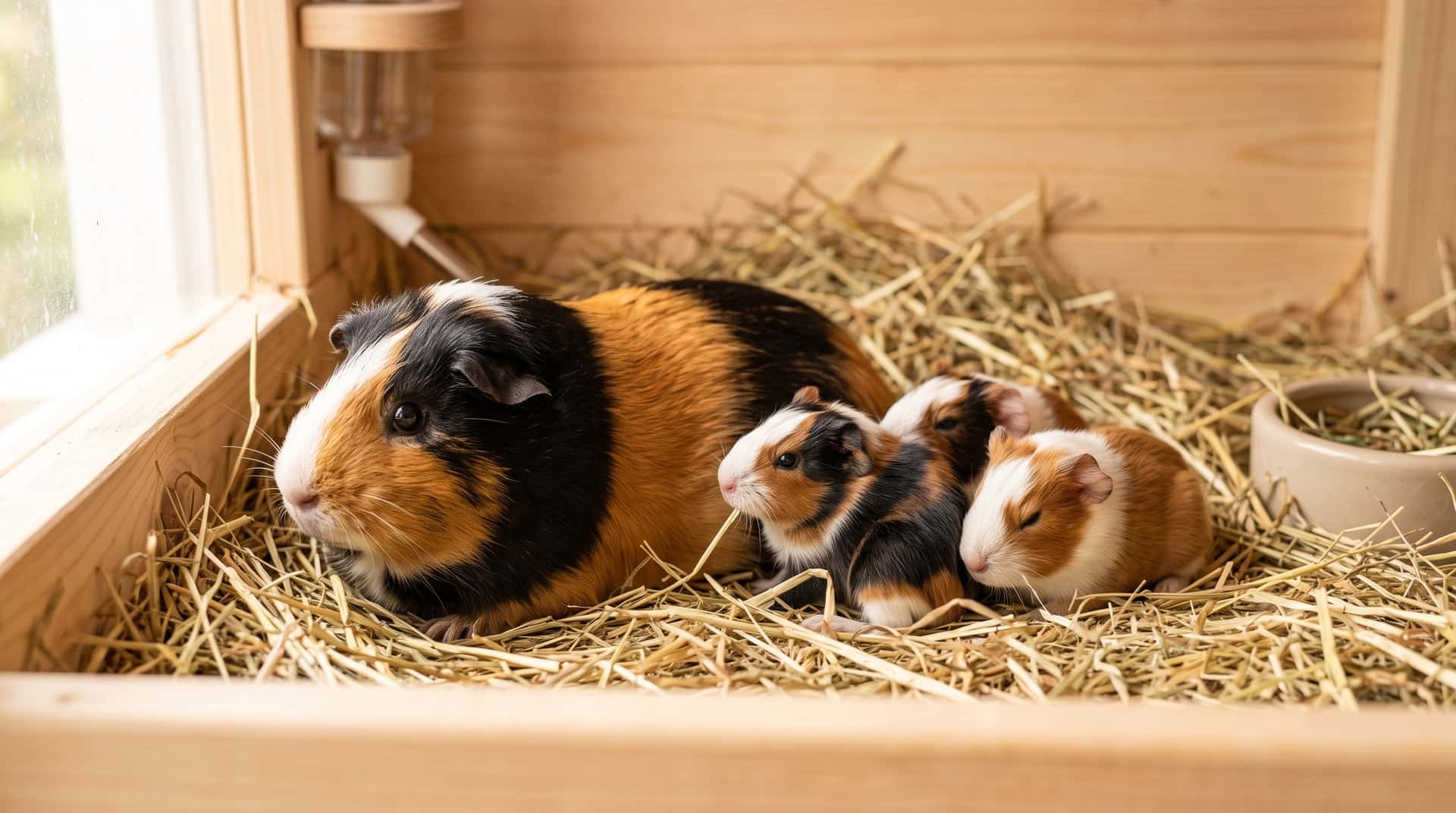
Find an unrelated, healthy breeding partner near you, and know the three deadlines before you plan a litter.
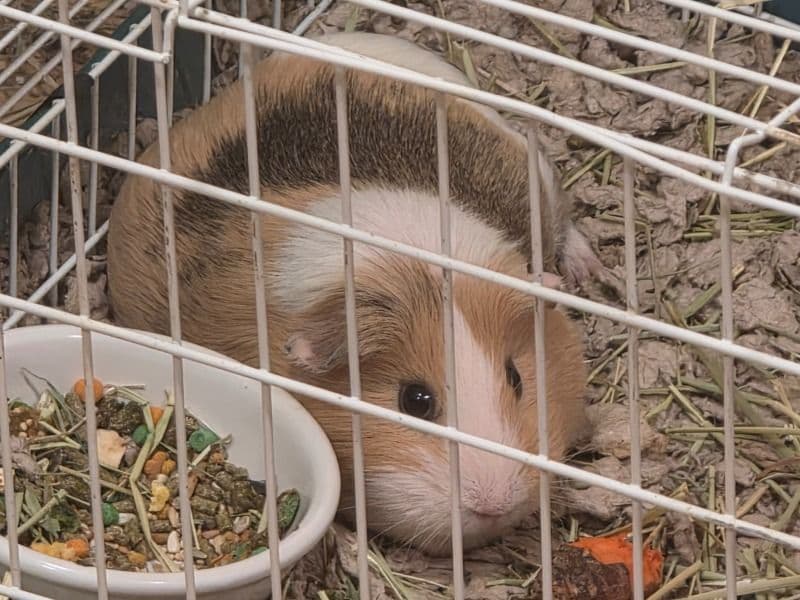
Guinea Pig
Guinea pig breeding is ruled by deadlines. A sow (a female guinea pig) should have her first litter before she is about six months old. She can get pregnant again within hours of giving birth. Her sons can sire litters at three weeks. The owners above are looking for breeding matches. Learn the deadlines first.
Short answer
Guinea pig breeding runs on three deadlines. Veterinary references say a sow’s first litter should arrive before she is about six months old. After a birth she can conceive again within 2 to 10 hours. And her male pups can father litters as young as three weeks old. Miss a deadline and the sow pays.
The three deadlines
Most guinea pig breeding pages open with the word don’t. This one opens with the dates, because plenty of people who land here planned nothing at all. They bought two guinea pigs, a shop sexed them wrong, and the sow is already pregnant. If you are still at the buying stage, our page on guinea pigs for sale walks through the sex check to run before you pay.
Here is the welfare position in full, not buried at the bottom. TheVetDesk, reviewed by a veterinarian in 2025, states it plainly: “For animal welfare, veterinarians do not recommend or encourage breeding guinea pigs. Breeding guinea pigs almost always reduces the lifespan of the female.”[5] Guinea Lynx, the hobby’s own medical reference, ends its breeding page with “do not breed!”[4] This page is written for people who will breed anyway, and for people with a pregnant sow today. It reports what those sources say at every step.
Short answer
Mate a sow between three and five months old so her first litter arrives before six months. Veterinary references report that a sow bred later often cannot deliver naturally: her pelvic joint separates less easily and fat pads narrow the birth canal. RSPCA Australia reports that as many as 20 percent of sows die giving birth.
The references disagree on the exact month and agree on the rule. RSPCA Australia puts first breeding between three and six months of age.[1] Riggs writes that a sow “should deliver her first young before she is 6 months of age.”[2] Purdue’s veterinary care sheet moves the hard stop to eight months, after which a sow is “unable to give birth without a C-section.”[6] VCA Animal Hospitals uses the same eight-month line for dystocia, meaning a stuck or difficult birth.[7] Six months or eight, no reference tells you to plan a first litter later than that.
In 2024 the usual explanation for that danger came under question. The textbook answer is the pubic symphysis, the cartilage joint at the front of the pelvis that has to open about an inch to let a pup through. Textbooks say the joint stiffens or fuses in a sow who never had a litter young. A micro-CT study went looking for that fusion in 23 sows and could not find it. The authors write that “the pubic symphysis of guinea pigs does not undergo ossification during the first year or after parturition.” They add that the classic claim has “no formal proof supporting it.”[8]
Read the study’s limits before you read too much into it. The study is small, and most of its sows were related to each other.[8] It does not make a late first litter safe. Difficult births in older first-time mothers are documented across the clinical literature. Guinea Lynx also names a second mechanism the study does not touch: fat pads that narrow the pelvic canal.[4] What changed is how confident anyone should sound about the reason. The deadline itself stands.
In a normal birth the joint does open, and you can feel it happen. Guinea Lynx describes a gap of about 15 mm roughly 48 hours before birth, widening to about 2.5 cm, an inch or so, at delivery.[4] That widening gap is the best home sign that a birth is close.
The stakes are why this is a deadline and not a suggestion. RSPCA Australia reports that as many as 20 percent of all sows die while giving birth.[1] That is their figure rather than a measured national rate, and it is still the number a welfare body is willing to print. A cesarean is not a backup plan you can count on either. It is abdominal surgery on a two-pound prey animal, and it needs an exotics vet, meaning one who treats species beyond cats and dogs, with a free slot that day.
Guinea pig breeding numbers
Labor itself is short. RSPCA Australia describes a normal delivery finishing in about 30 minutes, with 3 to 7 minutes between pups, and advises leaving the family undisturbed for the first day.[1] The emergency sign is a sow straining hard without producing a pup. That is a phone call to the vet, not a reason to wait and see.
Guinea pig pups are precocial, meaning born ready to go. They arrive fully furred, with open eyes and erupted teeth, and they nibble solid food within days.[9][6] Riggs puts the first solids at day four or five.[2] There is no pink hairless stage and no eyes-shut week. They still nurse for about three weeks, and they still need their mother for all of it.
One feeding change matters more than the rest. Guinea pigs cannot make their own vitamin C. A pregnant sow needs roughly triple the usual dose: 30 mg per kilogram a day against the usual 10, per the Merck Veterinary Manual.[10] Give it in food rather than the water bottle. Drops break down in water and change the taste, so the pigs drink less.[11] A daily slice of bell pepper does the job.
Short answer
Never mate roan to roan or Dalmatian to Dalmatian: one in four pups inherits two copies of the pattern gene and is born a “lethal white.” Those pups arrive blind or eyeless, often deaf, with deformed teeth. Satin-to-satin carries its own bone-disease risk. And never breed relatives, which store mix-ups often make possible.
Roan and Dalmatian are patterns rather than colors, and both come from one copy of the same gene. Pair two patterned pigs and every pup has a one-in-four chance of inheriting two copies. Those pups are the lethal whites. They are born pure white with red eyes, blind in one or both eyes or born with no eyes at all. They are also often deaf, with missing or deformed teeth and weak immune systems.[12] Many need syringe feeding for life. The rule is short: a roan or a Dalmatian is only ever paired with a solid, unspotted partner.
Satin is the second pairing to think hard about. The satin sheen comes from thinner, see-through hair shafts, and satins are hit far more often than other guinea pigs by fibrous osteodystrophy, a painful bone disease with no cure. A 2017 case report cites an earlier study estimating that 38 percent of satins appear to suffer from it. Signs such as a wobbly gait, trouble eating, and birth complications show up around 12 to 18 months old.[13] The guinea pig associations of New Zealand, Sweden, and Finland refuse to register satins or animals with a satin parent.[14] In the United States, five of the 13 recognized breeds are satin breeds, and they compete at shows like any other.[15] Both facts are true. Decide with both in front of you.
Then the rule that catches beginners hardest: no matings between relatives.[1] A pair bought together at a shop is often brother and sister, and a home-bred pair is related by definition. Finding an unrelated, healthy partner is a matching problem, and the listings at the top of this page are where owners solve it.
Pregnancy toxemia is the complication that kills sows with little warning. It is a form of ketosis, meaning the body burns fat faster than the liver can handle. It strikes in the last two weeks of pregnancy or the first week after the birth, and it hits first and second pregnancies hardest. Riggs is direct about the outlook: “prognosis is generally considered poor.”[2]
The risk factors are mostly things you control: an overweight sow, a sow going off her food late in pregnancy, stress, a large litter, and no room to move.[7] Prevention is dull and it works. Keep food in front of her, keep water available, change nothing about the diet in the final weeks, and keep the cage quiet.[2][7] A sow who skips meals in her final two weeks is the classic case.
Call the vet the same day if
That list is also the reason to find an exotics vet before the mating, not during the emergency. Vets who see guinea pigs are scarce in most areas, and the first appointment on offer can be days away. Call around while the sow is still healthy and ask who handles guinea pig dystocia and cesareans.
The last item in the late-pregnancy plan is the boar. He leaves the cage before the birth, not after it. A fertile heat opens 2 to 10 hours after delivery, and RSPCA Australia reports that 60 to 80 percent of sows conceive if they are mated on it.[1] “I will move him tomorrow” is how a sow ends up pregnant again while nursing her first litter. Move him to his own cage in the same room, where he can still hear and smell the others, because a boar kept alone is its own welfare problem.
Short answer
Sex every pup by three weeks and move the males out: they can father litters that young, including on their own mother. A boar’s genitals look like a dotted “i,” a sow’s like a “Y.” Pups leave for new homes fully weaned, at three weeks and 150 to 200 grams minimum.
Three weeks is both the weaning point and the deadline. Boars produce their first viable sperm at 45 to 55 days on average. The RSPCA-hosted sexing guide, though, records males as young as three weeks impregnating females, “including family members.”[3] Guinea Lynx gives the same instruction: separate the males from the females by three weeks of age.[4] Weaning finishes around the same mark, so 21 days works for the pups and for the sow.
The check itself takes seconds once you know the two shapes. Hold the pup on its back in your palm. A boar reads as a dotted “i,” a small round opening above a short line. A sow reads as a “Y.”[3] If the shape is not obvious, press gently just above the opening, and an intact boar’s penis pops out.[3] Newborns are genuinely hard to call, because the mother’s hormones swell a female’s vulva and a male’s testicles have not dropped yet.[3] When you are unsure, a vet settles it in seconds. Our guinea pigs for sale page teaches the same check from the buyer’s side, for the minute before money changes hands.
A pup is ready to leave when it is fully weaned and eating solids on its own. That means 150 to 200 grams at three weeks or older, with the males already housed apart.[4] Two states put a floor under that. Colorado makes it unlawful to sell guinea pigs under four weeks old, one of the few statutes anywhere that names the species.[16] Virginia bans the sale of any unweaned mammal kept as a pet.[17] Most other states set eight-week floors that cover only puppies and kittens, so the welfare floor here is yours rather than the statute book’s.
Two more rules matter for most hobby breeders. Federal rules exempt face-to-face retail sales from USDA licensing, while shipping animals to buyers who never see them first does need a license.[18] Cities can go further than states: New York City banned retail guinea pig sales in 2023.[19]
Line up homes before the mating, not after the birth.[1] A litter can be seven pups. Half of them may be boars who need their own cage from three weeks, and boars who fall out as they mature need a cage each. The cage count grows faster than most first-time breeders expect. Write the placement plan first, then breed. If a surprise litter has already left you with more pups than homes, our guinea pig adoption page covers placing them with people who are already looking.
Show guinea pigs are called cavies, and a breeder’s herd is a caviary. The American Cavy Breeders Association, the ACBA, is their national specialty club, and cavies are shown alongside rabbits at shows sanctioned by the American Rabbit Breeders Association. If you have never been to one, go before you buy anything. An afternoon at a show puts your questions in front of people who have answered them for decades.
ARBA recognizes 13 breeds of cavies.[20] The list runs American, American Satin, Abyssinian, Abyssinian Satin, Coronet, Peruvian, Peruvian Satin, Silkie, Silkie Satin, Teddy, Teddy Satin, Texel, and White Crested.[15] The standards are more precise than newcomers expect. An Abyssinian needs at least ten rosettes, the swirls in its coat, in set positions on the body.[15]
Registration runs in the opposite direction from dogs. There are no litter papers. An individual cavy is registered as an adult, at six months or older and at senior weight. A licensed registrar physically inspects and weighs the animal against the Standard of Perfection, with a three-generation pedigree in hand. The fee is $6.[21] Show classes are generally split by age too, with juniors under four months, intermediates from four to six months, and seniors above six.
For a first-time breeder the practical read is simple. Quality lives in the parents, not in paperwork handed over with a pup. If you want stock you can show, buy from a breeder who registers cavies and can put pedigrees and show records in front of you.
Short answer
Plan on losing money. A litter averages two to five pups that sell for $30 to $60 each at pet quality. One emergency C-section can cost more than the litter brings in, and a breeding herd needs separate housing for boars, sows, and weaned males. Nobody credible calls this profitable.
What the money actually looks like
Now set the income against the costs. Two to four pups at pet-quality prices bring in a hundred dollars or two, once. A pair of adults eats most of that every month, and a breeding setup keeps more than one pair. The animals are the cheapest line on the receipt.
There is no stud fee culture here, which surprises people who come from the dog world. Cavy breeders keep their own boars or buy breeding stock outright. Lending a boar between herds moves mites, lice, and respiratory infection with him, and every move means a quarantine at both ends. Expect to buy a good boar rather than rent one.
Housing is the cost people forget. A breeding setup is never one cage. You need the sow with her pups, the boar somewhere else, and the weaned males somewhere else again from three weeks. Boars raised together can fall out as they mature, and that is another cage.
The last line of the budget is the sow herself. Welfare guidance is few litters and early retirement, because every litter repeats the mortality risk from the deadline section above. TheVetDesk closes the loop: breeding “almost always reduces the lifespan of the female.”[5]
That leaves three honest endings. If your goal is show stock and you are inside ACBA club culture, buy pedigreed parents and breed to the Standard. If your goal is pets, the guinea pigs at the top of this page already need homes. If your goal is money, this is the wrong species.
Sources
Fact-checked against RSPCA Australia, VCA Animal Hospitals, the Merck Veterinary Manual, Purdue University College of Veterinary Medicine, the American Rabbit Breeders Association, and peer-reviewed veterinary literature.
What first-time breeders ask before they put two guinea pigs together
Mate a sow between three and five months old so her first litter arrives before she is about six months. Veterinary references report that sows bred later often cannot deliver naturally and need a cesarean. Boars can breed from about six to eight weeks old, and some far earlier.
59 to 72 days, about 68 on average. That is unusually long for a rodent, and it is why pups are born fully furred with open eyes. If a pregnancy passes 70 days, have a vet check the sow immediately.
Usually two to five pups per litter, and litters of one to seven happen. Pups weigh 70 to 100 grams at birth. Pups under 60 grams, which usually come from the largest litters, rarely survive.
Within 2 to 10 hours. RSPCA Australia reports 60 to 80 percent of sows conceive if mated on that heat. Move the boar out before the birth, not after.
At three weeks old. Boars average first viable sperm at 45 to 55 days, but males as young as three weeks have impregnated their own mothers and sisters. Weaning finishes around three weeks, so the timing works.
Yes. RSPCA Australia reports that as many as 20 percent of sows die giving birth, and pregnancy toxemia in late pregnancy is often fatal even with treatment. The risk is lowest when the first litter comes before six months.
No. Veterinary guidance is that breeding is discouraged for welfare reasons and almost always shortens the female's life. If you breed anyway, the deadlines on this page are how you lower the risk.
A pup that inherited two copies of the roan or Dalmatian pattern gene. Lethal whites are born pure white with red eyes, blind or missing eyes, often deaf, with deformed teeth. Pairing roan with roan or Dalmatian with Dalmatian gives each pup a one-in-four chance. Pair patterned pigs only with solids.
The satin coat gene is linked to fibrous osteodystrophy, a painful and incurable bone disease; one study estimated 38 percent of satins develop it. Associations in Sweden, Finland, and New Zealand refuse satin registrations, while the ACBA in the US still shows five satin breeds.
Every major veterinary reference advises it is likely, and some say it is near certain. A 2024 imaging study questioned the textbook explanation, a fused pelvic joint, but not the danger itself. No reference supports planning a first litter after six to eight months.
Physically several per year, because of the post-birth heat. Responsible practice is the opposite: welfare guidance is to breed rarely, skip the post-birth heat every time, and retire sows early, since every litter repeats the mortality risk.
Usually not, if every buyer meets the animal in person: federal rules exempt face-to-face retail sales, while sight-unseen shipping sales need a USDA license. Check your state and city too. Colorado bans selling guinea pigs under four weeks old, and New York City bans pet-store guinea pig sales entirely.
Discover breeding guides for other small pets and find the perfect match for your breeding program
Message owners directly, ask how old the sow is and whether the two are related, and plan the dates together.
No card required to sign up.