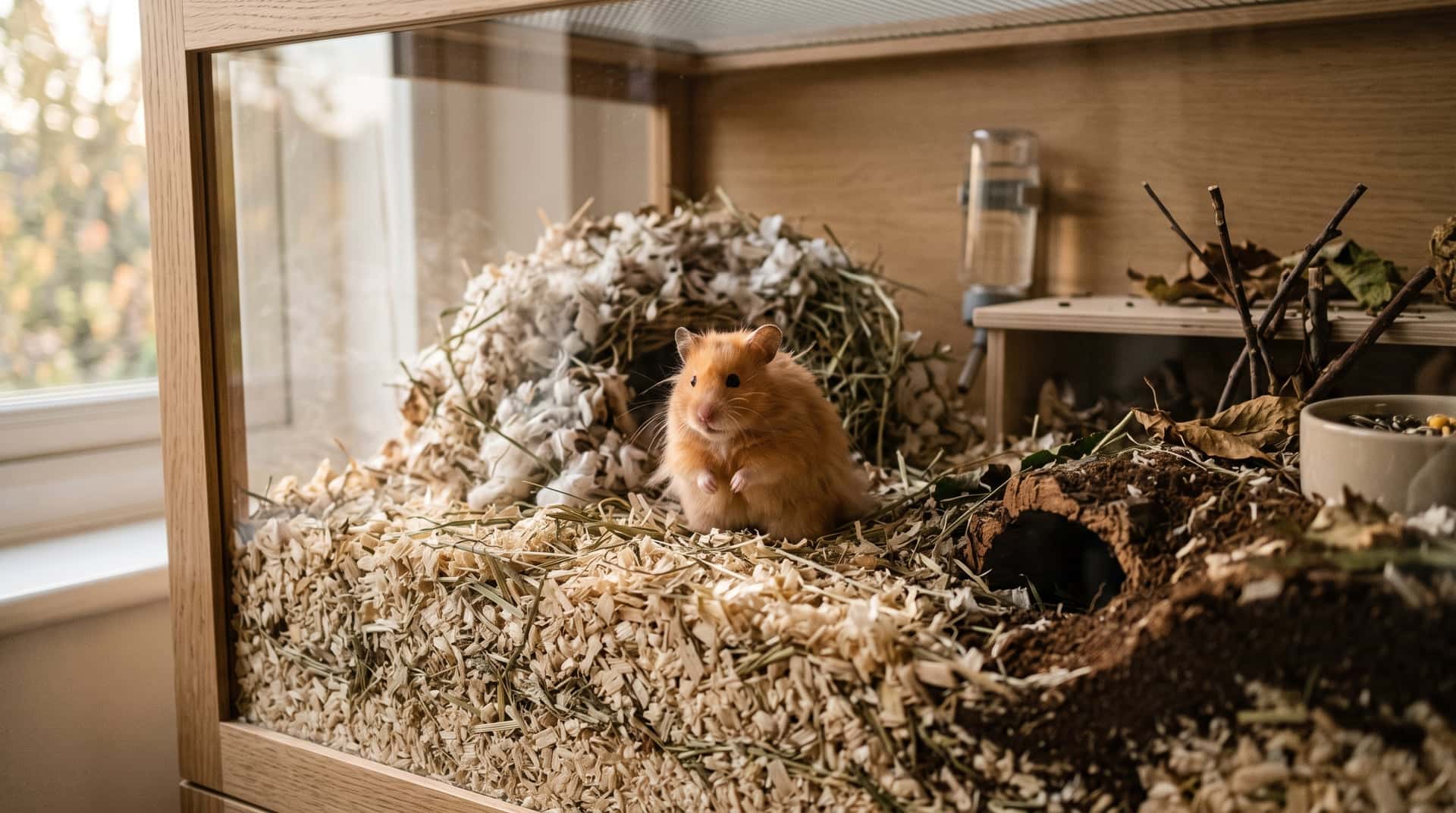
Find a breeding partner near you, and work out where nine pups will live five weeks later.
Finding a partner is the easy half, and the listings above cover it. The hard half arrives about five weeks after the mating, when a species that has to live alone produces a litter that averages nine. Work that part out first. Everything else on this page follows from it.
Short answer
Merck puts Syrian litter size at 2 to 16 pups, with an average of 9. Merck also says Syrians are normally housed singly, because sexually mature animals fight. Put those two sentences next to each other and the real question is not who to pair. It is where nine hamsters will live.
The exact wording is worth having in front of you. On litters: “Litter sizes range from 2 to 16, with an average of 9.”[1] Merck’s owner-facing page is more conservative and calls a normal litter 6 to 8 pups.[9] On housing: “Hamsters are normally housed singly except during breeding periods. Sexually mature females are territorial and aggressive and frequently fight each other.”[2]
Nobody disagrees with the housing part either. The RSPCA says Syrians “should always live on their own.”[5] PDSA says that if two meet “they will fight, leading to injury or possibly even death.”[15] The NC3Rs adds that in the wild Syrians are solitary and “social contact is limited to mating.”[11]
So here is the arithmetic that decides whether this is a good idea in your house. One generation, no projections, nothing exponential.
One mating, worked through
Read that as a single question. Do you have nine homes lined up, or nine enclosures? One of those answers has to be yes before the pairing happens, because the deadline is fixed by the animals and not by you. Homes that fall through after the litter is born leave you holding hamsters that can no longer share a cage.
This is the honest reason to think hard before breeding Syrians. It is not that the mating is difficult. It is that the output is nine animals that each need their own room.
Short answer
Syrian hamsters carry a coat gene called anophthalmic white, written Wh. Hamsters with two copies are deaf, blind and white. The gene is semi-dominant, so the carriers look like ordinary patterned hamsters, which is exactly what makes the rule easy to break.
The biology is well documented. A 1982 paper in the Proceedings of the National Academy of Sciences describes Wh as “a highly pleiotropic dominant spotting color mutation causing homozygotes to be deaf, blind, and white.”[6] Pleiotropic means one gene affecting several unrelated traits at once, which here means coat colour, eyes and ears together. Homozygous simply means carrying two copies of the gene.
In 1998 a team in Human Molecular Genetics found the actual mutation. It is a nonsense change in the Mitf gene that stops the protein working, and they confirmed that “the Wh mutation is inherited as a semi-dominant trait.”[7] Semi-dominant means one copy shows, but not fully. A hamster with a single copy carries more white on its underside than it otherwise would. In the hamster fancy those animals are the varieties known as white-bellied and roan.
Reproduction is affected too. A 1980 study in the Journal of Experimental Zoology reported that “male hamsters homozygous for this gene are usually sterile”. Most testes from those animals were hypoplastic, meaning underdeveloped, and aspermic, meaning producing no sperm.[8]
Now the arithmetic, presented as arithmetic rather than as a measured result. Pair two carriers and, on average across many litters, one pup in four inherits two copies. That is standard Mendelian expectation for a gene inherited this way, not a figure anyone counted in a pet litter. It is still the reason the rule exists.
Do not pair
The safe version of this rule is short. Pair a patterned hamster with a solid-coloured one, or ask the other owner what variety their animal is before anything else. Coat pattern is the first question on a Syrian pairing, ahead of temperament, size and every other trait.
Short answer
In Syrian hamsters the female is heavier than the male and more aggressive than him. Merck says a female that is not in season can behave especially aggressively toward young males, sometimes killing them. So the mating is a short, supervised, timed event.
Merck states the size difference plainly: Syrians “range in weight from 110 to 140 g, and females are larger than males”, and female Syrians “generally are aggressive toward other hamsters.”[1] The NC3Rs agrees on which sex to worry about: “both sexes are capable of inflicting severe injuries, but females tend to be the more aggressive sex.”[11]
Timing is what makes the difference between a mating and a fight. Merck records “the 4-day estrous cycle” in hamsters, and adds that “estrus in hamsters lasts approximately 1 day.”[1] Estrus is the part of the cycle when a female will accept a male. So on three days out of every four, introducing him is simply putting a smaller animal into the territory of a larger one.
The supervised introduction
There is no version of this where the pair simply lives together. That is worth saying because it is the norm for most other small pets on this site. With Syrians, the mating is the only social contact of their adult lives, and it lasts one evening.
Short answer
A Syrian pregnancy lasts 16 to 17 days, the shortest of any hamster. Then comes the part people get wrong. Merck says mothers and litters should not be disturbed for at least 7 days. The RSPCA is blunter about why: nursing mothers have been known to abandon or kill their young if their environment is disturbed.
Merck: “Syrian hamster pregnancies tend to last 16 to 17 days.”[9] Its professional reference gives 16 to 19 days across hamster types.[1] Either way, you have barely more than two weeks between the mating and a nest full of pups. That is why the enclosures have to be sorted beforehand.
The RSPCA’s guidance for people housing hamsters professionally is the most specific advice available on the weeks that follow. Cleaning “should be restricted to every two weeks for breeding females, avoiding the first two to three days post-partum, to minimise the disturbance to the nesting environment.”[10] Post-partum simply means after the birth.
The timeline, start to separation
The urge to check on a new litter is strong. Giving in to it is the single most expensive mistake in the whole process. Feed and water the mother without opening the nest, and leave the rest alone until the first week is over.
Short answer
Pups wean at about 20 days and can reproduce at 7 to 8 weeks. That leaves roughly a month in which mixed-sex littermates have to be separated, then the same-sex groups have to be broken up too, because adult Syrians do not share.
There is one nuance here that gets misquoted, so it is worth stating carefully. The RSPCA’s guidance for laboratories says that “it is possible for groups of same sex animals to be kept together if groups are formed at weaning or before puberty, and the animals are monitored closely to ensure that they remain compatible”, and that if this is done it is “absolutely vital to provide adequate space and a stimulating environment, particularly refuges to allow animals to escape from each other.”[10] The NC3Rs says something similar about forming groups as juveniles.[11]
That is a monitored colony with staff, not a pet home, and it does not change the pet rule. The RSPCA’s own pet advice is unambiguous: Syrians “should always live on their own.”[5] For a breeder, the practical meaning is a short holding window. Same-sex littermates can share while they are young, if the space is large and you are watching daily. Every one of them still needs its own enclosure before it matures.
The window only works if you sex the pups correctly. You do that by looking at the gap between the anus and the genital opening. In males that gap is noticeably longer, and an adult male develops a more tapered rear end. Check every pup, then check them all again a few days later. Getting one wrong produces a second litter inside two months, because Syrians reproduce from 7 to 8 weeks.[1]
Fighting is not a phase to wait out. If two littermates start scrapping, separate them permanently that day and do not put them back together. The RSPCA’s guidance on hamsters that fall out is exactly that: they need to be permanently separated into different cages.[5]
Short answer
Chewy’s expert-reviewed cost guide puts one hamster setup at $102 to $394 and the running cost past $540 a year. Breeding does not add to those numbers. It multiplies them, by however many pups have not yet left.
The figures below come from Chewy’s cost guide, which is reviewed by two named veterinarians and a hamster rescue founder.[12] They are per-animal figures. The multiplication that follows is this page’s arithmetic, not theirs.
Per hamster, before you multiply
There is no stud fee market in Syrian hamsters, so nobody recovers this through a mating fee, and this page quotes no Petmeetly median for one. The only figure we hold covers every small pet species at once, from a sample of eighteen. That is not a hamster number.
Plan the money the way you plan the space. Assume some pups stay longer than expected, and assume at least one vet visit you did not budget for.
Short answer
Merck writes that most hamsters sold as pets today are the descendants of three littermates caught in 1930. Every pet Syrian in the world comes from a very small founding group. There is no outcross available to breed your way out of a problem.
The founding event is unusually well recorded for a pet species. Merck’s professional reference names “a litter of eight hamsters collected in 1930 near Aleppo, Syria”.[1] Its owner-facing page adds that “most of the hamsters sold as pets today are the descendants of 3 littermates caught in 1930.”[13] A pet trade, a laboratory species and a global population, all from one nest.
The wild animal is still there, and it has been studied. Gattermann and colleagues ran expeditions into northern Syria in 1997 and 1999, caught thirteen golden hamsters near Aleppo, and mapped 30 burrows. Their finding that “none of the inhabited burrows contained more than one adult” is the field evidence behind everything on this page about solitary housing. They also took nineteen animals back to Germany to “form a new breeding stock.”[14]
What this means for you is narrow but real. You cannot buy your way around a small gene pool, so the only levers you have are the pairing you choose and the records you keep. Write down what you paired, what the litter size was, what the pups looked like, and what happened to them. There is no national registry doing that job for hamsters, which makes your notebook the only record that exists.
Everything above collapses into a short list. If any line is a no, that is the answer for now rather than forever.
Before the introduction
If the solitary part is what gives you pause, that is a reasonable place to stop. Some small pets are built for company, and our guinea pig breeding page covers a species where the housing rules run the other way entirely.
Sources
Fact-checked against the Merck Veterinary Manual, the RSPCA, PDSA, the NC3Rs, and peer-reviewed genetics published in PNAS, Human Molecular Genetics and the Journal of Experimental Zoology.
What first-time breeders need settled before they pair anything
Merck gives a range of 2 to 16 pups with an average of 9 for Syrian hamsters, and its owner-facing page describes a normal litter as 6 to 8. Plan around nine, because that is the figure the veterinary reference settles on.
Only for a short window, and only under supervision. Laboratory guidance allows same-sex groups formed at or before puberty with plenty of space and refuges. As pets, the RSPCA says Syrians should always live on their own, so every pup eventually needs its own enclosure.
Merck says Syrian hamster pregnancies tend to last 16 to 17 days, the shortest of any hamster. Its professional reference gives 16 to 19 days across hamster types. You have roughly two weeks between the mating and a litter of nine.
Two carriers of the anophthalmic white gene, known to the hamster fancy as white-bellied or roan. The gene is semi-dominant, and hamsters carrying two copies are deaf, blind and white. Pairing two carriers produces those pups on average one time in four.
Merck says Syrians are capable of reproducing at 7 to 8 weeks old. Since pups are weaned at about 20 days, that leaves a narrow window between weaning and maturity in which mixed-sex littermates must already be separated.
Yes, and quickly. Merck describes female Syrians as larger than males and generally aggressive toward other hamsters. It also notes that a female not in season can behave especially aggressively toward young males, sometimes killing them.
Merck says mothers and litters should not be disturbed for at least 7 days after birth. From about day 7 it is usually safe to begin handling pups gently. Before that, leave the nest completely alone.
Disturbance is the main trigger. The RSPCA writes that nursing mothers have been known to abandon or kill their young if their environment is disturbed. Merck adds that good nesting material helps a mother feel secure and lowers the risk.
The gap between the anus and the genital opening is noticeably longer in males, and an adult male has a more tapered rear end. Check every pup, twice, before separation. Syrians can breed at 7 to 8 weeks, so a mistake becomes a second litter.
Multiply, do not add. Chewy puts one hamster setup at $102 to $394 and running costs past $540 a year. A litter of nine that does not all leave quickly means several of those setups at once, plus vet fees of $30 to $100 per visit.
There is no national registry with the authority a kennel club has. Show clubs publish variety standards, but no body certifies health or ancestry. That makes your own written records of pairings, litter sizes and outcomes the only real documentation.
It is not wrong, but it is harder than it looks. Every pet Syrian descends from a handful of animals caught in 1930, so the gene pool is small. Breed only with homes arranged, records kept, and enclosures ready for the pups nobody claims.
Discover breeding guides for other small pets and find the perfect match for your breeding program
Message owners directly, ask what variety their hamster is before anything else, and agree where the pups are going before you pair.
No card required to sign up.